
• KANAD
  • Contact us
  • E-Submission
ABOUT
BROWSE ARTICLES
EDITORIAL POLICY
FOR CONTRIBUTORS

Page Path

244
results for

"Nursing"

Filter

Article category

Keywords

Publication year

Authors

Funded articles

"Nursing"

Review Article

Generative AI Use and Its Impact on Nurses' Decision-Making: A Systematic Review
Minji Kwon, Sang Dol Kim
J Korean Acad Nurs Adm 2026;32(1):1-18.   Published online January 30, 2026
DOI: https://doi.org/10.11111/jkana.2025.0078
Purpose
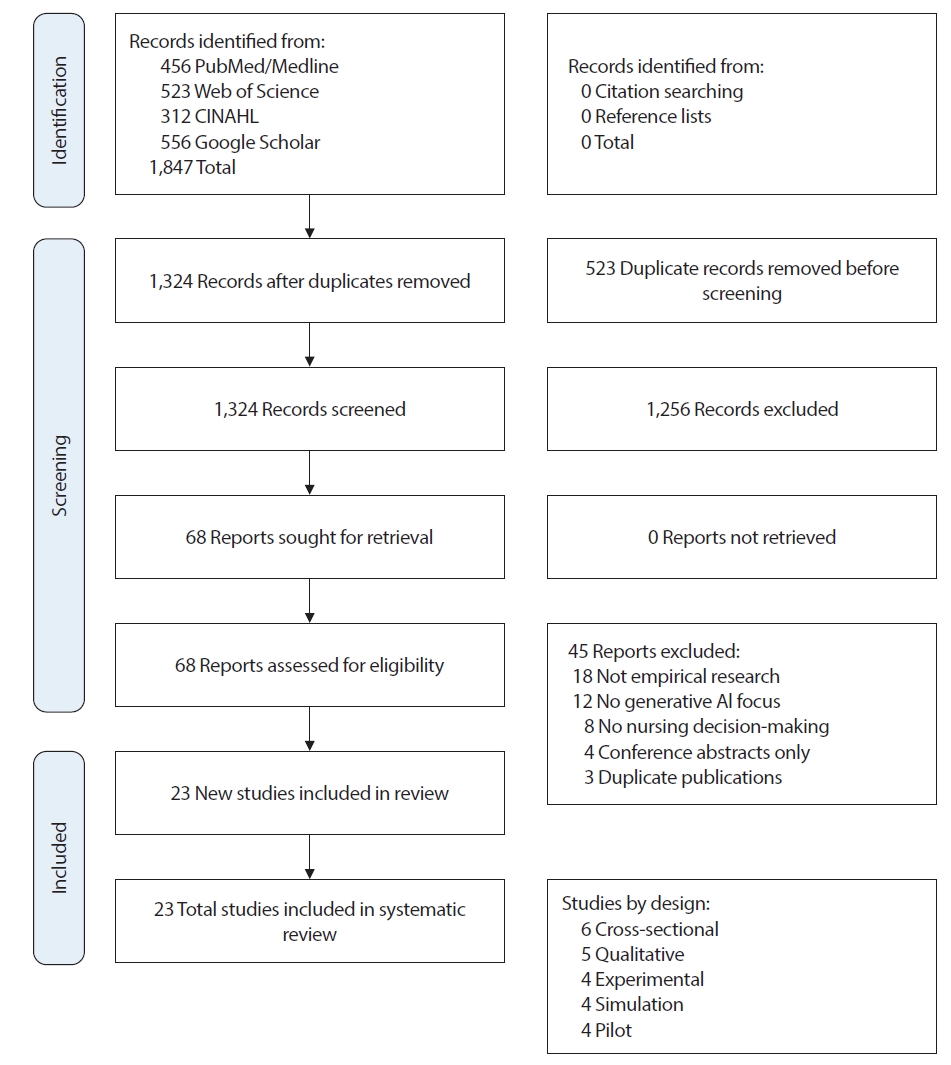
This systematic review examined the impact of generative artificial intelligence (AI) on nurses' clinical decision-making. Methods: Following PRISMA guidelines, we searched four databases for empirical studies (2000-2025) examining generative AI in nursing decision-making. Two reviewers independently conducted study selection and quality assessment. Results: Twenty-three studies were included (simulation studies n=7, cross-sectional n=4, qualitative n=3, implementation n=3, retrospective evaluation n=3, observational comparison n=3, experimental n=2). Large language models, particularly ChatGPT and GPT-4, were most commonly examined. Benefits included 11.3-fold faster response times, high diagnostic appropriateness (94-98%) in neonatal intensive care, improved emergency triage agreement (Cohen's κ 0.899-0.902), and documentation time reductions (35% to >99%). Challenges included limitations in therapeutic reliability, hallucinations in vital sign processing, demographic biases, and over-reliance risks (only 34% high trust reported). Conclusion: Generative AI shows promise for augmenting nursing decision-making with appropriate oversight, though evidence is limited by predominance of simulation studies and insufficient patient-level outcome data. AI literacy integration in nursing education and robust institutional governance is essential before routine deployment. Large-scale randomized controlled trials are needed.
  • 1,241 View
  • 72 Download

Original Articles

Factors Influencing Nursing Care Left Undone by Cancer Ward Nurses
Chung Hee Woo, Yeon Joo Kim
J Korean Acad Nurs Adm 2025;31(5):594-603.   Published online December 31, 2025
DOI: https://doi.org/10.11111/jkana.2025.0047
Purpose
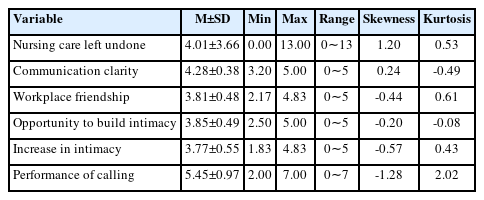
This study aimed to investigate the effects of communication clarity, workplace friendship, and performance of calling on nursing care left undone among oncology nurses. Methods: Data were collected from 159 oncology nurses with more than one year of experience working in cancer wards between September 11 and September 30, 2024. Statistical analyses included descriptive statistics, the independent t-test, one-way analysis of variance, the Scheffé post hoc test, Pearson’s correlation coefficients, and hierarchical multiple regression analysis, all conducted using IBM SPSS Statistics version 29.0. Results: Communication clarity, workplace friendship, and performance of calling were significantly correlated with nursing care left undone. Hierarchical multiple regression analysis identified communication clarity (β=-.37, p<.001) and being aged 30–39 years (β=-.24, p<.001) as the main factors influencing nursing care left undone, collectively explaining 37% of the total variance. Conclusion: Communication clarity was the most influential factor affecting nursing care left undone in cancer wards. To reduce the incidence of nursing care left undone and ensure high-quality nursing services in oncology units, strategies aimed at enhancing communication clarity are essential. Institutions should consider implementing simulation-based training or ongoing education tailored to their organizational context. Further research is warranted to examine the effects of communication clarity on nursing care left undone.
  • 423 View
  • 23 Download
Purpose
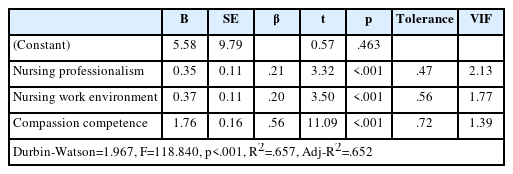
This study aimed to identify the influence of nursing professionalism, the nursing work environment, and compassion competence on person-centered care among nurses working in comprehensive nursing care units. Methods: An online survey using structured self-report questionnaires was administered to 190 nurses in comprehensive nursing care units at three tertiary general hospitals. The collected data were analyzed using descriptive statistics, the independent t-test, the Mann-Whitney U-test, one-way analysis of variance, Pearson’s correlation coefficient, and multiple linear regression using SPSS version 29.0 program. Results: The average score for person-centered care was 3.70±0.49, nursing professionalism was 3.56±0.51, the nursing work environment was 2.53±0.46, and compassion competence was 4.01±0.47. Person-centered care demonstrated significant positive correlations with nursing professionalism (r=.636, p<.001), the nursing work environment (r=.542, p<.001), and compassion competence (r=.743, p<.001). Factors influencing person-centered care included compassion competence (β=.56, p<.001), nursing professionalism (β=.21, p<.001), and the nursing work environment (β=.20, p<.001), with an explanatory power of 65.2% (F=118.84, p<.001). Conclusion: To improve person-centered care among nurses in comprehensive nursing care units, it is necessary to strengthen nurses’ compassion competence and professionalism, as well as enhance the nursing work environment. The findings of this study may be used as foundational evidence for developing programs to promote person-centered care in comprehensive nursing care units.
  • 327 View
  • 27 Download
Purpose
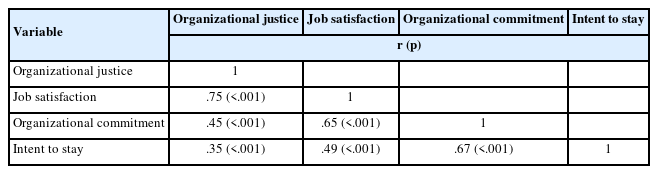
This study investigated the influence of organizational justice on junior nursing officers’ intent to stay in their positions and explored the mediating roles of job satisfaction and organizational commitment. Methods: A descriptive correlational design was employed, and data were analyzed using SPSS 29.0 software. Statistical analyses included descriptive statistics, the t-test, one-way analysis of variance, Pearson’s correlation coefficients, and multiple linear regression. The mediating effects of job satisfaction and organizational commitment were evaluated following Baron and Kenny’s three-step mediation procedure, and significance was confirmed through the bootstrapping method. Results: Organizational justice, job satisfaction, organizational commitment, and intent to stay were all significantly positively correlated. The mediating effects of job satisfaction and organizational commitment on the relationship between organizational justice and intent to stay were confirmed. Conclusion: Based on the findings of this study, job satisfaction and organizational commitment were found to fully mediate the relationship between organizational justice and intent to stay. Therefore, to enhance the intent to stay among junior nursing officers, it is considered necessary to develop supportive measures and establish systems within the military and nursing corps that strengthen organizational justice for junior nursing officers.
  • 309 View
  • 17 Download
Effect of Nursing Professionalism on Turnover Intention among Nurses: The Mediating Effect of Job Embeddedness
Ja In Kim, Seok Hee Jeong, Hyoung Eun Chang, Sunmi Kim
J Korean Acad Nurs Adm 2025;31(4):446-457.   Published online September 30, 2025
DOI: https://doi.org/10.11111/jkana.2025.0013
Purpose
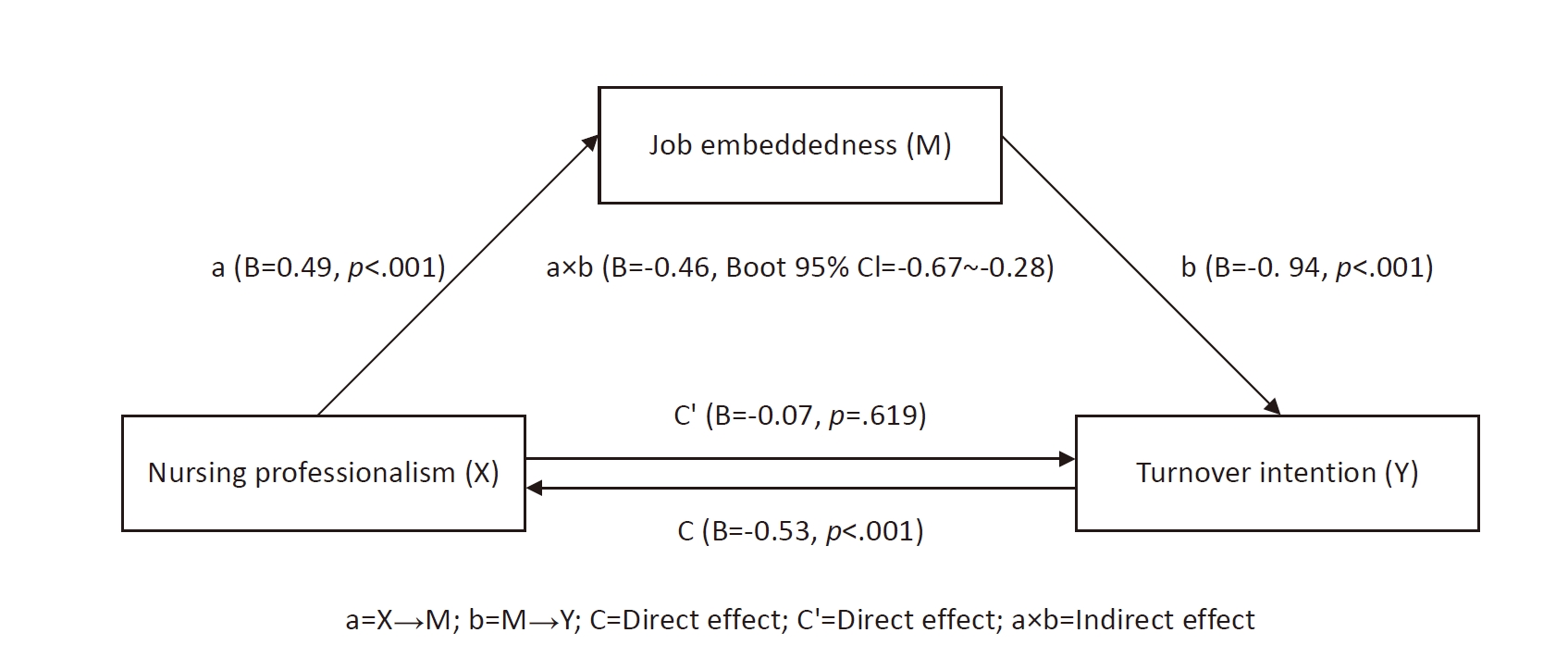
This study investigates the mediating effect of job embeddedness in the relationship between nursing professionalism and turnover intention among clinical nurses. Methods: A nationwide online survey was conducted using a structured questionnaire. Participants included 204 clinical nurses from tertiary hospitals in South Korea. Data on general characteristics, nursing professionalism, job embeddedness, and turnover intention were collected through self-reported questionnaires from March 19 to March 22, 2024. The analysis involved descriptive statistics, independent t-tests, one-way analysis of variance, Scheffé test, Pearson's correlation coefficients, multiple linear regression analysis, and bootstrapping, using SPSS/WIN version 29.0 and the SPSS PROCESS macro 4.2 version programs. Results: The mean score of nursing professionalism was 3.48±0.45 out of 5, job embeddedness was 3.13±0.52 out of 5, and turnover intention was 2.80±1.00 out of 5. Nursing professionalism did not directly impact turnover intention (B=-0.07, p=.649). Job embeddedness acted as a mediating factor in the relationship between nursing professionalism and turnover intention (B=-0.46, p<.05). Conclusion: These findings suggest that increasing job embeddedness can reduce nurses' turnover intention. Therefore, to decrease nurses' turnover intention, it is essential to enhance nursing professionalism while simultaneously promoting job embeddedness.
  • 1,554 View
  • 70 Download

Review Articles

Factors Influencing Burnout of Nurses in Comprehensive Nursing Care Service Wards: Focusing on Positive Psychological Capital, Role Conflict, and Authentic Leadership
Jung Wha Park, Kyoung Ja Kim, Ji Young Im, Ji Young Kim
J Korean Acad Nurs Adm 2025;31(4):345-357.   Published online September 30, 2025
DOI: https://doi.org/10.11111/jkana.2025.0010
Purpose
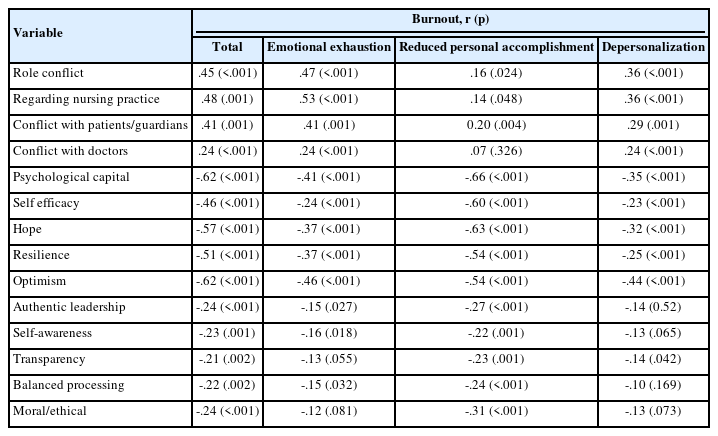
This study aimed to identify the influence of positive psychological capital, role conflict, and authentic leadership on burnout among nurses working in comprehensive nursing care service wards of general hospitals. Methods: A descriptive cross-sectional survey was conducted with 208 nurses from four general hospitals. Data were collected using structured questionnaires between September 26, 2024, and October 18, 2024, and were analyzed using descriptive statistics, independent t-tests, one-way analysis of variance, Pearson’s correlation coefficient, and hierarchical multiple regression analysis. Results: Burnout showed a correlation with role conflict (r=.45, p<.001), positive psychological capital (r=-.62, p<.001) and authentic leadership (r=-.24, p<.001). In the regression analysis, the factors significantly associated with burnout included conflict with patients/guardians (β=.24, p<.001) and conflict regarding nursing practices (β=.22, p<.001), which are subdomains of role conflict. Among the components of positive psychological capital, optimism (β=-.37, p<.001) was identified as a significant protective factor against burnout. However, authentic leadership was not found to be a statistically significant predictor. Conclusion: To effectively manage nurse burnout, it is essential to develop strategic programs that focus on enhancing optimism. Furthermore, establishing clear delegation guidelines between nurses and nursing assistants is recommended.
  • 1,908 View
  • 168 Download
A Systematic Review and Meta-Analysis of Information Literacy Competencies and Associated Variables among Korean Nursing Students
Shin Hyang Kim, Jong Mi Lim
J Korean Acad Nurs Adm 2025;31(4):358-370.   Published online September 30, 2025
DOI: https://doi.org/10.11111/jkana.2024.0061
Purpose
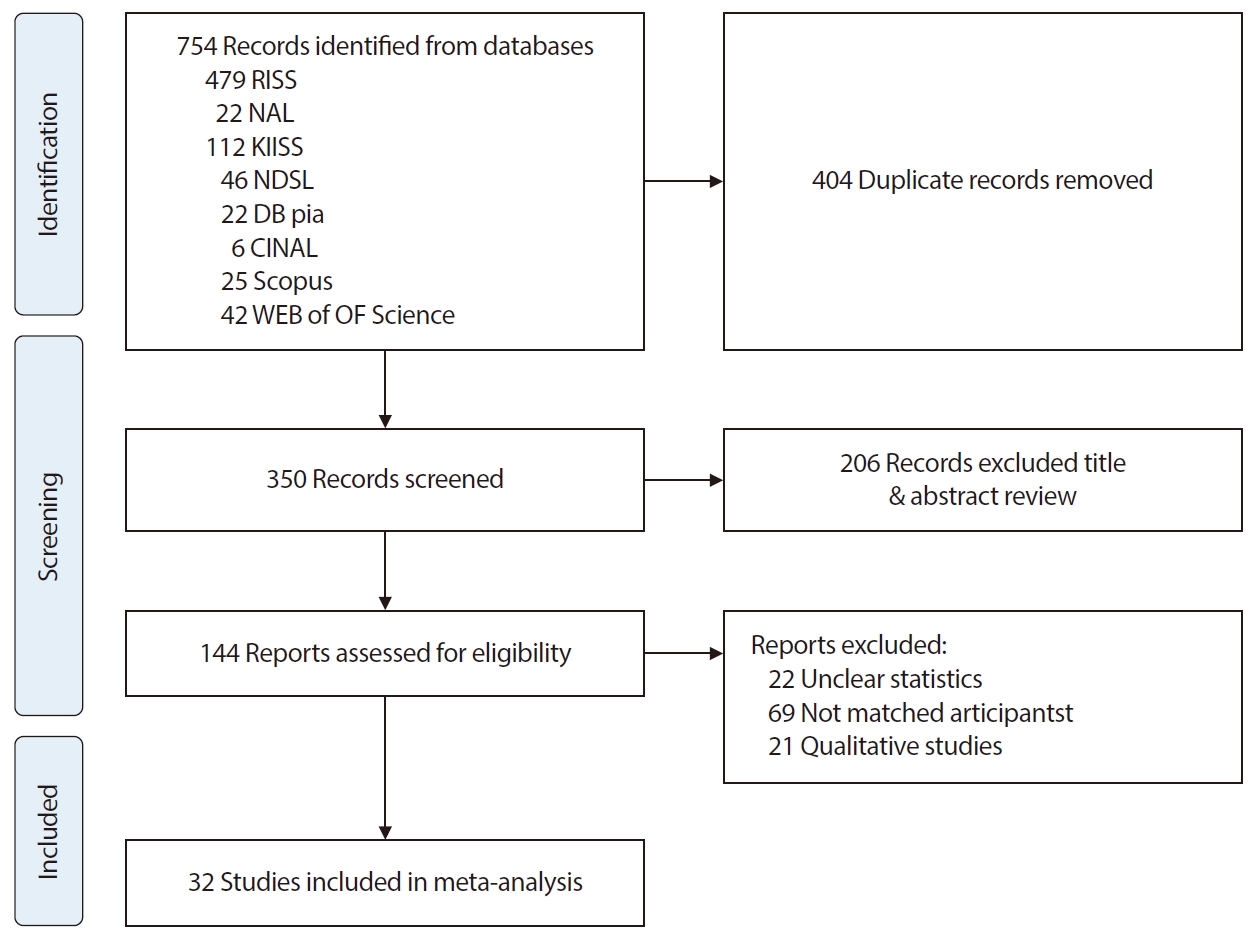
The purpose of this study is to provide academic basic data by quantitatively integrating variables related to information literacy competence of Korean nursing students. Methods: This study is a meta-analysis study to systematically review the research on information literacy competence of Korean nursing students and related variables to identify the effectiveness of each variable group. The selection criteria for the analysis subjects were determined using the PICOS framework in accordance with the PRISMA (Preferred Reporting Items for Systematic Reviews and Meta-Analyses) systematic review reporting guidelines. Theses and journal articles published from September 1, 2024, to September 30, 2024, were searched. Results: The effect sizes of the sub-variables of each variable group showed that the personal thinking competence group showed the largest effect size in the order of problem-solving ability (Fisher’s Z=.90) and critical thinking ability (Fisher’s Z=.57); the professional competence group showed evidence-based practice (Fisher’s Z=.84), clinical performance (Fisher’s Z=.65), learning engagement (Fisher’s Z=.51), communication ability (Fisher’s Z=.49), and academic achievement (Fisher’s Z=.45); and the professional competence group showed privacy awareness (Fisher’s Z=.51), professionalism (Fisher’s Z=.42), and ethical awareness (Fisher’s Z=.41). Conclusion: Based on the results of this study, it is necessary to develop a program to strengthen the information literacy competence of nursing students. Furthermore, there is a need to develop curricula and teaching-learning strategies to enhance information utilization capabilities, along with sustained attention to practice-based educational models tailored to AI and digital environments.
  • 1,922 View
  • 66 Download
Original Articles
Purpose
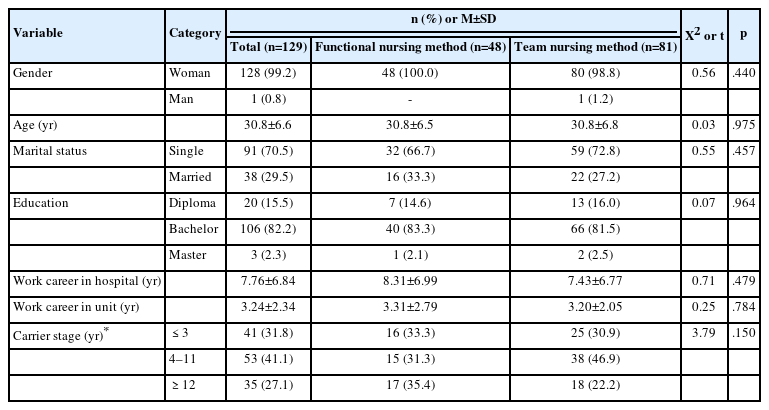
This study compares burnout, accountability, nursing competency, and quality of nursing services among nurses through the nursing care models and work experience. Methods: A cross-sectional study was conducted on 129 nurses working for more than six consecutive months in a tertiary hospital in South Korea. Data were collected in August 2023 using the Shirom-Melamed Burnout Questionnaire, Specht and Ramler Accountability Index, Nurse Competence Scale, and Good Nurse Care Scale. Differences between nursing care models were analyzed using an independent t-test. Results: Nurses in the team nursing method demonstrated lower levels of burnout and higher levels of accountability, nursing competency, and quality of nursing services than those in the functional nursing method. All differences were statistically significant, except for accountability. Novice and advanced beginner nurses showed statistically significant differences in burnout; competent and proficient nurses showed statistically significant differences in accountability, nursing competency, and quality of nursing services, excluding burnout; and expert nurses showed no statistically significant differences in nursing performance by nursing care model. Conclusion: The team nursing method showed better results in addressing nurses’ burnout, accountability, nursing competency, and quality of nursing services. The team nursing methods meet the needs of nurses seeking the total care of patients.
  • 1,665 View
  • 124 Download
Purpose
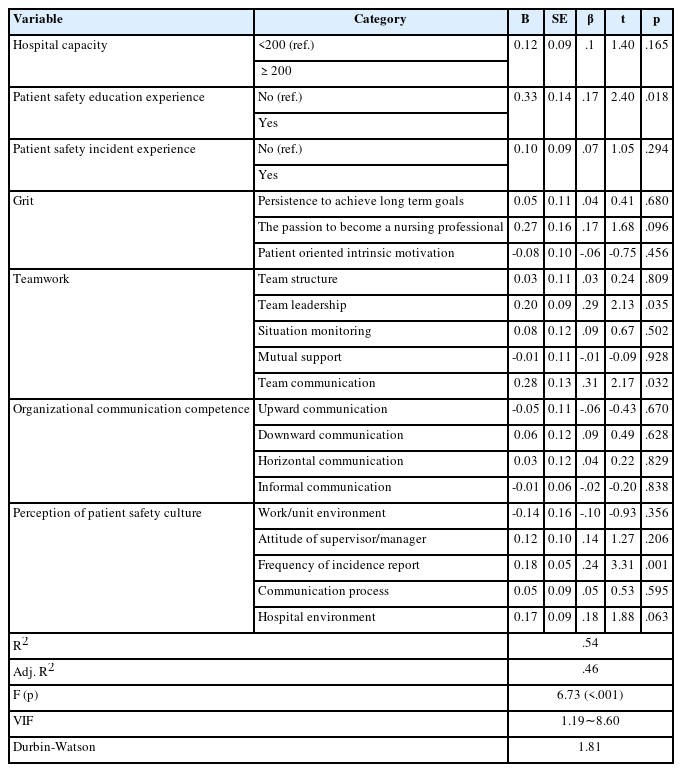
This study examined factors influencing patient safety nursing activities in integrated nursing care units. Methods: A survey was conducted with 134 nurses from hospitals (100~300 beds) in Busan using self-administered questionnaires (August 17–September 15, 2024). Data were analyzed using descriptive statistics, Pearson correlation, and multiple regression analysis. Results: The mean score for patient safety nursing activities was 4.31±0.55. Positive correlations were found with grit, teamwork, communication, and patient safety culture awareness. The predictor variables explained 46.0% of the variance in patient safety nursing activities. Significant factors included communication (β=.31, p=.032) and leadership (β=.29, p=.035) within teamwork, incident reporting frequency (β=.24, p<.001) within patient safety culture awareness, and experience in patient safety education (β=.17, p=.018). Conclusion: The findings of this study highlight the importance of enhancing teamwork, particularly in leadership and communication, and creating a safety culture that promotes incident reporting and education to strengthen patient safety nursing practices. Improving patient safety training, developing systematic evaluation and feedback mechanisms, and establishing structured support systems through campaigns and workshops will boost staff involvement and elevate the quality of patient safety practices.
  • 2,459 View
  • 199 Download
The Effect of Job Characteristics and Professional Self-concept on Competency of Forensic Nursing among Perioperative Nurses
Yeo-Jin Jeon, Bu Kyung Park
J Korean Acad Nurs Adm 2025;31(3):302-311.   Published online June 30, 2025
DOI: https://doi.org/10.11111/jkana.2023.0073
Purpose
This study aimed to investigate the effects of job characteristics and professional self-concept on competency in forensic nursing among operating room nurses at university hospitals. Methods: Data were collected from 164 operating room nurses employed at university hospitals. The collected data were analyzed in SPSS 23.0, using the mean, standard deviation, independent t-test, one-way analysis of variance, Scheffé post-hoc test, Pearson correlation coefficients, and multiple regression analysis. Results: Professional self-concept showed a statistically significant positive correlation with forensic nursing competency (r=.60, p<.001). The following factors significantly influenced forensic nursing competency among operating room nurses: professional self-concept (β=.69, p<.001), total career lengths of <5 years (β=.21, p=.006) and 5-9 years (β=.20, p=.011), and job characteristics (β=.19, p=.007). A three-step regression model was statistically significant (F=29.74, p<.001) and the total explanatory power of the regression model was 41.4%. Conclusion: This study identified that professional self-concept, total career years, and job characteristics as the most significant factors influencing operating room nurses' forensic nursing competency. Therefore, it will be necessary to develop educational programs to improve professional self-concept and job characteristics.
  • 639 View
  • 48 Download
Reemployment Experience in Civilian Hospital of Retired Military Nurse Officer: A Phenomenological Study
Hye-Kyung Lee, Mi Yu
J Korean Acad Nurs Adm 2025;31(2):214-226.   Published online March 31, 2025
DOI: https://doi.org/10.11111/jkana.2025.31.2.214
Purpose
This study employs Giorgi's descriptive phenomenological approach to explore the experiences of retired military nurse officers transitioning to civilian hospitals and to identify the essential meanings and underlying structures of this transition.
Methods
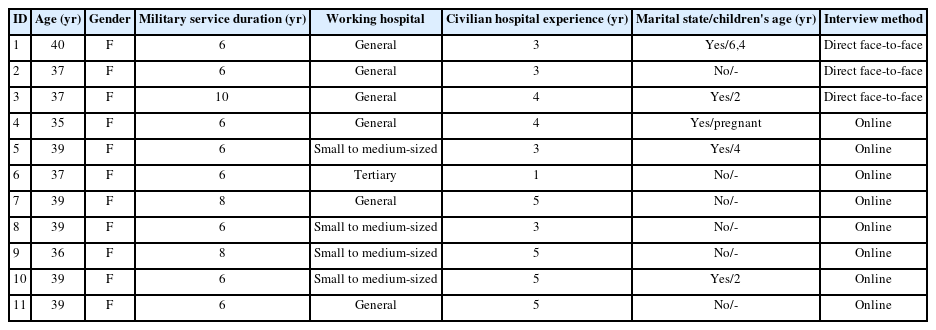
Eleven participants with over two years of military hospital experience, now employed in civilian hospitals, were recruited via snowball sampling. Data were collected through in-depth interviews conducted between December 2023 and March 2024.
Results
Analysis using Giorgi’s four-stage method identified 257 meaning units, 37 central meanings, 12 themes, and six general structures: 1) Positive perceptions of the nursing profession, 2) Confusion due to lack of information, 3) Difficulty in adapting due to differences between military and civilian hospitals, 4) Self-blame for a lack of competence, 5) Struggles in finding a position suitable for one’s career, and 6) Satisfaction with freedom and a stable life.
Conclusion
These findings emphasize the need for tailored transition programs, including job placement support, skill development, and cultural adaptation training. Socialization and communication programs can further aid integration and contribute to the professional growth. Additionally, a positive perception of nursing significantly influenced the decision to return to the workforce, highlighting the importance of fostering professional identity and confidence among transitioning military nurses.
  • 2,846 View
  • 34 Download
Purpose
This study investigated the effects of newly graduated nurses’ perceived readiness for nursing practice, resilience, and preceptors’ teaching behaviors on turnover intention.
Methods
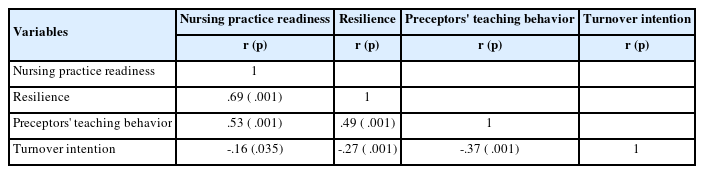
A survey was conducted among 168 newly graduated nurses between August 7 and 31, 2023. The data were analyzed using descriptive statistics, t-tests, one-way ANOVA, Pearson's correlation, and hierarchical multiple regression analysis.
Results
The factors that significantly affected turnover intention included preceptors' teaching behavior (β=-.29, p=.001) and resilience (β=-.21, p=.026). This model explained 32.0% of the variance.
Conclusion
Newly graduated nurses’ resilience and their initial training environment are key factors influencing turnover intention. Therefore, nursing managers should develop strategies to enhance the resilience of newly graduated nurses and improve training systems. Additionally, efforts should be made to promote positive teaching behaviors among the educators responsible for training newly graduated nurses.

Citations

Citations to this article as recorded by  
  • Experiences of work performance among physician assistant nurses during the period of healthcare disruption in South Korea: a qualitative content analysis
    Juyoung Ha, Minji Kim
    Journal of Korean Academy of Nursing.2026; 56(1): 98.     CrossRef
  • Perceptions on Fixed Night Shift System and Turnover Intention of General Hospital Nurses
    Mi-Aie Lee, Hye-Jin Cho, Sung-Hee Ahn, Hyo-Ju Kim
    Journal of Korean Academy of Nursing Administration.2015; 21(5): 519.     CrossRef
  • 4,084 View
  • 254 Download
  • 2 Crossref
Purpose
This study aimed to identify the effects of shared leadership, communication skills, and team effectiveness, as perceived by nurses and nursing assistants in comprehensive nursing service units.
Methods
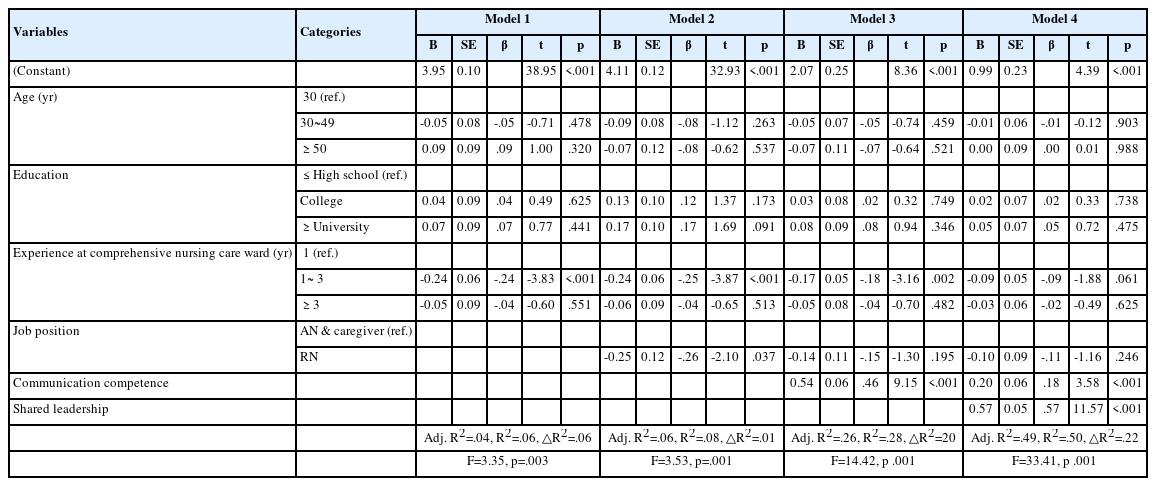
A cross-sectional research design was adopted, and the sample included 306 nurses, nurse assistants, and caregivers working in nine hospitals with fewer than 500 beds in two South Korean cities. The data were analyzed using descriptive statistics, t-tests, ANOVA, Pearson’s correlation coefficient, and four-step hierarchical regression analysis.
Results
The factors influencing team effectiveness in the hierarchal multiple regression analysis were shared leadership (β=.57, p<.001) and communication skills (β=.18, p<.001). These factors explained 49% of the total variance.
Conclusion
To enhance team effectiveness in compressive nursing service units, educational programs focusing on shared leadership and communication skills among nurses, nursing assistants, and caregivers must be developed.

Citations

Citations to this article as recorded by  
  • Effects of Shared Leadership, Role Conflict, and Organizational Commitment on Patient-Safety Competency Among Clinical
    Hye-Jeong Hwang
    Journal of Digital Contents Society.2025; 26(7): 1821.     CrossRef
  • 3,797 View
  • 206 Download
  • 1 Crossref
Structural Equation Model for Intent of Return to Nursing Practice among Inactive Korean Nurses
Ji-Yeon Yoo
J Korean Acad Nurs Adm 2025;31(1):87-98.   Published online January 31, 2025
DOI: https://doi.org/10.11111/jkana.2025.31.1.87
Purpose
This study aimed to predict and test a hypothetical model for the Intent of Return to Nursing Practice(IRNP) among inactive Korean nurses and to identify the interrelationships and influences of factors affecting IRNP.
Methods
The conceptual model was developed by integrating Ajzen’s Theory of Planned Behavior and Herzberg’s Two-Factor Theory. Data were collected from 224 Korean nurses who experienced a career disruption of more than one year through online or offline surveys. Data were analyzed using SPSS 20.0 and AMOS 22.0.
Results
The average nursing care length was seven years. The primary reason for leaving practice was rotating shifts, while the main barrier to reemployment was exhaustion. Among the variables, Career Commitment (β=.59, p<.001), Nursing Work Environment (β=.37, p<.001), and Attitude (β=.32, p<.001) had significant total effects on IRNP. Career Nursing Commitment, Subjective Norm, and Attitude showed direct effects, while the Nursing Work Environment had the second-largest total effect on IRNP, acting indirect by mediating Career Commitment.
Conclusion
The findings highlight the need for collaborative efforts among nurses, family, colleagues, hospitals, professional associations, and nursing policymakers to prevent the permanent loss of skilled nursing professionals.
  • 1,404 View
  • 38 Download
Purpose
The study aims to confirm the mediating effect of nursing professional pride in the relationship between nursing practice environment, nursing performance, and retention intention.
Methods
A descriptive cross-sectional survey was conducted from December 13 to 31, 2021, involving 127 nurses. The following statistical analysis was conducted: t-test, ANOVA, Scheffé test, Pearson's correlation coefficient analysis, and Hayes Process Macro Model 4 (to test the mediating effect).
Results
Nursing practice environment showed a significant positive correlation with nursing performance, retention intention, and nursing professional pride. Nursing practice performance showed a positive correlation with retention intention and nursing professional pride, and retention intention showed a significant positive correlation with nursing professional pride. The mediating effect of nursing professional pride was found in the effect of nurses' nursing practice environment on their retention intention. In addition, the mediating effect of nursing professional pride was found in the effect of nurses' nursing practice performance on their retention intention.
Conclusion
Through this study, it was confirmed that nursing professional pride is a major A factor affecting retention intention in the hospital. Therefore, in order to increase nurses' retention intention to remain in Hospital, the basis of basic data was presented for strategy development.

Citations

Citations to this article as recorded by  
  • Effects of the nursing practice environment, slow nursing, and living a calling on geriatric nursing stress among general hospital nurses in South Korea: a cross-sectional descriptive study
    Chung Hee Woo
    Journal of Korean Biological Nursing Science.2026; 28(1): 157.     CrossRef
  • A Grounded Theory Approach to Understanding Retention among Career Nurses in Clinical Practice
    Su Mi Choi, Ji Won Kim
    The Korean Journal of Health Service Management.2025; 19(2): 57.     CrossRef
  • Retention and Associated Factors among Nurses in Small- and Medium-Sized Hospitals across South Korea
    Eun Mi Kim, Su Jung Choi, mi sug Lee, Hyun Jin Park, Jeong Yun Park
    Journal of Korean Critical Care Nursing.2025; 18(3): 16.     CrossRef
  • 3,463 View
  • 217 Download
  • 3 Crossref
Readiness for Practice among Senior Nursing Students in South Korea: A Cross-sectional Study
Jihye Kim, Kyungmi Lee, Hye Suk Jun
J Korean Acad Nurs Adm 2025;31(1):54-63.   Published online January 31, 2025
DOI: https://doi.org/10.11111/jkana.2025.31.1.54
Purpose
Nursing students are future healthcare workers responsible for maintaining public health. Owing to the increase in early resignation among new nurses, nursing education outcomes must be evaluated by investigating students' practice readiness.
Methods
Using convenience sampling, we recruited fourth-year students from two nursing colleges to participate in a cross-sectional online survey in November 2023. The Casey-Fink Readiness for Practice Survey was used to assess practice readiness and the data were analyzed using descriptive statistics, independent t-tests, and ANOVA.
Results
Among the 157 participants (female, 77.7%; mean age, 23.12±1.93 yrs), the overall practice readiness score was 63.53±8.30 (range: 20~80) and the mean subscale score was 23.14±3.73 for clinical problem-solving (range: 7~28), 6.69±1.25 for learning techniques (range: 2~8), 16.87±2.46 for professional identity (range: 5~20), and 16.82±3.46 for trials and tribulations (range: 6~24). Practice readiness did not differ significantly by gender or age and was greater among subgroups with high grades and satisfaction with the major, classroom practice, simulation practice, clinical practice, and lectures.
Conclusion
Universities must improve the quality of classes and practical education to enhance fourth-year nursing students’ practice readiness. Nursing education programs incorporating problem-based learning must be developed and evaluated to strengthen students’ clinical inference and critical-thinking skills.
  • 8,129 View
  • 88 Download
Influence of Nurses' Moral Distress and Ethical Nursing Competence on Retention Intention
Ji-Hyun Choi, Mi-Jin Byun, Thi Ninh Do
J Korean Acad Nurs Adm 2025;31(1):36-44.   Published online January 31, 2025
DOI: https://doi.org/10.11111/jkana.2025.31.1.36
Purpose
This study aimed to ascertain the influence of moral distress and ethical nursing competence on retention intention among nurses.
Methods
Participants included 191 nurses working in general hospitals. Data were collected from July 11 to 18, 2023 and analyzed using SPSS/WIN 23.0.
Results
Factors Influencing retention intention were clinical experience in the present department (β=.22, t=3.20, p=.002), moral distress (β=-.22, t=-3.15, p=.002) and ethical nursing competence (β=.26, t=3.82, p<.001). These variables accounted for 19.7% of nurses' retention intentions.
Conclusion
Based on our findings, it is necessary to identify interventions aimed at alleviating moral distress, and establish and implement systematic programs to improve ethical nursing competence in order to increase the retention intention of nurses.
  • 1,382 View
  • 69 Download
Acuquisition of Professional Nursing Intuition: A Grounded Theory Approach
Hwa-Young Ahn, Sung-Bok Kwon
J Korean Acad Nurs Adm 2025;31(1):1-13.   Published online January 31, 2025
DOI: https://doi.org/10.11111/jkana.2025.31.1.1
Purpose
This study aimed to analyze how professional nursing intuition is acquired and develop a corresponding theory.
Methods
This qualitative study used the grounded theory method proposed by Strauss and Corbin (1998).
Results
Through axial coding, conflict was identified as the causal condition directly leading to the establishment of ‘me’ as a professional nurse, the central phenomenon. Personal competence, educational needs, and work environment were revealed as the contextual conditions. Social recognition, autonomy, and professionalism were the mediating conditions. The actions and interactions were divided into indifference-realistic and compromise-selfdirected. Dissatisfaction-mechanical, ambivalence -technical, and self-actualization-qualitative and independent nursing were derived. Through selective coding, the core category was derived as ‘becoming a nurse is desirable for myself and others.’ Conclusion: To meet the contemporary need for nurses with professional intuition. It was confirmed that nurses must demonstrate self-will and make continuous efforts to establish ‘me’ as professional nurses. To motivate nurses to acquire professional intuition, measures for social and institutional improvement should be developed to enhance the nursing education curriculum, work environment, autonomy, and professionalism.
  • 6,024 View
  • 354 Download
Voice of Customer Analysis of Nursing Care in a Tertiary Hospital: Text Network Analysis and Topic Modeling
Hyunjung Ko, Nara Han, Seulki Jeong, Jeong A Jeong, Hye Ryoung Yun, Eun Sil Kim, Young Jun Jang, Eun Ju Choi, Chun Hoe Lim, Min Hee Jung, Jung Hee Kim, Dong Hyu Cho, Seok Hee Jeong
J Korean Acad Nurs Adm 2024;30(5):529-542.   Published online December 31, 2024
DOI: https://doi.org/10.11111/jkana.2024.30.5.529
Purpose
This study aimed to explore customer perspectives of nursing services in tertiary hospitals.
Methods
The data comprised mobile Voice Of Customer (VOC) data related to “nursing” or “nurses” generated from June 25, 2019, to December 31, 2022, in a tertiary hospital. A total of 44,727 VOC data points were collected, of which 4,040 were selected for the final analysis. Text network analysis and topic modeling were conducted using NetMiner 4.5.1.
Results
Topic modeling identified five topics for positive aspects and four topics for areas requiring improvement. The positive aspects were: 1) sincere nursing care; 2) rapid response from professional medical staff; 3) teamwork for delivering customer-centric services; 4) provision and coordination of system-based healthcare services; and 5) customer-focused responsiveness. The areas requiring improvement were: 1) demand for skilled nursing care tailored to customer expectations; 2) demand for enhanced communication and reduced mechanical responses; 3) demand for appropriate handling of diverse situations; and 4) demand for overall improvements to the healthcare system, including reservation systems.
Conclusion
These results may be used to enhance customer and patient experiences in tertiary hospitals and are necessary for utilization from a hospital management perspective.
  • 1,161 View
  • 53 Download
Purpose
This study aimed to compare and identify factors affecting delirium nursing stress among nurses in comprehensive nursing care service wards and general wards.
Methods
Using structured questionnaires, data were collected from 230 nurses working in two tertiary university hospitals. Data were analyzed using descriptive statistics, t-tests, ANOVA, Pearson's correlation coefficient, and multiple regression analysis using SPSS/WIN 27.0.
Results
The average delirium nursing stress score for nurses in comprehensive nursing care service wards was 2.98±0.30 out of 4 points, which was significantly higher than 2.89±0.29 points for nurses in general wards (t=2.17, p=.031). Factors influencing delirium nursing stress among comprehensive nursing care service ward nurses included nursing work environment (β=-.58, p<.001) and conflicts with medical staff and other departments related to delirium patients (β=.24, p=.006), explaining power of 44% (F=12.13, p<.001). For general ward nurses, the nursing work environment(β=-.39, p<.001) was the main influencing factor, explaining power of 17% (F=3.93, p<.001).
Conclusion
Both types of nurses require improvements in their work environment. Strategies to reduce conflict between medical staff and other departments are essential in comprehensive nursing care service wards.
  • 1,294 View
  • 38 Download
Purpose
This study aims to find ways to reduce the reality shock of newly graduated nurses by exploring the relationship between nursing practice readiness, social support from clinical nurse educators, and reality shock.
Methods
From August 24 to September 13, 2023, data were collected from 134 newly graduated nurses with less than 12 months of clinical experience, who were trained by clinical nurse educators at one general hospital and two tertiary hospitals in I City and G Province. The data were analyzed using descriptive statistics, independent t-test, one-way analysis of variance, Pearson’s correlation coefficient, and hierarchical multiple regression with the SPSS/WIN 28.0 program.
Results
Reality shock was negatively correlated with nursing practice readiness (r=-.50, p<.001) and social support (r=-.19, p=.03), while nursing practice readiness was positively correlated with social support (r=.37, p<.001). Nursing practice readiness was identified as a significant predictor of reality shock in newly graduated nurses (β=-.46, p<.001), accounting for 31% of the variance in reality shock (F=18.82, p<.001).
Conclusion
To alleviate the reality shock of newly graduated nurses, it is important to improve their practice readiness and ensure systematic, continuous education for clinical nurse educators.
  • 1,494 View
  • 66 Download
Purpose
This study aimed to identify the factors influencing nurses’ perceptions of the disclosure of patient safety incidents in tertiary hospitals.
Methods
As a descriptive study, data were collected from 315 nurses working in two tertiary hospitals in Busan via structured self-report questionnaires from June 28 to September 3, 2023, through an online survey. Data were analyzed using descriptive statistics, t-test, one-way ANOVA, Pearson’s correlation coefficients, and hierarchical regression analysis with SPSS/WIN 27.0.
Results
Analysis was conducted by controlling for the characteristics of the study participants, which revealed significant differences in their perceptions of the disclosure of patient safety incidents. Ethical nursing competence (β=.30, p<.001) and patient safety culture (β=.15, p=.012) were significant influencing factors on the perception of such disclosure, and the explanatory power of the regression model was 21.0% (F=14.63, p<.001).
Conclusion
To enhance the aforementioned perception among nurses in tertiary hospitals, healthcare institutions should provide learning opportunities to improve their ethical nursing competence. Fostering an organizational culture that promotes and encourages open disclosure of patient safety incidents is also essential.

Citations

Citations to this article as recorded by  
  • Impact of Nursing Professionalism, Ethical Sensitivity, and the Clinical Learning Environment on Nursing Students' Intention to Report Near Misses and Adverse Events
    Sookhee Yoon, Ha-Young Park
    Journal of Korean Academy of Fundamentals of Nursing.2025; 32(2): 209.     CrossRef
  • Factors Influencing End-of-life Care Competency in Nursing Students
    Jinryung Park, Minjeong Seo
    Korean Journal of Medical Ethics.2024; 27(4): 267.     CrossRef
  • 3,994 View
  • 124 Download
  • 2 Crossref
Effects of Nurse-Nurse Collaboration and Nurse-Physician Collaboration on Nursing Performance in Nurses: The Mediating Effect of Patient Safety Management Activities
JaHyun Kim, Seok Hee Jeong, Hee Sun Kim, Sunmi Kim
J Korean Acad Nurs Adm 2024;30(4):343-356.   Published online September 30, 2024
DOI: https://doi.org/10.11111/jkana.2024.30.4.343
Purpose
This study investigated the mediating effects of patient safety management activities on the relationship between nurse-nurse collaboration, nurse-physician collaboration, and nursing performance of clinical nurses.
Methods
Online survey was performed from February 18 to February 28, 2023 using structured questionnaires. The participants were 212 clinical nurses working in tertiary general hospitals in South Korea. The participants completed self-reporting questionnaires, that measured nurse-nurse collaboration, nurse-physician collaboration, nursing performance, and patient safety management activities. Data were analyzed using SPSS 29.0 program, for multiple regression and a simple mediation model, applying the PROCESS macro with a 95% bias-corrected bootstrap confidence interval.
Results
Nurses' patient safety management activities had a mediating effect on the relationship between nurse-nurse collaboration and nursing performance (B=0.24, Boot 95% CI=0.16∼0.34). In addition, patient safety management activities showed a mediating effect on the relationship between nurse-physician collaboration and nursing performance (B=0.10, Boot 95% CI=0.07∼0.15).
Conclusion
The levels of nurse-nurse collaboration, nurse-physician collaboration, and patient safety management activities must be considered when developing strategies to improve nurses’ performance in nursing practice settings.

Citations

Citations to this article as recorded by  
  • Nurses’s Experience with Department Transfer Following Sudden Ward Closure after a Collective Resignation of Residents
    Yeon Hee Kim, Jeong Min Jo, Hye Mi Kim, Gyu Ri An, Na Yeon Lee, Hee Suk Ha
    Journal of Korean Association for Qualitative Research.2025; 10(1): 14.     CrossRef
  • The Mediating Effect of Missed Nursing Care on Nurse Collaboration and Perceived Care Quality Among Nurses
    Merve Tarhan, Dilan Şahin Kaya
    Journal of Nursing Care Quality.2025;[Epub]     CrossRef
  • Interprofessional Education in Nursing: Current Status and Student Readiness
    Seuk Oh, Chaeeun Jeong, Seungheon Jang, Songwhi Noh, Jina Choo
    Korean Medical Education Review.2025; 27(Suppl1): S31.     CrossRef
  • 8,057 View
  • 480 Download
  • 3 Crossref
Second-Degree Bachelor of Science in Nursing: Current Status and Key Challenges and Future Directions
Eui Geum Oh, Bada Kang, Ji Yea Lee, Jae Jun Lee
J Korean Acad Nurs Adm 2024;30(4):332-342.   Published online September 30, 2024
DOI: https://doi.org/10.11111/jkana.2024.30.4.332
Purpose
This study examines the current status of a second-degree Bachelor of Science in Nursing (BSN) program in South Korea, identifies its advantages and limitations, and provides future directions for improving the program.
Methods
A mixed-methods, sequential explanatory design was employed. A cross-sectional survey (n=28 faculty members, 122 enrolled students, 20 graduates) was conducted, followed by focus group interviews (n=six faculty members, 13 enrolled students, six graduates).
Results
Among the 28 nursing colleges, 19 had a second-degree BSN program enrollment capacity of less than 10% of their total student capacity, whereas six colleges had a capacity ranging from 20% to 30%. The advantages of the program included producing nurses with diverse backgrounds, demonstrating a strong aspiration for the nursing profession, diligent attitude, and mature interpersonal skills among the second-degree BSN students. The limitations included inadequate support and resources for program operations, difficulties in ensuring the quality of classes and clinical practice, and limited opportunities for interaction with other students.
Conclusion
This study highlights the importance of establishing clear policies and guidelines for such programs and developing standardized curricula to ensure high-quality nursing education while accommodating an increasing number of students.
  • 2,704 View
  • 22 Download
Nursing Students’ Experience of Using Digital Healthcare Applications (DiGA)
Young-Eun Jang, Hwa-Mi Yang
J Korean Acad Nurs Adm 2024;30(4):319-331.   Published online September 30, 2024
DOI: https://doi.org/10.11111/jkana.2024.30.4.319
Purpose
This study examined nursing students' experiences of using digital healthcare applications in terms of the source and demand of socio-psychological needs, expectations, exposures, use satisfaction, and derivative effects based on the components of use satisfaction theory.
Methods
This study was conducted using focus group interviews, and data were collected from 12 nursing students enrolled in two universities located in Seoul and Gyeonggi Province from April 1 to May 31, 2023.
Results
The nursing students mainly used digital healthcare applications to address needs such as sleep, exercise, goal setting, social support, and motivation, which included the need for physical well-being, growth and development, emotional stability, and social needs. Participants met various needs such as achieving goals, feeling of achievement, enhancing self-confidence, and acquiring helpful information through digital healthcare applications. The satisfaction gained in setting and achieving goals was the driving force for motivation.
Conclusion
Nursing students value intuitive interfaces, personalized features, and appropriate notifications. Step-by-step rewards and reasonable pricing are also vital for using digital healthcare apps. These findings should be incorporated into developing programs to improve nursing students' health management and digital healthcare skills.
  • 1,367 View
  • 41 Download
Improving Handover Efficiency for Emergency Nurses
Seungeun Lee, Heeje Yun, Yukyung Lee, Minji Kang, Eunbi Jo, Sunjong Yoo, I Gyeong Jo, Jung Hwan Heo, Min Jin Choi
J Korean Acad Nurs Adm 2024;30(3):294-305.   Published online June 30, 2024
DOI: https://doi.org/10.11111/jkana.2024.30.3.294
Purpose
Patient handovers are critical for patient safety. Studies have shown that nurses are often interrupted during handovers, and standardized guidelines are lacking. This study aimed to develop and evaluate the effectiveness of a new handover method for emergency nurses.
Methods
This quasi-experimental study implemented a new handover method from August 1, 2022, at the emergency department of a university hospital. Pre- (34 responses) and post-(16 responses, six months later) surveys and post-interviews (six participants) were conducted. In the pre-survey, data were collected regarding handover-related characteristics, cause of handover error, handover perception and handover error experience. Data regarding handover perception and handover error experience were obtained again at the post-survey. Wilcoxon’s signed rank test was used to compare handover perception and handover error experience. The interview results were analyzed using inductive content analysis.
Results
There were no significant differences in information quality or interaction and support, but the new handover method was more efficient, and handover errors decreased. Four themes were identified from interview responses.
Conclusion
By providing a quiet place and allowing emergency nurses to independently review patient records during handovers, we expect to maintain nursing continuity, increase efficiency, and ultimately ensure patient safety and nurses’ job satisfaction.
  • 1,666 View
  • 99 Download
Purpose
The study was conducted to identify the influencing factors the quality of work life in emergency nurses during prolonged COVID-19.
Methods
Data was collected on 197 emergency nurses, from November 8 to December 8, 2022. Data were analyzed based on descriptive statistics, t-test, ANOVA, Scheffé test, Pearson's correlation, hierarchical multiple regression analysis.
Results
There was significant positive correlation between disaster nursing core competencies, coping flexibility, and quality of work life. The primary factors that significantly affected the quality of work life of emergency nurses were disaster nursing core competencies (β=.66, p<.001) and emergency department experience (β=.19, p=.030). The explanatory power of variable was 60%.
Conclusion
As a result of the study, it was confirmed that disaster nursing core competencies were the factor that had the greatest impact on the quality of work life of emergency nurses. Thus, it is expected that regular simulation training and education to improve the disaster nursing core competencies of emergency nurses.

Citations

Citations to this article as recorded by  
  • Factors Influencing the Mental Well-being of Shift Nurses
    Yu Jin Lee, Chung Hee Woo
    Journal of Korean Academy of psychiatric and Mental Health Nursing.2025; 34(1): 54.     CrossRef
  • 1,669 View
  • 54 Download
  • 1 Crossref
Influence of Work Environment, Missed Nursing Care, and Non-Nursing Tasks of Hospital Nurses on Job Stress
Ji Yeong Park, Kyoung Ja Kim
J Korean Acad Nurs Adm 2024;30(3):246-258.   Published online June 30, 2024
DOI: https://doi.org/10.11111/jkana.2024.30.3.246
Purpose
This study aimed to determine the impact of work environment, missed nursing care, and non-nursing tasks on the job stress of hospital nurses.
Methods
A descriptive, cross-sectional survey of 164 nurses working in three hospitals was conducted. Data were collected using structured questionnaires and analyzed using descriptive statistics, t-test, one-way analysis of variance, Pearson’s correlation coefficient, and multiple regression analysis using SPSS/WIN 26.0.
Results
Hospital Nurses' job stress was negatively correlated with the work environment (r=-.37, p<.001). Job stress had a statistically significant positive correlation with non-nursing tasks (r=.34, p<.001); however, it had no significant correlation with missed nursing care (r=.05, p=.552). Regression model analysis revealed that the variables associated with job stress were non-nursing tasks (β=.29, p<.001) and the foundation for quality nursing care (β=-.25, p=.034), which are subdomains of the work environment. In contrast, missed nursing care was not determined to be a significant factor.
Conclusion
To effectively manage nurses' job stress, nurse managers should provide higher quality care by reducing the number of non-nursing tasks and creating a positive work environment, especially by providing adequate nursing workforce and material support.

Citations

Citations to this article as recorded by  
  • A Systematic Review of Stress-Related Work and Missed Nursing Care Among Clinical Nurses
    Yetty Mardelima Uli Pakpahan, Maria Komariah, Hana Rizmadewi Agustina
    Healthcare.2026; 14(3): 304.     CrossRef
  • Effects of the nursing practice environment, slow nursing, and living a calling on geriatric nursing stress among general hospital nurses in South Korea: a cross-sectional descriptive study
    Chung Hee Woo
    Journal of Korean Biological Nursing Science.2026; 28(1): 157.     CrossRef
  • Effects of Role Conflict, Work Environment, and Meaning of Work on Job Embeddedness among Physician Assistants
    Kwang Hoon Seo, Tae Yeong Yang, Nam Gyu Park, Jung Eun Park
    Journal of Korean Academy of Nursing Administration.2025; 31(3): 249.     CrossRef
  • Occupational Stress, Coping, and Outcomes among Korean Nurses: An Integrative Review Based on the Transactional Model of Stress and Coping
    Myungji Kim, Hyunkyung Choi
    STRESS.2025; 33(3): 127.     CrossRef
  • Factors Influencing Nursing Care Left Undone by Cancer Ward Nurses
    Chung Hee Woo, Yeon Joo Kim
    Journal of Korean Academy of Nursing Administration.2025; 31(5): 594.     CrossRef
  • Comparison of Factors Affecting Delirium Nursing Stress between Nurses in Comprehensive Nursing Care Service Wards and General Wards
    Sumin Gwon, Gaeun Kim
    Journal of Korean Academy of Nursing Administration.2024; 30(5): 517.     CrossRef
  • 4,293 View
  • 223 Download
  • 6 Crossref
Relationships among Nursing Skill Mix, Missed Nursing Care, and Adverse Events in Small and Medium-Sized Hospital Comprehensive Nursing Care Wards
Yoon Sook Cho, Hyoung Eun Chang, Hyunjung Lee
J Korean Acad Nurs Adm 2024;30(2):163-174.   Published online March 31, 2024
DOI: https://doi.org/10.11111/jkana.2024.30.2.163
Purpose
This study aimed to investigate the relationships among nursing skill mix, missed nursing care, and adverse events according to the nursing skill mix and the factors influencing.
Methods
This study is a descriptive survey that used survey data were collected from 158 nurses working in comprehensive nursing care wards in small and medium-sized hospitals. The data were analyzed using the t-test, analysis of variance, and multiple regression analysis.
Results
The average age of the study participants was 37.9 years, and they had over 10 years of experience. The average mean ratio of nursing skill mix 1 was 69.98. For nursing skill mix 2, the average mean ratio was 68.44%. The mean score for missed nursing care was 1.33, and the mean score for adverse events was 1.90 points. The factors affecting adverse events experience were missed nursing care, total work experience of >3 years, number of beds between ≥200 and <300.
Conclusion
Our findings suggest that patient safety and management education should consider the nurses’ age and total work experience. Furthermore, nursing workforce management, particularly focusing on nursing assistants in small- and medium-sized hospitals, is essential for fostering a safer healthcare environment.

Citations

Citations to this article as recorded by  
  • Effects of presenteeism on turnover intention in clinical nurses through the serial mediating roles of missed nursing care and job satisfaction: a cross-sectional predictive correlational study
    Hyeonseon Cheon, Seok Hee Jeong, Hyun Kyung Kim, Hyoung Eun Chang
    Journal of Korean Academy of Nursing.2025; 55(4): 584.     CrossRef
  • 982 View
  • 58 Download
  • 1 Crossref
Development of Guidelines for the Delegation of Nursing Tasks in Integrated Nursing Care Service
Yeojin Yi, Haena Lim, Ji-Mee Kim, Jung-Hee Song
J Korean Acad Nurs Adm 2024;30(2):114-129.   Published online March 31, 2024
DOI: https://doi.org/10.11111/jkana.2024.30.2.114
Purpose
The aim was to develop guidelines for delegating nursing tasks among nurses in integrated nursing care wards.
Methods
This was a methodological approach. Literature reviews were conducted on delegation policies and practices for nurses in Korea and other countries to explore the area of nursing delegation. Focus group interviews were performed with nurses to identify the strength and weakness of the delegation of nursing tasks in clinical practice, and qualitative content analysis was conducted based on the interview. Ten areas and 115 items were derived through these steps, and their validity was confirmed using the Delphi technique.
Results
The delegation guidelines of nursing tasks consisted of nine domains, 21 sub-categories, and 101 items, including Nurses and nursing assistants' duties, the necessity of delegation, definition of terms, scope of delegation, considerations for delegation, procedure, characteristics, and principles of delegation, and educational content for delegation.
Conclusion
These guidelines can help nurses to make decisions about delegating nursing tasks according to the delegation procedure. Education on the delegation of nursing tasks is necessary for both nurses and nursing assistants. The guidelines developed in this study can serve as a standard for delegating nursing tasks to ensure patient safety.

Citations

Citations to this article as recorded by  
  • Effects of a mobile simulation program for nursing delegation: A randomised controlled trial
    Haena Lim, Yeojin Yi
    Nurse Education in Practice.2025; 83: 104283.     CrossRef
  • Effects of Shared Leadership and Communication Competence on Nursing Team Effectiveness in Comprehensive Nursing Service Units: Focusing on the Team Nursing System
    Hye Jin Kim, Eunjoo Lee
    Journal of Korean Academy of Nursing Administration.2025; 31(2): 143.     CrossRef
  • 2,422 View
  • 74 Download
  • 2 Crossref
Purpose
This study used a structural model to identify organizational characteristics, such as work environment, nursing organizational culture, and manager leadership of general hospital nurses, and to examine the effect of organizational characteristics on turnover intention through organizational silence.
Methods
Data were collected from July 1, 2017 to August 30, 2017, using structured questionnaires. Participants were nurses in general hospitals with more than 250 beds and less than 500 beds in Busan City and Gyeongsangnam Province. The collected data were analyzed using IBM SPSS 23.0 and AMOS 23.0.
Results
The nursing work environment, external employment opportunities, relationship-oriented culture, and acquiescent and defensive silence directly impacted turnover intention. Additionally, the nursing work environment and external employment opportunities indirectly affected turnover intention through acquiescent silence.
Conclusion
To lower general hospital nurses’ turnover intention, the external environment should be reviewed and continuously compared to provide a better internal nursing work environment. In addition, it is necessary to find a way to lower the acquiescent silence, which can negatively affect the organization, by creating a relationship-oriented culture that emphasizes the relationship between members.
  • 1,532 View
  • 65 Download
Purpose
To identify the mediating effect of the communication competence on the relationship between emotional intelligence and nursing managerial competence among experienced nurses.
Methods
A total of 186 nurses with more than 10 years of experience working in six general hospitals participated. Data were collected using a selfreported questionnaire and analyzed using SPSS Statistics ver. 23.0 and SPSS Process Macro for descriptive statistics, independent t-test, one-way analysis of variance (ANOVA), Scheffé test, Pearson’s correlation coefficient, multiple regression analysis, and bootstrapping method.
Results
Nursing managerial competence was significantly associated with emotional intelligence (r=.32, p<.001) and communication competence (r=.42, p<.001). Additionally, communication competence had a complete mediating effect on the relationship between emotional intelligence and nursing managerial competence (indirect effect=0.45, boot SE=0.11, 95% boot CI=[0.25, 0.67]).
Conclusion
Strategies for enhancing the experienced nurses’ nursing managerial competence should be considered to improve communication competence as well as emotional intelligence and develop nursing managerial competency-related education programs by career stages. In particular, the nursing management competency-related education should focus on improving human resource management and planning competences.

Citations

Citations to this article as recorded by  
  • Influences of Clinical Nurses’ Second Victim Experience after Patient Safety Incidents, Individual and Organizational Support, and Job Satisfaction on Turnover Intention
    Hyeran Kang, Jeong-Hee Kim
    Journal of Korean Academy of Nursing Administration.2026; 32(1): 58.     CrossRef
  • Factors influencing delirium nursing competency among nurses in integrated nursing care wards in South Korea: a cross-sectional study
    Jeeyoung Yeon, Gisoo Shin
    Journal of Korean Biological Nursing Science.2025; 27(2): 256.     CrossRef
  • Factors Impacting on Nurse Unit Managers’ Knowledge and Ability Importance of Managerial Competencies
    Jihae Lee, Miyoung Kim
    Journal of Korean Academy of Nursing Administration.2024; 30(4): 428.     CrossRef
  • Factors Influencing Depression Among Nurses in General Hospitals During the COVID-19 Pandemic: Focus on Job Demands, Post-traumatic Stress, and Social and Organizational Support
    Si Hyun Baek, Jeong-Hee Kim
    Journal of Korean Academy of Nursing Administration.2024; 30(3): 306.     CrossRef
  • 1,442 View
  • 73 Download
  • 4 Crossref
Purpose
To explore the relationship between nursing care needs and acuity based on the Korean Patient Classification System for Critical Care Nurses (KPCSC) and APACHE II, and to identify their prognostic value in predicting mortality.
Methods
A total of 617 patients admitted to a surgical intensive care unit in a tertiary hospital from January 1 to June 30, 2021 were included. The correlation between KPCSC and APACHE II scores, and their predictive power regarding mortality were examined.
Results
KPCSC and APACHE II scores showed a significant, positive correlation (r=.32, p<.001). The KPCSC score was significantly correlated with 10 out of 11 KPCSC categories and 2 out of 3 APACHE II domains, whereas the APACHE II score had a significant correlation with all APACHE II domains and only 4 out of 11 KPCSC categories. Both KPCSC and APACHE II demonstrated moderate discriminatory performance in predicting ICU and in-hospital death, and their AUC values were not significantly different.
Conclusion
KPCSC, reflecting the severity of illness, predicted mortality as well as APACHE II. However, KPCSC was found to consider factors other than severity, such as patient dependency, which substantiates its value as an assessment tool for nursing care needs.

Citations

Citations to this article as recorded by  
  • Comparisons of nursing hours and nurse-to-patient ratios required for patients with mechanical ventilation, CRRT, and ECMO in intensive care units: A cross-sectional study
    Sung-Hyun Cho, Shin-Ae Kim, Eunhye Kim
    Intensive and Critical Care Nursing.2025; 89: 103982.     CrossRef
  • Relationship between Nurse Staffing and Critical Nursing Activities in Intensive Care Units : Analysis of National Health Insurance Claims Data from 2009 to 2020
    U Ri Go, Sung-Hyun Cho
    Journal of Korean Critical Care Nursing.2024; 17(2): 25.     CrossRef
  • 1,974 View
  • 61 Download
  • 2 Crossref
General Nurses’ Nursing Leadership Experience in Patient Care: Applying Focus Group Interviews
Ji-Mee Kim, Haena Lim, Yeojin Yi, Jung-Hee Song
J Korean Acad Nurs Adm 2024;30(1):19-30.   Published online January 31, 2024
DOI: https://doi.org/10.11111/jkana.2024.30.1.19
Purpose
This study aimed to examine general nurses' nursing leadership in patient care using focus group interviews.
Methods
This study was conducted after obtaining approval from the ethics committee of a university. After completing a focus group interview with 13 general nurses working at a general hospital, we performed qualitative content analysis according to Kreuger's guidelines.
Results
A total of 170 meaningful statement units of nursing leadership that appeared in the clinical experience of general nurses were extracted, and 10 final sub-themes and the three themes connecting them were derived. The themes derived were “leading patients into nursing,” “experiencing the power of growth,” and “facilitating situations that allow focus on patient care.” Conclusion: This study helps in understanding the nursing leadership of general nurses in patient care. To encourage general nurses to exert their nursing leadership and grow as autonomous nurses, nursing educators must appropriately present the learning outcomes and content of nursing leadership. Additionally, in the clinical setting, organizational support is necessary to foster understanding and the demonstration of general nurses' nursing leadership.

Citations

Citations to this article as recorded by  
  • Effects of Patient Safety Management System, Leadership, and Communication Types on Nurse’ Patient Safety Management Activities
    Eunji Lee, Haejung Lee
    Journal of Korean Academy of Nursing Administration.2024; 30(4): 367.     CrossRef
  • Mediating Effect of Self-efficacy in the Relationship between Informal Learning, Shared Leadership and Organizational Socialization of Beginner · Advanced Beginner Nurses
    Nam Yi Kim, Chung Hee Woo
    Journal of Korean Academy of Nursing Administration.2018; 24(1): 1.     CrossRef
  • Nursing Performance and Organizational Socialization of New Nurses according to Teaching Style of Preceptors and Personality of New Nurses
    Jeong Sill Choi, Nam Young Yang
    Journal of Korean Academy of Nursing Administration.2012; 18(3): 281.     CrossRef
  • 1,749 View
  • 98 Download
  • 3 Crossref
Exploring the Applicability of Artificial Intelligence for the Improvement of Nursing Practice in Korea
Hanbit Lee, Woojong Moon, Sla Kim, Jinhee Lee, Yuzhu Zhang
J Korean Acad Nurs Adm 2023;29(5):564-576.   Published online December 31, 2023
DOI: https://doi.org/10.11111/jkana.2023.29.5.564
Purpose
Based on a literature review of artificial intelligence (AI) applications within nursing tasks, this study delves into the feasibility of employing AI to improve nursing practice in Korea.
Methods
We used "nursing" and "artificial intelligence" as keywords to search academic databases, resulting in 96 relevant studies from an initial pool of 940. After a detailed review, 35 studies were selected for analysis based on nursing process stages.
Results
AI improves nursing assessment by enhancing pain diagnosis, fall detection, and movement monitoring in older adults. It aids nursing diagnosis through clinical decision support, risk prediction, and emergency patient triage. Further, it expedites the creation of precise plans utilizing predictive models in nursing planning. AI also forecasts medication errors and reduces the nursing documentation burden for nursing implementation. Additionally, it manages (re)hospitalization risks by assessing patient risk and prognoses in nursing evaluation.
Conclusion
AI in Korean nursing can enhance assessment and diagnosis accuracy, promote a prevention-focused paradigm through risk prediction, and ease the burden of nursing practice amidst human resource shortages.

Citations

Citations to this article as recorded by  
  • Research trends in generative artificial intelligence in nursing: a scoping review
    Myung Jin Choi, Myoung Hee Seo, Jihun Kim, Sunmi Kim, Seok Hee Jeong
    Journal of Korean Academy of Nursing.2025; 55(3): 468.     CrossRef
  • Concept Analysis of Social Intelligence of Nurses Using Hybrid Model
    Kyung Ran Lee, Na Kyoung Lee, Hee Oh, Kyoung Ae Park
    Journal of Korean Academy of Nursing.2024; 54(3): 459.     CrossRef
  • Why nursing cannot be replaced with artificial intelligence
    Hae-Kyung Jo
    Women's Health Nursing.2024; 30(4): 340.     CrossRef
  • 11,867 View
  • 747 Download
  • 3 Crossref
Future Outlook of Nursing Management Research: Analysis of Articles Published in the Journal of Korean Academy of Nursing Administration from 2012-2021
Eungyung Kim, Sung-Hyun Cho, Jihyun Kim, Jong Kyung Kim, Eunhee Lee
J Korean Acad Nurs Adm 2023;29(5):553-563.   Published online December 31, 2023
DOI: https://doi.org/10.11111/jkana.2023.29.5.553
Purpose
To examine the characteristics, core variables, and their correlations in articles published in the Journal of Korean Academy of Nursing Administration (JKANA) from 2012-2021 and suggest future directions for nursing management research.
Methods
A total of 506 articles were analyzed according to study design, participants and setting, statistical methods, keywords, and core concepts and variables.
Results
Quantitative research accounted for 73.5%, and most participants were staff nurses (66.8%) and nursing students (9.1%). Furthermore, 318 studies (62.8%) conducted surveys, and settings were mainly acute hospitals(81.5%) and nursing schools (9.7%). Statistical methods for data analysis included independent t-test (81.2%), one-way ANOVA (77.2%), Pearson correlation coefficients (77.2%), post-hoc testing (74.3%), and linear regression(65.9%). Among 2,058 keywords, the most frequent were “nurses” (49.2%), “job satisfaction” (10.7%), and “personnel turnover” (9.1%). The most frequently core concepts were job satisfaction (10.5%), turnover intention(9.5%), organizational commitment (8.5%), and job stress (7.5%). The most frequently variables with significant correlations were turnover intention, work environment, job satisfaction, job stress, burnout, and emotional labor.
Conclusion
Most JKANA studies examined nursing-related outcomes and performance. Future research should examine the effects of nursing practice and policy on patient outcomes.
  • 2,580 View
  • 56 Download
Recommending Revised Inpatient Nursing Fee Schedules Based on Actual Nurse Staffing Levels in General Wards
Sung-Hyun Cho, Jinhyun Kim, Jiyeong Seong, Ji-Yun Lee
J Korean Acad Nurs Adm 2023;29(5):540-552.   Published online December 31, 2023
DOI: https://doi.org/10.11111/jkana.2023.29.5.540
Purpose
This study aims to propose revised inpatient nursing fee schedules that address three discrepancies between actual nurse staffing levels in general wards and the corresponding patient payment structures.
Methods
A total of 45 tertiary hospitals, 329 general hospitals, and 1,379 hospitals from publicly released data for 2021~2022 were analyzed. This analysis focused on three primary discrepancies between (1) the staffing grades under which patients were hospitalized and the corresponding grades for which they were charged; (2) the staffing grades determined by bed-to-nurse and patient-to-nurse criteria; and (3) the current differentiation rates of nursing fees and the expected differentiation rates based on the number of nurses required for each grade.
Results
The first discrepancy occurred in 8.9% of tertiary hospitals, 21.0% of general hospitals, and 26.0% of hospitals. The bed-to-nurse and patient-to-nurse grades differed by 2.23 and 2.29 grades on average in general hospitals and hospitals, respectively. The current differentiation rates were higher than the expected differentiation rates. New nursing fee schedules were suggested to resolve those discrepancies.
Conclusion
Nursing fees should be charged to reflect the staffing levels under which patients were cared for and proportionate to the number of nurses required to provide the corresponding staffing levels.
  • 1,103 View
  • 41 Download
Influence of Teamwork, Role Conflict, and Delegation Preparedness on Job Satisfaction among Nurses Working in Integrated Nursing Care Wards
Deokhyun Lee, Yoonju Lee, Haejung Lee, Sunyoung Jung
J Korean Acad Nurs Adm 2023;29(4):478-489.   Published online September 30, 2023
DOI: https://doi.org/10.11111/jkana.2023.29.4.478
Purpose
This study aimed to identify the factors influencing job satisfaction among nurses working in integrated nursing care wards.
Methods
The study participants were 196 nurses working in integrated nursing care wards at four general hospitals and one tertiary hospital. Data were collected using structured questionnaires from April 11 to 25, 2022, through an online survey. Data were analyzed using descriptive statistics, t-test, one-way ANOVA, Pearson correlation, and stepwise multiple regression with SPSS/WIN 26.0.
Results
The factors influencing job satisfaction of participants were team structure (β=.32, p<.001), role conflict regarding nursing practice (β=-.24, p<.001), mutual support (β=.23, p<.001), master's degree or higher(β=.16, p=.004), and spousal presence (β=.15, p=.005).
Conclusion
The findings of this study suggest that the tasks and roles of team members should be clarified, and a supportive team culture of mutual cooperation should be fostered to improve the job satisfaction of nurses working in the integrated nursing ward. In addition, it is necessary to reduce role conflict by providing support focused on allocating tasks that can strengthen the role of professional nurses.

Citations

Citations to this article as recorded by  
  • Effects of Shared Leadership and Communication Competence on Nursing Team Effectiveness in Comprehensive Nursing Service Units: Focusing on the Team Nursing System
    Hye Jin Kim, Eunjoo Lee
    Journal of Korean Academy of Nursing Administration.2025; 31(2): 143.     CrossRef
  • Influence of Job Delegation Preparedness, Individual and Organizational Communication Skills on Job Stress of Nurses in Comprehensive Nursing Care Service Wards
    Soo Jin Lee, Ji Won Kim, Nam Hee Park
    Journal of Korean Public Health Nursing.2025; 39(1): 5.     CrossRef
  • Impact of Grit, Teamwork, Organizational Communication Competence, Perception of Patient Safety Culture on Patient Safety Nursing Activities in Integrated Nursing Care Units
    Jeeseon Kim, Haejung Lee
    Journal of Korean Academy of Nursing Administration.2025; 31(3): 237.     CrossRef
  • Factors Influencing Burnout of Nurses in Comprehensive Nursing Care Service Wards: Focusing on Positive Psychological Capital, Role Conflict, and Authentic Leadership
    Jung Wha Park, Kyoung Ja Kim, Ji Young Im, Ji Young Kim
    Journal of Korean Academy of Nursing Administration.2025; 31(4): 345.     CrossRef
  • Structural Equation Model of Turnover Intention Among Integrated Nursing Care Service Wards Nurses in Small- and Medium-Sized Hospitals
    So Hyeon Yun, Won Hee Jun
    Western Journal of Nursing Research.2025;[Epub]     CrossRef
  • Influence of Nursing Professionalism, Nursing Work Environment, and Compassion Competence on Person-Centered Care of Nurses in Comprehensive Nursing Care
    Yeon-Jin Lee, Eun-Mi Kim
    Journal of Korean Academy of Nursing Administration.2025; 31(5): 572.     CrossRef
  • 3,086 View
  • 145 Download
  • 6 Crossref
Effects of Nurses' Grit on the Nursing Performance: Multiple Mediating Effects of Work Engagement and Job Crafting
Jeong-Lim Ryu, So-Hyoung Hong, Yoon Seo Yang
J Korean Acad Nurs Adm 2023;29(4):468-477.   Published online September 30, 2023
DOI: https://doi.org/10.11111/jkana.2023.29.4.468
Purpose
The purpose of this study was to identify the mediating effect of work engagement and job crafting on the relationship between nurses’ Grit on nursing performance.
Methods
The data were collected using structured questionnaires through online surveys from 142 clinical nurses in five hospitals. Data were analyzed using SPSS 24.0, Hayes’s SPSS Process Macro 4.0 version program.
Results
Nursing performance was significantly associated with Grit, work engagement and job crafting. The mediating effect of job crafting on the Grit on nursing performance was confirmed.
Conclusion
These results suggest that it is necessary to develop an intervention program that focuses on improving job crafting. Further, job crafting needs to be considered in developing nursing interventions to nurses' Grit and improve nursing performance for nurses.

Citations

Citations to this article as recorded by  
  • Mediating effect of grit on the influence of nurses’ silence behavior on medication safety competence: a cross-sectional study
    Haengsuk Kim, Wanju Park
    Journal of Korean Academy of Nursing.2025; 55(1): 81.     CrossRef
  • The impact of grit and job crafting on organizational commitment and job satisfaction among hospital nurses in Korea
    Mi-Suk Hyun
    Medicine.2025; 104(45): e45890.     CrossRef
  • Effects of Attitude Toward Interdepartmental Transfer, Career Growth Opportunity, and Role Breadth Self-Efficacy on Job Crafting among Nurses with Transfer Experience
    Yu Jin Lee, Chung Hee Woo
    Journal of Korean Academy of Fundamentals of Nursing.2025; 32(4): 497.     CrossRef
  • Job Crafting as the Missing Link: Understanding Its Role in Nurses’ Work Engagement
    Kyungjin Lee, Ja Kyung Seo, Seung Eun Lee, Yunhong Liu
    Journal of Nursing Management.2025;[Epub]     CrossRef
  • Effects of Grit and Retention Intention on Work Performance among Operating Room Nurses
    Ae-Kyung Jang, Jun-Hee Lee, Kyeong-Soo Lee, Tae-Yoon Hwang
    Journal of Korean Public Health Nursing.2025; 39(3): 381.     CrossRef
  • 1,067 View
  • 66 Download
  • 5 Crossref
Nursing Students‘Perception of Injustice in Clinical Practice
Hye Young Cho, Kyoung Ah Kang
J Korean Acad Nurs Adm 2023;29(4):433-445.   Published online September 30, 2023
DOI: https://doi.org/10.11111/jkana.2023.29.4.433
Purpose
This study explores nursing students’ perception and experience of injustice in clinical practice and to devise ways to improve the quality and increase satisfaction with clinical practice.
Methods
This study was conducted from December 9-28, 2021 among 22 nursing students with clinical practice experience attending two universities in Jeollabuk-do. Focus group interviews were used for collecting data that were analyzed using qualitative content analysis.
Results
A total of four main analysis units were derived from 220 statements comprising, the original data, and 30 concepts were identified through 112 meaningful statements. The injustice that nursing students perceived during clinical practice consisted of four categories: ‘not respected,’ ‘not guaranteed safety,’ ‘not protected by the system,’ ‘not resolved structural problems in clinical practice.’ Each category was derived from a statement based on the 'injustice in clinical practice' perceived by nursing students in the course of clinical practice.
Conclusion
To maintain quality in clinical practice and promote nursing students’ satisfaction with clinical practice, continuous problem analysis and multilateral efforts of clinical and educational institutions are considered necessary.
  • 869 View
  • 22 Download
Purpose
This study investigated the mediating effect of patient participation culture in the relationship between ethical leadership and performance in patient-engaged nursing services.
Methods
This study employed a cross-sectional descriptive online survey design. The sample comprised 104 nurses from small- and middle-sized Korean hospitals. Data were collected between May 10 and September 10, 2019 using the Smart Patient Engagement Assessment Checklist, Korean versions of the Patient Participation Culture Tool for healthcare workers, the Ethical Leadership Scale, and a questionnaire about nurses' demographic and work characteristics. A mediation analysis was conducted using multiple regression and a simple model applying the PROCESS macro using SPSS/WINdows software version 26.0.
Results
Ethical leadership directly affected (c'=0.28, p<.001) performance in patient-engaged nursing services. Patient participation culture partially mediated the relationship between ethical leadership and performance in patient-engaged nursing services (a ․ b=0.51×0.20=0.10, 95% Boot CI=0.18~0.20).
Conclusion
Optimizing the patient participation culture and adherence to ethical leadership among hospital administrators and managers can improve nurses' performance in patient-engaged nursing services. Nurse managers' ethical leadership should be strengthened, and patient participation culture should be encouraged at policy levels through systematic nurse education on patient safety and engagement to enhance performance-engaged nursing services.

Citations

Citations to this article as recorded by  
  • Characteristics of Leadership Competency in Nurse Managers: A Scoping Review
    Silvia Perez-Gonzalez, Pilar Marques-Sanchez, Arrate Pinto-Carral, Alberto Gonzalez-Garcia, Cristina Liebana-Presa, Carmen Benavides, Ruishuang Zheng
    Journal of Nursing Management.2024;[Epub]     CrossRef
  • 1,957 View
  • 39 Download
  • 1 Crossref
Purpose
This study examined hospital nurses’ perception of work-life balance, nursing work environment, nursing organizational culture, and job satisfaction before turnover, and compared differences in variables between current clinical nurses and non-clinical nurses.
Methods
This descriptive study involved 172 nurses with over six months experience, who changed jobs within the last 5 years in G Province. Data were collected from September 5th-22nd, 2022, and analyzed through independent t-test, one-way ANOVA, and Pearson correlation coefficient using SPSS/WIN 25.0 program.
Results
Total work-life balance (t=3.85, p<.001), work-family balance (t=4.79, p<.001), work-leisure balance (t=2.96, p=.004), work-growth balance (t=3.01, p=.003), and overall work-life balance (t=2.95, p=.004) in work-life balance, the role of professionalism (r=2.05, p=.042) and interpersonal relationships (t=2.59, p=.011) in job satisfaction, the relationship-oriented nursing organizational culture (t=2.68, p=.008), and the nurse-doctor relationship within the nursing work environment (t=2.51, p=.013) were all significantly higher among current clinical nurses than non-clinical nurses.
Conclusion
Hospital-level interventions should be established and implemented to improve work-life balance, the relationship-oriented nursing organizational culture, and job satisfaction through interprofessional relationships to retain hospital nurses.

Citations

Citations to this article as recorded by  
  • The Effects of Nurses’ Dispatch Work Characteristics on Job Embeddedness, Organizational Commitment, and Turnover Intention
    Eejee Jung, Gunjeong Lee
    Journal of Korean Academy of Nursing Administration.2025; 31(5): 560.     CrossRef
  • 1,758 View
  • 86 Download
  • 1 Crossref
Social Influencing Factors of Clinical Nurses’ Patient Advocacy
Myungji Kim, Hyunkyung Choi
J Korean Acad Nurs Adm 2023;29(4):363-373.   Published online September 30, 2023
DOI: https://doi.org/10.11111/jkana.2023.29.4.363
Purpose
This study’s aim was to understand clinical nurses’ patient advocacy and identify factors influencing this based on the Theory of Patient Advocacy.
Methods
The subjects of this study were 173 clinical nurses working in two university hospitals in D city, South Korea. Data were collected using a structured self-report questionnaire. Analysis was conducted using IBM SPSS 26.0 and included descriptive statistics, Mann-Whitney U test, one-way ANOVA, Pearson’s correlation coefficients, and hierarchical multiple regression analysis.
Results
Among the general characteristics, gender was found to be an influencing factor for patient advocacy. As a macrosocial antecedent, the ethical climate of the hospital influenced patient advocacy. For the microsocial antecedents, human rights sensitivity and patient vulnerability influenced nurses’ patient advocacy. This final model explained 35.6% of variance of clinical nurses’ patient advocacy.
Conclusion
Considering the findings of this study, the ethical climate of hospitals must be improved. In addition, programs to strengthen nurses’ human rights sensitivity and to help improve communication with patients must be developed. This could further aid nurse and patient relationships.

Citations

Citations to this article as recorded by  
  • How Registered Nurses Practice Patient Advocacy? A Qualitative Study on the Perceptions, Activities and Influencing Factors
    Sun‐Young Park
    Journal of Advanced Nursing.2025;[Epub]     CrossRef
  • 1,442 View
  • 44 Download
  • 1 Crossref
Factors Affecting Political Competency of Advanced Practice Nurses
Wooyeong Park, Taewha Lee
J Korean Acad Nurs Adm 2023;29(3):246-257.   Published online June 30, 2023
DOI: https://doi.org/10.11111/jkana.2023.29.3.246
Purpose
This descriptive correlation study was designed to identify the job characteristics of advanced practice nurses (APNs) and the degree of nursing professionalism as factors influencing the political competency of APNs. Additionally, the relationship between these two factors and political competency was analyzed.
Methods
Data were collected through an online survey of 118 APNs from June 16 to September 16, 2021. The data collected were analyzed using descriptive statistics, a t-test, ANOVA, Scheffé ́’s test, Pearson’s correlation, and a multiple regression analysis using SPSS/WIN 25.0.
Results
Statistically significant differences were noted in the political competency of APNs based on age, workplace, position, experience as an APN, political education, and political party membership. Furthermore, political competency positively correlated with job characteristics and nursing professionalism. The factors affecting the political competency of APNs included skill variety, workplace, political education, political party membership, and nursing professionalism.
Conclusion
Findings of this study confirmed the importance of the political competency of APNs. Furthermore, policy efforts to promote independent job development reflecting the job characteristics of APNs and improvement in nursing professionalism are required, and support from professional nursing organizations is needed.

Citations

Citations to this article as recorded by  
  • Enhancing political competency among nurses and nursing students: A scoping review
    Min Kyoung Han, Jeonghyun Kim, Minjae Lee, Sujin Shin
    Nurse Education in Practice.2025; 87: 104497.     CrossRef
  • 1,416 View
  • 35 Download
  • 1 Crossref
A Study on the Outflow Intention of Nursing Students in Non-Metropolitan Area: Honam Region
Purum Kang, A Young Han
J Korean Acad Nurs Adm 2023;29(3):234-245.   Published online June 30, 2023
DOI: https://doi.org/10.11111/jkana.2023.29.3.234
Purpose
Nursing colleges are continuously being expanded to solve the problem of imbalance among regions, but the outflow of the provincial brain-drain to metropolitan regions continues. Therefore, this study aimed to identify the influencing factors on the regional outflow intention of nursing students.
Methods
This study employed a mixedmethod design, and 214 nursing students in the Honam region filled out a self-administered questionnaire. Eight participants recruited through random sampling were interviewed in depth. Data were analyzed using a t-test, x2 test and logistic regression.
Results
Among the total respondents, 161 students (75.2%) had intent to regional outflow. Influencing factors were significantly correlated with employment in tertiary general hospitals (OR=3.32, 95% CI=1.35~8.16), perception of job opportunities in the province (OR=0.52, 95% CI=0.31~0.87), intrinsic job values (OR=2.43, 95% CI=1.14~5.22), and voluntary employment preparation behaviors (OR=2.75, 95% CI=1.05~ 7.19). Through the interviews, themes related to regional outflow intentions were drawn into the following three categories: “recognition of working environment by region”, “aspiration for professional growth”, and “expectation for self-development and rich experience”.
Conclusion
This study’s results are expected to be used as strategic data for establishing plans for nurturing regional human resources and improving the local nursing workforce in non-metropolitan areas.

Citations

Citations to this article as recorded by  
  • Factors Affecting Non-response in a Cohort Study of Female Participants: The Korea Nurses' Health Study (Preprint)
    Young Taek Kim, Chiyoung Prof. Cha, Gumhee Baek, Bohye Kim, Bo Mi Song, Joong-Yeon Lim, Hyun-Young Park, Juhyun Shin
    JMIR Public Health and Surveillance.2024;[Epub]     CrossRef
  • 900 View
  • 22 Download
  • 1 Crossref
Purpose
This study aimed to examine the influence of nurses’ general and job-related characteristics, nursing practice environment, and grit on the intent to stay of operating room nurses.
Methods
This descriptive study focused on 198 operating room nurses employed in university hospitals at Busan metropolitan city and Kyungnam district, with a minimum of six months of experience in the operating room. Data were collected between February 16, 2022 and May 25, 2022, using self-report questionnaires and analyzed using SPSS 21.0.
Results
The average of operating room nurses' intent to stay was 5.01, indicating a high intent to stay. Positive correlations were found between grit(r=.58, p<.001) and nursing practice environment(r=.36, p<.001) with intent to stay. Grit(β=.52, p<.001) and nursing practice environment(β=.13, p=.035) significantly influenced the intent to stay and explained 35% of the variance in the intent to stay.
Conclusion
The findings of this study suggest that strengthening nurses’ grit and providing a healthy practice environment may help increase their intent to stay. Developing a grit-enhancing program, especially one that fosters enthusiasm and perseverance toward long-term goals, can improve operating room nurses’ psychological resources and enhance their willingness to stay.

Citations

Citations to this article as recorded by  
  • Impact of job stress and grit on health-promoting behaviors among shift-working nurses
    Hyejeong Yang, Weon-Hee Moon
    Korean Journal of Health Education and Promotion.2025; 42(5): 45.     CrossRef
  • Effects of Grit and Retention Intention on Work Performance among Operating Room Nurses
    Ae-Kyung Jang, Jun-Hee Lee, Kyeong-Soo Lee, Tae-Yoon Hwang
    Journal of Korean Public Health Nursing.2025; 39(3): 381.     CrossRef
  • The Influences of Teamwork and Grit on Job Adaptation and Intention to Remain among Advanced Beginner Nurses
    Seon Kyeong Jeong, Kyoung Ja Kim, Eun Ji Choi
    Journal of Korean Academy of Nursing Administration.2024; 30(4): 379.     CrossRef
  • 1,048 View
  • 28 Download
  • 3 Crossref
Factors Influencing Patient Safety Management Activities among General Hospital Operating Room Nurses
Seon Mi Kim, Su Hye Kwon
J Korean Acad Nurs Adm 2023;29(2):89-98.   Published online March 31, 2023
DOI: https://doi.org/10.11111/jkana.2023.29.2.89
Purpose
This study was to examine the influential factors on patient safety management activities of operating room nurses in general hospitals.
Methods
The subject of this study were 133 operating room nurses of seven general hospitals in B metropolitan city. Data were collected from July 23 to August 14, 2020 using self-report questionnaires. For data analysis, a descriptive analysis and stepwise multiple regression were utilized with IBM SPSS Statistics for Windows version 22.0.
Results
The significant predictors of patient safety management activities were perception of patient safety culture (β=.73, p<.001) and physical burden (β=-.13, p=.025). These variables were found to contribute 56.3% to the outcomes of patient safety management activities.
Conclusion
Based on the research results, to promote patient safety management activities of operating room nurses, it is required to establish active and multifaceted strategies and systems at the hospital level to enhance awareness of patient safety culture and reduce physical burden.

Citations

Citations to this article as recorded by  
  • Study of Patient Safety Culture Awareness of Radiological Technologists in Magnetic Resonance Imaging Laboratories
    Min-Seo Park, Dong-Ha Lee, Hyun-Jin Jo, Hea-Youn Cho, Yeong-Cheol Heo
    Journal of the Korean Society of MR Technology.2024; 34(1): 9.     CrossRef
  • The Effects of a Simulation-Based Patient Safety Education Program on Compliance with Patient Safety, Perception of Patient Safety Culture, and Educational Satisfaction of Operating Room Nurses
    OkBun Park, MiYang Jeon, MiSeon Kim, ByeolAh Kim, HyeonCheol Jeong
    Healthcare.2023; 11(21): 2824.     CrossRef
  • 1,216 View
  • 50 Download
  • 2 Crossref
Development of Discharge Nursing Service Model for Heart Failure Patients
Sung Hye Park, Ju Hee Lee, Yeon Soo Jang, Soo Young Han, Young Ah Kim, Eui Geum Oh
J Korean Acad Nurs Adm 2023;29(2):141-154.   Published online March 31, 2023
DOI: https://doi.org/10.11111/jkana.2023.29.2.141
Purpose
This study aimed to develop a discharge nursing service model (DNSM), including one that accounts for the role of discharge nurses and the discharge nursing process for heart failure patients (HFP) with a high readmission rate, and to verify its clinical feasibility.
Methods
As a methodological study, DNSM was established through a literature review and benchmarking, and the clinical feasibility of the expert group was confirmed through the Delphi technique.
Results
Through a literature review and the benchmarking, the DNSM for HFP was formulated. The nine core competencies are professional nursing practice, education, counseling, advice, ethical decision-making, research, collaboration, evidence-based practice, and leadership. In addition, fifteen criteria and 42 indicators were added as detailed items. The discharge process comprised five stages and 25 processes identified by analyzing and integrating the content of discharge nursing intervention required for HFP by period-from hospitalization to 30 days after discharge. Content validity was verified by the twofold application of the Delphi technique, and the average CVI was over 0.92.
Conclusion
In terms of quality management, developing an efficient system or service is necessary to prevent readmission, and developed DNSM should be continuously revisioned and reinforced through follow-up studies.
  • 2,125 View
  • 85 Download
Research Trends Review of Financial Performance in Hospitals
Wonjung Noh, Ji Young Lim, Gyeong Ae Seomun, Miyoung Kim, Soyoung Yu, Yoomi Jung, Youngjin Lee
J Korean Acad Nurs Adm 2023;29(1):76-87.   Published online January 31, 2023
DOI: https://doi.org/10.11111/jkana.2023.29.1.76
Purpose
This study aims to analyze the financial performance research trends in medical institutions and to suggest the necessity and future research direction for financial management from the perspective of nursing organizations. Methods: Financial performance research in medical institutions was extracted by combining the keywords ‘finance’, ‘nursing’, ‘medical’, and ‘hospital’ in three domestic and foreign online databases. 55 studies were finally extracted. Results: Of the 55 studies selected, 41.8% have been published after 2010, and 79.6% have been published in Korea. 83.6% of the studies used financial statements, and 74.5% used the financial ratio. Among the studies on the use of financial statements, 40 balance sheets and 41 profit and loss statements were used. Conclusion: There were some limitations in deriving implications for financial performance management at the level of nursing organization. When establishing strategies for future financial performance improvement, it is recommended to prioritize nursing cost optimization and profitability enhancement at the nursing organization level.

Citations

Citations to this article as recorded by  
  • Impact of Security Management Activities on Corporate Performance
    Hyunwoo Cho, Keuntae Cho
    Systems.2025; 13(8): 633.     CrossRef
  • 1,714 View
  • 20 Download
  • 1 Crossref
Improving Patients’ Perception of the Quality of Nursing Services and Nurses’ Perception of Nursing Rounds through Purposeful and Timely Nursing Rounds
Yun Sook Kim, Dong Yeon Kim, Na Young Kim, Jinsuk Kim, Young Eun Yang, Youmin Jeong, Hee Young Choi, Eun Oh
J Korean Acad Nurs Adm 2023;29(1):12-21.   Published online January 31, 2023
DOI: https://doi.org/10.11111/jkana.2023.29.1.12
Purpose
This descriptive study aimed to identify the effects of purposeful and timely nursing rounds on patients' perception of the quality of nursing services and nurses' perception of nursing rounds.
Methods
Intentional nursing rounds were conducted by communicating patients’ questions on pain, position, pump, potty, and possessions. A total of 144 nurses and 149 patients participated, and data were collected using self-report questionnaires. The independent t-test, x 2 test, and Wilcoxon’s rank-sum test were used to analyze the data with SPSS version 24.0.
Results
Although intentional nursing rounds improved the nurses’ perception of nursing rounds, there was no significant difference. The nurses’ benefit had the lowest score (3.36), and the benefit of communication with patients had the highest score (3.79). Intentional nursing rounds significantly improved the patients’ perception of the quality of nursing services in the intervention group. Among the factors of empathy (Z=4.98, p<.001) related to the quality of nursing services as perceived by the patient, assurance (Z=5.50, p<.001), reliability (Z=4.43, p<.001), and responsiveness (Z=5.02, p<.001) significantly increased.
Conclusion
Intentional nursing rounds positively affected patients’ perception of the quality of nursing service. It is important to improve intentional nursing rounds to enhance nurses’ perceptions of them.

Citations

Citations to this article as recorded by  
  • Associations of perceptions of patient safety culture, job crafting, and perceptions of patient rounding with patient safety management activities among tertiary hospital nurses
    Saet-Byeol Kim, Yun-Hee Kim
    Journal of Korean Biological Nursing Science.2024; 26(3): 259.     CrossRef
  • 1,759 View
  • 89 Download
  • 1 Crossref
TOP