
• KANAD
  • Contact us
  • E-Submission
ABOUT
BROWSE ARTICLES
EDITORIAL POLICY
FOR CONTRIBUTORS

Articles

Original Article

Effects of Resilience and Job Satisfaction on Organizational Commitment in Korean-American Registered Nurses

Journal of Korean Academy of Nursing Administration 2014;20(1):48-58.
Published online: January 29, 2014

1Department of Nursing, Kaya University, Korea.

2Division of Nursing Science, College of Health Sciences, Ewha Womans University, Korea.

Corresponding author: Kim, Miyoung. Division of Nursing Science, College of Health Sciences, Ewha Womans University, 52 Ewhayeodae-gil, Seodaemun-gu, Seoul 120-750, Korea. Tel: +82-2-3277-6694, Fax: +82-2-3277-2850, mykim0808@ewha.ac.kr
• Received: October 21, 2013   • Revised: November 25, 2013   • Accepted: December 1, 2013

Copyright © 2014 Korean Academy of Nursing Administration

This is an open access article distributed under the terms of the Creative Commons Attribution Non-Commercial License (http://creativecommons.org/licenses/by-nc/3.0/), which permits unrestricted non-commercial use, distribution, and reproduction in any medium, provided the original work is properly cited.
  • 608 Views
  • 3 Download
  • 12 Crossref
prev next
  • Purpose
    The purpose of this study was to examine the effects of resilience and job satisfaction on organizational commitment in Korean-American registered nurses.
  • Methods
    A cross-sectional study was conducted using a structured questionnaire survey with 203 Korean-American registered nurses living in New York State and New Jersey State. Data were collected from May 8 to August 25, 2012. Collected data were analyzed using t-test, ANOVA, Scheffé test and hierarchical multiple regression.
  • Results
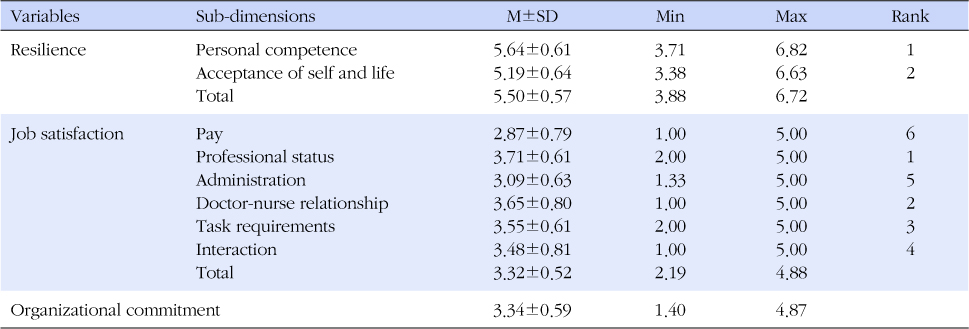
    The mean organizational commitment of Korean-American registered nurses was 3.34±0.59 out of a possible 5.00. The resilience and job satisfaction were significant variables predicting the level of organizational commitment among Korean-American registered nurses, accounting for 50% of the variability.
  • Conclusion
    The results of the study indicate that it is necessary to identify factors influencing job satisfaction and develop programs to strengthen personal resilience in order to increase organizational commitment.
  • 1. Ablett JR, Jones RS. Resilience and well-being in palliative care staff: A qualitative study of hospice nurses' experience of work. Psychooncology. 2007;16:733-740. http://dx.doi.org/10.1002/pon.1130
  • 2. Aiken LH, Clarke SP, Sloane DM, Sochalski J, Silber JH. Hospital nurse staffing and patient mortality,nurse burnout, and job dissatisfaction. JAMA. 2002;288:1987-1993. http://dx.doi.org/10.1001/jama.288.16.1987
  • 3. Bae SH. Organizational socialization of international nurses in the New York metropolitan area. Int Nurs Rev. 2011;59:81-87. http://dx.doi.org/10.1111/j.1466-7657.2011.00928.x
  • 4. Beechinor LAV, Fitzpatrick JJ. Demands of immigration among nurses from Canada and Philippines. Int J Nurs Pract. 2008;14:178-187. http://dx.doi.org/10.1111/j.1440-172X.2008.00680.x
  • 5. Berg JA, Rodriguez D, Kading V, De Guzman C. Demographic survey of Filipino-American nurses. Nurs Adm Q. 2004;28(3):199-206.
  • 6. Cheng CY, Liou SR. Intention to leave of Asian nurses in US hospitals: Does cultural orientation matter? J Clin Nurs. 2011;20:2033-2042. http://dx.doi.org/10.1111/j.1365-2702.2010.03594.x
  • 7. Gillespie BM, Chaboyer W, Wallis M. The influence of personal characteristics on the resilience of operating room nurses: A predictor study. Int J Nurs Stud. 2009;46:968-979. http://dx.doi.org/10.1016/j.ijnurstu.2007.08.006
  • 8. Hayne AN, Gerhardt C, Davis J. Filipino nurses in the United States: Recruitment, retention, occupational stress, and job satisfaction. J Transcult Nurs. 2009;20:313-322. http://dx.doi.org/10.1177/1043659609334927
  • 9. Health Resources and Services Administration (HRSA). The registered nurse population: Findings from the 2008 national sample survey of registered nurses. 2010;Retrieved February 15, 2012. from http://bhpr.hrsa.gov/healthworkforce/rnsurvey2008.html
  • 10. Jung KI, Oh CS. Clinical nurses's organizational commitment and influencing factors. Korean J Health Serv Manage. 2011;5(1):101-110.
  • 11. Kim BN, Oh HS, Park YS. A study of nurses' resilience, occupational stress and satisfaction. Korean J Occup Health Nurs. 2011;20(1):14-23.
  • 12. Kim KJ. An empirical study on the turnover decision process model. Seoul, Korea: Korea University; 1986. Unpublished master's thesis.
  • 13. Kingma M. Nurses on the move: Migration and the global health care economy. New York: Cornell University Press; 2006.
  • 14. Korean Employment Information Service Worknet. JOBMAP. Job prospects in Korea. 2013;Retrieved January 20, 2013. from http://www.work.go.kr/consltJobCarpa/srch/jobDic/jobDicDtlInfo.do?pageType=jobDicSrchByKeyWord&job Code=2430&jobSeq=3
  • 15. Lee H, Hwang S, Kim J, Daly B. Predictors of life satisfaction of Korean nurses. J Adv Nurs. 2004;48:632-641. http://dx.doi.org/10.1111/j.1365-2648.2004.03251.x
  • 16. Lee JH, Jin SJ, Ju HJ. Impact of the organizational commitment and organizational culture of nursing and turnover intention on the job satisfaction of public hospital nurses. Health Soc Sci. 2011;30:205-230.
  • 17. Lee JY, Cho SJ, Min HY. The influence of the resilience on the organizational commitment of kindergarten and childcare teachers: Social support as a mediating variable. J Korean Home Manage Assoc. 2012;30(3):59-67.
  • 18. Lee SL. A study on the relationship between personality traits and job satisfaction in hospital nurses. Seoul, Korea: Korea University; 1986. Unpublished master's thesis.
  • 19. Liou SR. An analysis of the concept of organizational commitment. Nurs Forum. 2008;43:116-125. http://dx.doi.org/10.1111/j.1744-6198.2008.00103.x
  • 20. Lu H, While AE, Barriball KL. A model of job satisfaction of nurses: A reflection of nurses' working lives in Mainland China. J Adv Nurs. 2007;58:468-479. http://dx.doi.org/10.1111/j.1365-2648.2007.04233.x
  • 21. Matos P, Neushotz LA, Quinn Griffin MT, Fitzpatick JJ. An exploratory study of resilience and job satisfaction among psychiatric nurses working in inpatient units. Int J Ment Health Nurs. 2010;19:307-312. http://dx.doi.org/10.1111/j.1447-0349.2010.00690.x
  • 22. Mowday RT, Steers RM, Porter LW. The measurement of organizational commitment. J Vocat Behav. 1979;14:79-94.
  • 23. Park GJ, Kim YN. Factors influencing organizational commitment among hospital nurses. J Korean Acad Nurs Adm. 2010;16(3):250-258. http://dx.doi.org/10.11111/jkana.2013.19.2.196
  • 24. Porter LW, Steers RM, Mowday RT, Boulian PV. Organizational commitment, job satisfaction and turnover among psychiatric technicians. J Appl Psychol. 1974;59:603-609.
  • 25. Riner ME. The global nursing workforce. In: Roux G, Halstead JA, editors. Issues and trends in nursing: Essential knowledge for today and tomorrow. Sundbury, MA: Jones and Bartlett; 2009.
  • 26. Seo KS. Clinical work experiences of Korean nurses in U. S. hospitals. Seoul, Korea: Ewha Womans University; 2013. Unpublished doctoral dissertation.
  • 27. Seo K, Kim M, Lee G, Park J, Yoon J. The impact of acculturation and social support on mental health among Korean-American registered nurses. Korean J Adult Nurs. 2013;25:157-169. http://dx.doi.org/10.7475/kjan.2013.25.2.157
  • 28. Song YS. Determinants of resilience of the physical disabled at home. Busan, Korea: Kosin University; 2004. Unpublished master's thesis.
  • 29. Stamps PL, Piedmont EB, Slavitt DB, Haase AM. Measurement of work satisfaction among health professionals. Med Care. 1978;16(4):337-352.
  • 30. Wagnild GM, Young HM. Development and psychometric evaluation of the Resilience Scale. J Nurs Meas. 1993;1(2):165-178.
  • 31. Xu Y. Strangers in strange lands: A metasynthesis of lived experiences immigrant Asian nurses working in western countries. ANS Adv Nurs Sci. 2007;30:246-265. http://dx.doi.org/10.1097/01.ANS.0000286623.84763.e0
  • 32. Yi M, Jezewski MA. Korean nurses' adjustment to hospitals in the United States of America. J Adv Nurs. 2000;32:721-729. http://dx.doi.org/10.1046/j.1365-2648.2000.01533.x
  • 33. Youssef CM, Luthans F. Positive organizational behavior in the workforce: The impact of hope, optimism, and resilience. J Manage. 2007;33:774-800. http://dx.doi.org/10.1177/0149206307305562
  • 34. Zizzo KA, Xu Y. Post-hire transitional programs for international nurses: A systematic review. J Contin Educ Nurs. 2009;40(2):57-64.
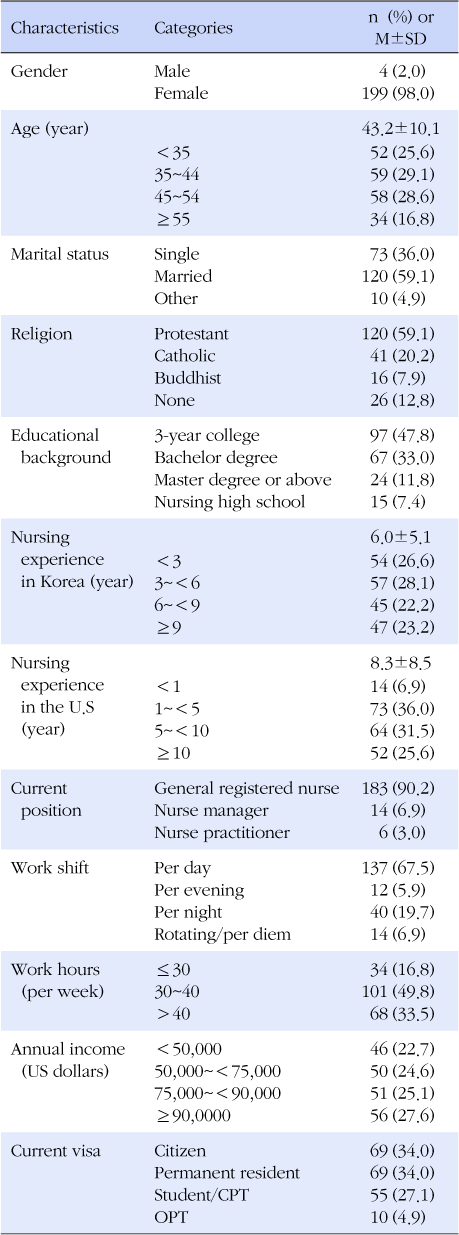
Table 1
General Characteristics of Participants (N=203)
jkana-20-48-i001.jpg

CPT=Curricular practical training; OPT=Optional practical training.

Table 2
Resilience, Job Satisfaction, and Organizational Commitment (N=203)
jkana-20-48-i002.jpg
Table 3
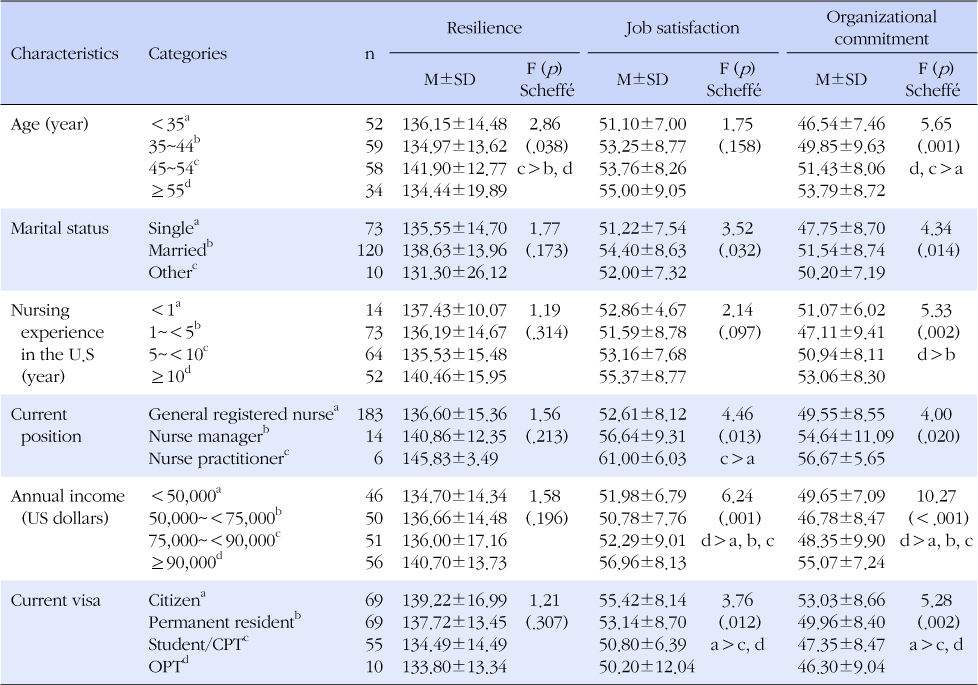
Resilience, Job Satisfaction, and Organizational Commitment according to Characteristics of Participants (N=203)
jkana-20-48-i003.jpg

CPT=Curricular practical training; OPT=Optional practical training.

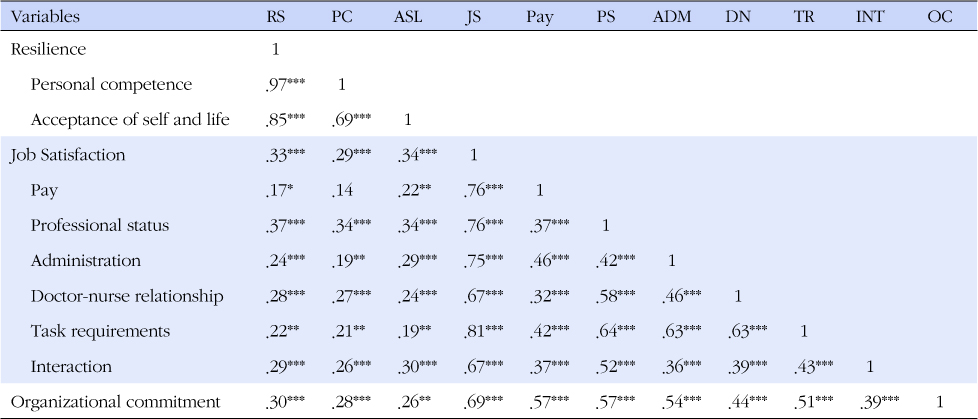
Table 4
Correlation Resilience, Job Satisfaction and Organizational Commitment (N=203)
jkana-20-48-i004.jpg

RS=Resilience; PC=Personal competence; ASL=Acceptance of self and life; JS=Job satisfaction; PS=Professional status; ADM=Administration; DN=Doctor-nurse relationship; TR=Task requirements; INT=Interaction; OC=Organizational commitment.

*p<.05; **p<.01; ***p<.001

Table 5
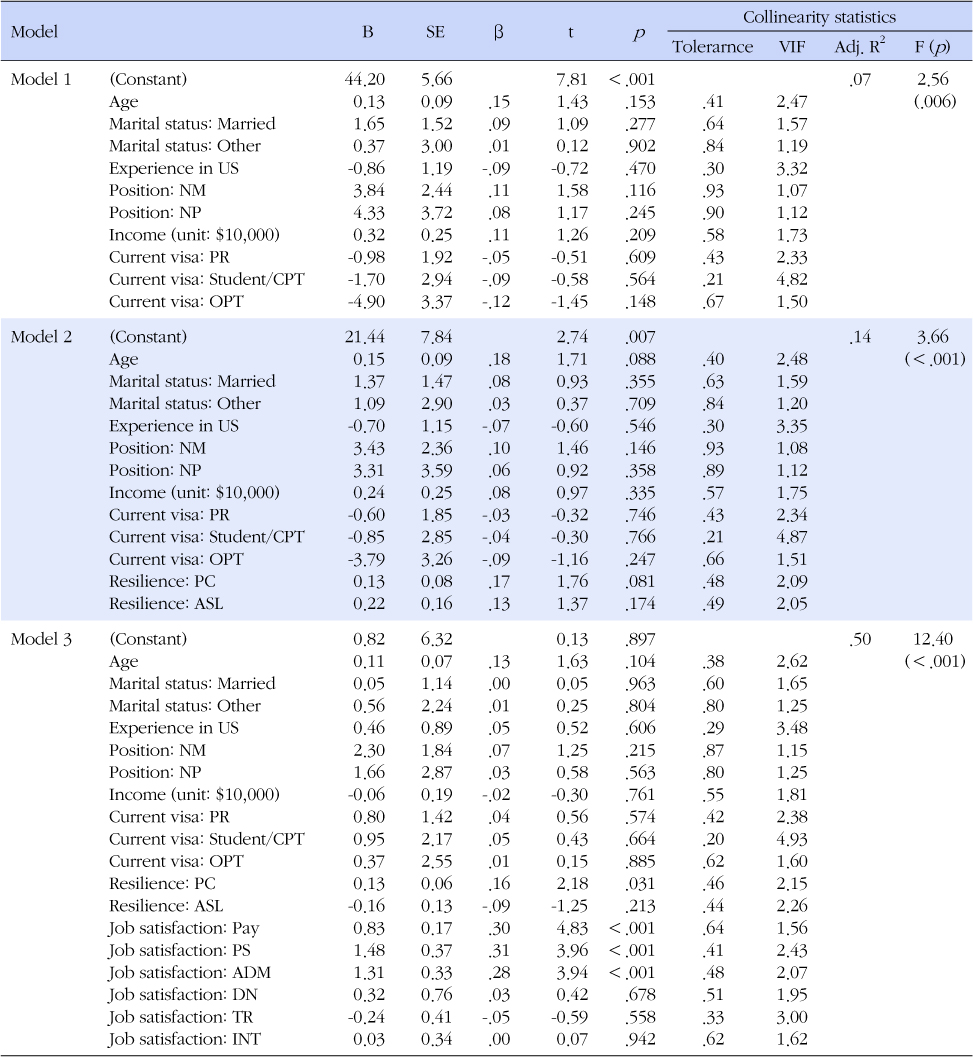
Effects of Resilience and Job Satisfaction on Organizational Commitment (N=203)
jkana-20-48-i005.jpg

NM=Nurse manager; NP=Nurse practitioner; PR=Permanent resident; CPT=Curricular practical training; OPT=Optional practical training; PC=Personal competence; ASL=Acceptance of self and life; PS=Professional status; ADM=Administration; DN=Doctor-nurse relationship; TR=Task requirements; INT=Interaction.

Figure & Data

References

    Citations

    Citations to this article as recorded by  
    • Organizational Commitment of Korean American Nurses: A Cross-Sectional Study
      Myunghee Jun, Hye-Kyung Kim, Sungsu Kim, Michael Wreen, Yeon Hee Kim, Christine Vandenhouten, Soo Il Shin
      Western Journal of Nursing Research.2025; 47(5): 338.     CrossRef
    • Success doesn’t come to you, you go to it: the role of self-perceived employability among engineering graduates
      Arun Aggarwal, Amit Mittal, Ishani Sharma, Pawan Kumar Chand, Amruta Deshpande
      Industrial and Commercial Training.2025; 57(4): 361.     CrossRef
    • Resilient Coping Levels and Psychometric Properties of the Brief Resilient Coping Scale Among Nursing Professionals in Saudi Arabia
      Abdulrhman Albougami
      Healthcare.2024; 12(21): 2181.     CrossRef
    • The relationship of stress, self-efficacy and sociodemographic factors among physicians during the COVID-19 pandemic
      Burcu Beyazgül, Çiğdem Cindoğlu, İbrahim Koruk
      Journal of Surgery and Medicine.2023; 7(6): 369.     CrossRef
    • The job demands-resource model and performance: the mediating role of employee engagement
      Da Ye Lee, Yunseong Jo
      Frontiers in Psychology.2023;[Epub]     CrossRef
    • A Nuanced Analysis of Salesperson Grit: Exploring Perseverance, Consistency, and Mind-set
      Matthew M. Lastner, Michael C. Peasley, Mark J. Pelletier
      Journal of Business-to-Business Marketing.2022; 29(3-4): 271.     CrossRef
    • Hemşirelerin Psikolojik Dayanıklılığının Merhamet Yorgunluğu, Tükenmişlik ve Merhamet Memnuniyetini Yordayıcı Rolü
      Bahar SEVİN, Neslihan GÜNÜŞEN
      Dokuz Eylül Üniversitesi Hemşirelik Fakültesi Elektronik Dergisi.2021; 14(4): 379.     CrossRef
    • Factors Influencing Organizational Commitment of Nurses in Korean Red Cross Blood Center: Focusing on Positive Psychological Capital, Communication Ability, and Social Support
      Sun Young Park, Jae Soon Yoo
      Journal of Korean Academy of Community Health Nursing.2020; 31(2): 179.     CrossRef
    • The Impact of Organizational Commitment and Nursing Organizational Culture on Job Satisfaction in Korean American Registered Nurses
      Young Im Kim, Hyo Geun Geun, SookJa Choi, Young Sil Lee
      Journal of Transcultural Nursing.2017; 28(6): 590.     CrossRef
    • A Study on the Influencing Factors of Forest Trail Guide's Organizational Commitment: Focused on the Job Motivation
      Siyeon Ha
      Journal of Korean Forest Society.2016; 105(04): 496.     CrossRef
    • Influence of Head Nurses' Ethical Leadership on Job Satisfaction among Staff Nurses: Mediating Effect of Affective Commitment
      Min Jung
      Journal of Korean Academy of Nursing Administration.2016; 22(5): 553.     CrossRef
    • A Study on the Influencing Factors of Forest Interpreter's Organizational Commitment: Focused on the Job Motivation
      Ji Won Son, Si Yeon Ha, Il Sun Choi
      Journal of Korean Forest Society.2014; 103(4): 655.     CrossRef

    Download Citation

    Download a citation file in RIS format that can be imported by all major citation management software, including EndNote, ProCite, RefWorks, and Reference Manager.

    Format:

    Include:

    Effects of Resilience and Job Satisfaction on Organizational Commitment in Korean-American Registered Nurses
    J Korean Acad Nurs Adm. 2014;20(1):48-58.   Published online January 31, 2014
    Download Citation
    Download a citation file in RIS format that can be imported by all major citation management software, including EndNote, ProCite, RefWorks, and Reference Manager.

    Format:
    • RIS — For EndNote, ProCite, RefWorks, and most other reference management software
    • BibTeX — For JabRef, BibDesk, and other BibTeX-specific software
    Include:
    • Citation for the content below
    Effects of Resilience and Job Satisfaction on Organizational Commitment in Korean-American Registered Nurses
    J Korean Acad Nurs Adm. 2014;20(1):48-58.   Published online January 31, 2014
    Close
    Effects of Resilience and Job Satisfaction on Organizational Commitment in Korean-American Registered Nurses
    Effects of Resilience and Job Satisfaction on Organizational Commitment in Korean-American Registered Nurses

    General Characteristics of Participants (N=203)

    CPT=Curricular practical training; OPT=Optional practical training.

    Resilience, Job Satisfaction, and Organizational Commitment (N=203)

    Resilience, Job Satisfaction, and Organizational Commitment according to Characteristics of Participants (N=203)

    CPT=Curricular practical training; OPT=Optional practical training.

    Correlation Resilience, Job Satisfaction and Organizational Commitment (N=203)

    RS=Resilience; PC=Personal competence; ASL=Acceptance of self and life; JS=Job satisfaction; PS=Professional status; ADM=Administration; DN=Doctor-nurse relationship; TR=Task requirements; INT=Interaction; OC=Organizational commitment.

    *p<.05; **p<.01; ***p<.001

    Effects of Resilience and Job Satisfaction on Organizational Commitment (N=203)

    NM=Nurse manager; NP=Nurse practitioner; PR=Permanent resident; CPT=Curricular practical training; OPT=Optional practical training; PC=Personal competence; ASL=Acceptance of self and life; PS=Professional status; ADM=Administration; DN=Doctor-nurse relationship; TR=Task requirements; INT=Interaction.

    Table 1 General Characteristics of Participants (N=203)

    CPT=Curricular practical training; OPT=Optional practical training.

    Table 2 Resilience, Job Satisfaction, and Organizational Commitment (N=203)

    Table 3 Resilience, Job Satisfaction, and Organizational Commitment according to Characteristics of Participants (N=203)

    CPT=Curricular practical training; OPT=Optional practical training.

    Table 4 Correlation Resilience, Job Satisfaction and Organizational Commitment (N=203)

    RS=Resilience; PC=Personal competence; ASL=Acceptance of self and life; JS=Job satisfaction; PS=Professional status; ADM=Administration; DN=Doctor-nurse relationship; TR=Task requirements; INT=Interaction; OC=Organizational commitment.

    *p<.05; **p<.01; ***p<.001

    Table 5 Effects of Resilience and Job Satisfaction on Organizational Commitment (N=203)

    NM=Nurse manager; NP=Nurse practitioner; PR=Permanent resident; CPT=Curricular practical training; OPT=Optional practical training; PC=Personal competence; ASL=Acceptance of self and life; PS=Professional status; ADM=Administration; DN=Doctor-nurse relationship; TR=Task requirements; INT=Interaction.

    TOP