
• KANAD
  • Contact us
  • E-Submission
ABOUT
BROWSE ARTICLES
EDITORIAL POLICY
FOR CONTRIBUTORS

Page Path

131
results for

"Organization"

Filter

Article category

Keywords

Publication year

Authors

Funded articles

"Organization"

Original Articles
Factors Influencing Nursing Care Left Undone by Cancer Ward Nurses
Chung Hee Woo, Yeon Joo Kim
J Korean Acad Nurs Adm 2025;31(5):594-603.   Published online December 31, 2025
DOI: https://doi.org/10.11111/jkana.2025.0047
Purpose
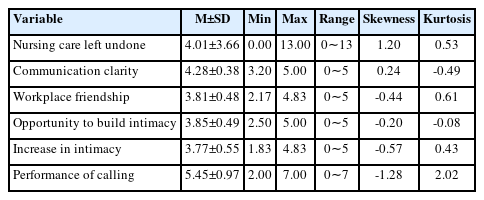
This study aimed to investigate the effects of communication clarity, workplace friendship, and performance of calling on nursing care left undone among oncology nurses. Methods: Data were collected from 159 oncology nurses with more than one year of experience working in cancer wards between September 11 and September 30, 2024. Statistical analyses included descriptive statistics, the independent t-test, one-way analysis of variance, the Scheff茅 post hoc test, Pearson鈥檚 correlation coefficients, and hierarchical multiple regression analysis, all conducted using IBM SPSS Statistics version 29.0. Results: Communication clarity, workplace friendship, and performance of calling were significantly correlated with nursing care left undone. Hierarchical multiple regression analysis identified communication clarity (尾=-.37, p<.001) and being aged 30鈥39 years (尾=-.24, p<.001) as the main factors influencing nursing care left undone, collectively explaining 37% of the total variance. Conclusion: Communication clarity was the most influential factor affecting nursing care left undone in cancer wards. To reduce the incidence of nursing care left undone and ensure high-quality nursing services in oncology units, strategies aimed at enhancing communication clarity are essential. Institutions should consider implementing simulation-based training or ongoing education tailored to their organizational context. Further research is warranted to examine the effects of communication clarity on nursing care left undone.
  • 147 View
  • 11 Download
The Effects of Nurses鈥 Dispatch Work Characteristics on Job Embeddedness, Organizational Commitment, and Turnover Intention
Eejee Jung, Gunjeong Lee
J Korean Acad Nurs Adm 2025;31(5):560-571.   Published online December 31, 2025
DOI: https://doi.org/10.11111/jkana.2025.0033
Purpose
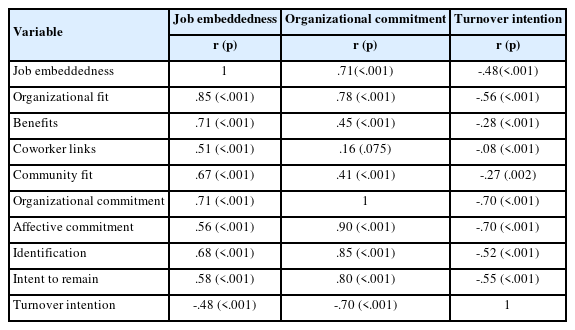
This study examined the effects of dispatch work experience on job embeddedness, organizational commitment, and turnover intention among nurses. Methods: A cross-sectional survey was conducted among 130 nurses working at a tertiary hospital in Seoul. Data were analyzed using IBM SPSS version 28.0 with descriptive statistics, the independent t-test, one-way analysis of variance, Pearson correlation coefficients, and multiple linear regression. Results: Overall, 62.3% of participants reported improved competency following dispatch work experience, whereas 80.7% perceived pre-training as insufficient. Nurses with prior interaction with dispatch unit staff demonstrated significantly higher job embeddedness (F=10.37, p=.002) and organizational commitment (F=5.87, p=.017), along with significantly lower turnover intention (F=4.98, p=.027). Multiple regression analysis showed that job embeddedness was positively associated with prior interaction with dispatch unit staff (尾=.170, p=.031) and perceiving dispatch operations as appropriate (尾=.297, p<.001). Organizational commitment was significantly influenced by the perception of dispatch operations as appropriate (尾=.209, p=.013). No dispatch-related factors were significantly associated with turnover intention. Conclusion: Positive perceptions of dispatch work and prior interaction with dispatch unit staff contribute to job embeddedness and organizational commitment. Improvements such as enhanced pre-interaction opportunities, practice-based training, and consideration of dispatch preferences are needed to optimize dispatch work experiences.
  • 196 View
  • 15 Download
Effects of Self-leadership on Job Performance Competency and Organizational Commitment of Insurance Review Nurses: A Nationwide Survey
Ju Eun Oh, Seok Hee Jeong, Young Hee Mun, Hee Sun Kim
J Korean Acad Nurs Adm 2025;31(5):537-548.   Published online December 31, 2025
DOI: https://doi.org/10.11111/jkana.2025.0028
Purpose
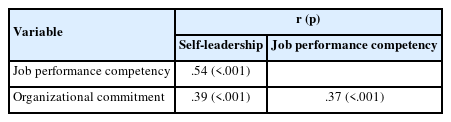
This study aimed to determine the effects of self-leadership on job performance competency and organizational commitment among insurance review nurses. Methods: A nationwide online survey was conducted using structured questionnaires. Participants included 189 insurance review nurses working in advanced general hospitals and general hospitals in South Korea. Data were collected through self-administered questionnaires between August 19 and September 17, 2021. Data analysis was performed using descriptive statistics, independent t-tests, one-way analysis of variance, Pearson鈥檚 correlation coefficients, and hierarchical multiple regression with IBM SPSS version 23.0. Results: The mean score for self-leadership was 3.64卤0.43 out of 5, for job performance competency was 3.10卤0.68 out of 5, and for organizational commitment was 4.38卤1.09 out of 7. Statistically significant positive correlations were observed among self-leadership, job performance competency, and organizational commitment in insurance review nurses. Hierarchical multiple regression analysis showed that self-leadership explained an additional 13.9 percentage points of variance in job performance competency and an additional 5.3 percentage points in organizational commitment. Self-leadership emerged as a statistically significant predictor of both job performance competency and organizational commitment. Conclusion: This study empirically demonstrates that self-leadership has significant effects on job performance competency and organizational commitment among insurance review nurses. These findings provide empirical evidence relevant to human resource management strategies for insurance review nurses.
  • 209 View
  • 13 Download
Purpose
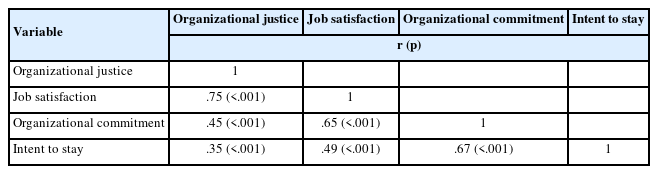
This study investigated the influence of organizational justice on junior nursing officers鈥 intent to stay in their positions and explored the mediating roles of job satisfaction and organizational commitment. Methods: A descriptive correlational design was employed, and data were analyzed using SPSS 29.0 software. Statistical analyses included descriptive statistics, the t-test, one-way analysis of variance, Pearson鈥檚 correlation coefficients, and multiple linear regression. The mediating effects of job satisfaction and organizational commitment were evaluated following Baron and Kenny鈥檚 three-step mediation procedure, and significance was confirmed through the bootstrapping method. Results: Organizational justice, job satisfaction, organizational commitment, and intent to stay were all significantly positively correlated. The mediating effects of job satisfaction and organizational commitment on the relationship between organizational justice and intent to stay were confirmed. Conclusion: Based on the findings of this study, job satisfaction and organizational commitment were found to fully mediate the relationship between organizational justice and intent to stay. Therefore, to enhance the intent to stay among junior nursing officers, it is considered necessary to develop supportive measures and establish systems within the military and nursing corps that strengthen organizational justice for junior nursing officers.
  • 159 View
  • 7 Download
Non-Value-Added Activities and Non-Nursing Tasks Affecting Nursing Task Efficiency: A Scoping Review
Mi Ha Chung, Yongah Kim, Na Yeong Kim, Min Ju Kim, Hyeon Jin Kim, Ju Hee Park, Ji In Park, Su Yeon Bae, Heajin Bae, Eunjeong Lee, Min Young Jeon, Suyoung Choi
J Korean Acad Nurs Adm 2025;31(4):405-420.   Published online September 30, 2025
DOI: https://doi.org/10.11111/jkana.2025.0006
Purpose
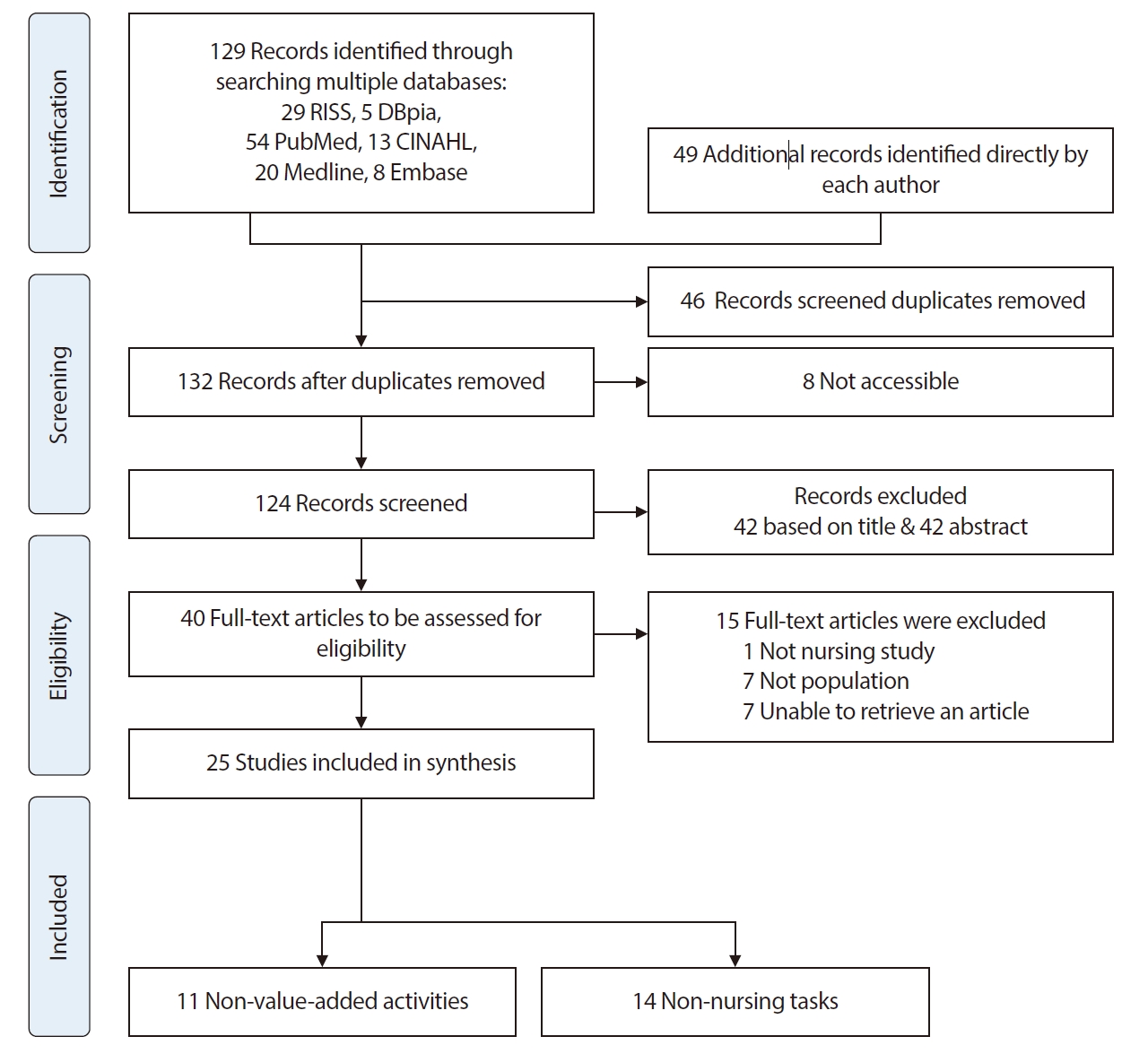
This study explored the literature on non-value-added (NVA) activities and non-nursing tasks (NNT). We analyzed domestic and international research trends and examined the types and characteristics of nursing tasks to improve efficiency. Methods: A comprehensive literature search was conducted using RISS, DBpia, PubMed, CINAHL, Medline, and Embase. Relevant studies published up to 2024 were identified using keywords such as 鈥渘on-value-added activity,鈥 鈥渘on-value-added nursing activity,鈥 鈥渘on-nursing tasks,鈥 and 鈥渘ursing.鈥 Results: Analysis of 25 studies revealed that 11 studies focused on NVA activity and 14 on NNT. Direct nursing tasks were classified into eight categories; indirect tasks were classified into seven categories. NVA activities were grouped into five main categories: 鈥減ersonal,鈥 鈥渨aste,鈥 鈥渄ocumentation,鈥 鈥渘ecessary activities,鈥 and 鈥渦nit-related,鈥 with overlapping subcategories such as 鈥渋nterruption鈥 and 鈥渄uplicating.鈥 Similarly, NNT were categorized into eight types, including 鈥渁dmission,鈥 鈥渆quipment,鈥 and 鈥渁dministrative activities.鈥 Although conceptually distinct, NVA activities and NNT often overlap. Reducing tasks unrelated to essential nursing care significantly improves job satisfaction, patient outcomes, and work efficiency. These findings provide valuable insights for optimizing nursing workflows and enhancing the quality of care. Conclusion: Identifying and reducing NVA activities and NNT enhance nursing efficiency and provide foundational data for improving clinical practice and patient safety.
  • 1,597 View
  • 65 Download
Purpose
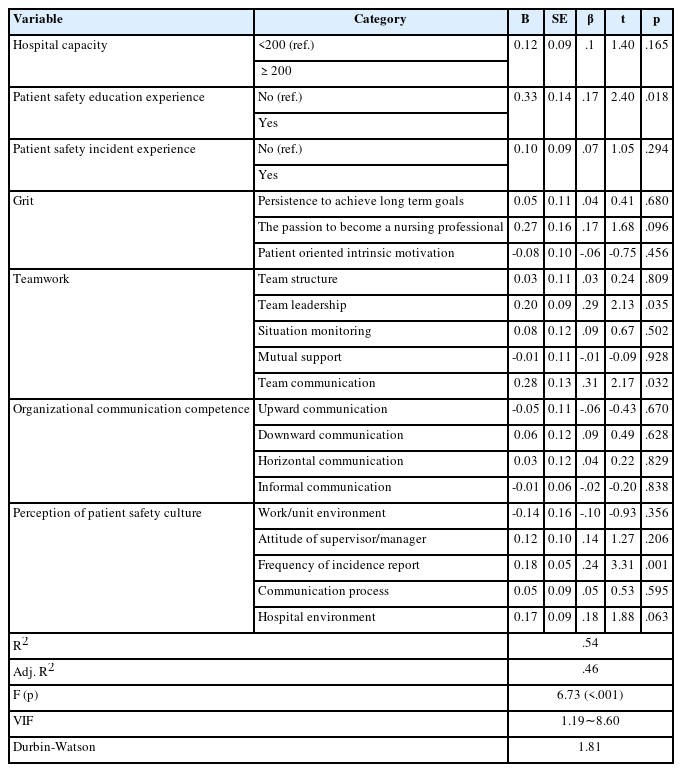
This study examined factors influencing patient safety nursing activities in integrated nursing care units. Methods: A survey was conducted with 134 nurses from hospitals (100~300 beds) in Busan using self-administered questionnaires (August 17鈥揝eptember 15, 2024). Data were analyzed using descriptive statistics, Pearson correlation, and multiple regression analysis. Results: The mean score for patient safety nursing activities was 4.31卤0.55. Positive correlations were found with grit, teamwork, communication, and patient safety culture awareness. The predictor variables explained 46.0% of the variance in patient safety nursing activities. Significant factors included communication (尾=.31, p=.032) and leadership (尾=.29, p=.035) within teamwork, incident reporting frequency (尾=.24, p<.001) within patient safety culture awareness, and experience in patient safety education (尾=.17, p=.018). Conclusion: The findings of this study highlight the importance of enhancing teamwork, particularly in leadership and communication, and creating a safety culture that promotes incident reporting and education to strengthen patient safety nursing practices. Improving patient safety training, developing systematic evaluation and feedback mechanisms, and establishing structured support systems through campaigns and workshops will boost staff involvement and elevate the quality of patient safety practices.
  • 2,323 View
  • 189 Download
Purpose
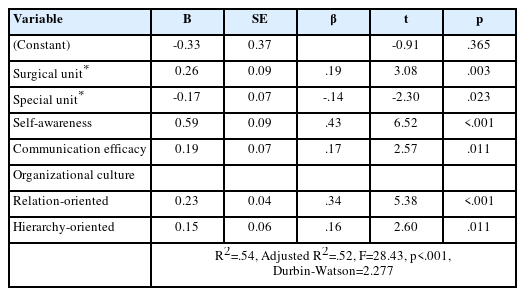
This study aimed to identify factors influencing communication competence among hospital nurses. Methods: The participants were 136 nurses working at five general or tertiary hospitals with over 100 beds in Busan, Ulsan, and Geoje Island. Data were collected using structured self-report online questionnaires from July 18 to August 31, 2023. The data were analyzed using descriptive statistics, the t-test, one-way analysis of variance, the Scheff茅 test, Pearson's correlation coefficients, and stepwise regression analysis using IBM SPSS version 25.0. Results: Self-awareness (尾=.43, p<.001), a relationship-oriented organizational culture (尾=.34, p<.001), working in a surgical ward (尾=.19, p=.003), communication efficacy (尾=.17, p=.011), hierarchy-oriented organizational culture (尾=.16, p=.011), and working in a special unit (尾=-.14, p=.023) were factors that significantly influenced nurses' communication competence. The model explained 52% of the variance in communication competence (F=28.43, p<.001) Conclusion: To improve communication competence in hospital nurses, healthcare institutions should provide learning opportunities to improve nurses鈥 self-awareness and communication efficacy. It is also essential to establish rules and order within a hierarchy-oriented organizational culture, while simultaneously promoting a relationship-oriented organizational culture based on trust and respect among colleagues.
  • 2,290 View
  • 168 Download
The Impact of Clinical Competence and Perception of Clinical Ladder System on Organizational Commitment among Nurses at a General Tertiary Hospital
Yeon Hee Shin, Mi Ra Lee, Sung Nam Kim, Min Jung Kim, Ae Jin Kim, Hyun Ja Kim, Ji Yoon Kang
J Korean Acad Nurs Adm 2025;31(1):120-131.   Published online January 31, 2025
DOI: https://doi.org/10.11111/jkana.2025.31.1.120
Purpose
This study aimed to evaluate the performance of a clinical ladder system in a tertiary hospital by examining how nurses' clinical competence and perceptions of the system affect organizational commitment.
Methods
The study involved 394 nurses working at a tertiary hospital. Data were collected from May 3 to July 10, 2023, using a self-reported questionnaire. Statistical analyses, including descriptive statistics, independent t-tests, one-way ANOVA, Kruskal-Wallis test, Scheff茅 post-hoc test, Pearson correlation, and hierarchical regression analysis, were performed using SPSS 27.0.
Results
Nurses who applied for promotion to the CN III level and current CN III nurses reported higher clinical competence, perceptions of the clinical ladder system, and organizational commitment than those who did not and those at lower levels (p<.001). A positive correlation existed among all independent variables. Controlling for general characteristics, the effects of clinical competence and perceptions of the clinical ladder system explained 49% of organizational commitment variance (Adjusted R 2 =.49, F=33.43, p<.001).
Conclusion
Greater clinical competence and positive perceptions of the clinical ladder system are likely to enhance organizational commitment, emphasizing its effectiveness in fostering better organizational outcomes.

Citations

Citations to this article as recorded by  
  • Effects of social support on organizational commitment among experienced nurses experiencing department rotation: the mediating effect of organizational socialization
    Young Jun Jang, Jeong A Jeong, Yu Seung Ban, Seon Hwa Park, Eun Jee Lee
    Journal of Korean Academy of Nursing.2025; 55(3): 364.     CrossRef
  • Validation of the Nursing Competency Scale for Intensive Care Unit Nurses and Prediction of Nursing Competency Using the Clinical Ladder
    Jin Hee Kim, Jaehee Jeon, Eun Hee Choi
    Journal of Korean Critical Care Nursing.2025; 18(3): 78.     CrossRef
  • 1,084 View
  • 65 Download
  • 2 Crossref
Purpose
This study aims to identify the moderating effect of nursing organizational culture on the relationship between resilience and clinical competence among new graduate nurses.
Methods
A survey was conducted from March 14 to July 14, 2023, targeting 210 new nurses with 3 to 12 months of experience, working in three general hospitals in Seoul and Gyeonggi-do. Data from 193 respondents were analyzed using descriptive statistics, correlation, and hierarchical regression.
Results
The resilience of new graduate nurses was moderate and their clinical competence was rated as good. They perceived a strong hierarchy-oriented culture, followed by a relationship-oriented culture, an innovation-oriented culture, and lastly, a task-oriented culture. Clinical competence was higher with greater resilience (尾=.40, p<.001) and stronger perception of hierarchy-oriented culture (尾=.16, p=.013). The interaction between resilience and innovation-oriented culture (尾=.22, p=.012) was statistically significant, indicating that the effect of resilience on clinical competence was significantly higher when the innovation-oriented culture was strongly perceived.
Conclusion
To improve the clinical competence of new graduate nurses, it is essential to enhance their personal resilience and, at an organizational level, to strengthen the positive aspects of hierarchy-oriented and innovation-oriented cultures.

Citations

Citations to this article as recorded by  
  • Resilience and Social Support Protect Nurses from Anxiety and Depressive Symptoms: Evidence from a Cross-Sectional Study in the Post-COVID-19 Era
    Aglaia Katsiroumpa, Ioannis Moisoglou, Ioanna V. Papathanasiou, Maria Malliarou, Pavlos Sarafis, Parisis Gallos, Olympia Konstantakopoulou, Fotios Rizos, Petros Galanis
    Healthcare.2025; 13(6): 582.     CrossRef
  • 2,256 View
  • 120 Download
  • 1 Crossref
Purpose
This study aimed to explore the mediating role of organizational silence in the effect of leader-member exchange on patient safety culture among perioperative nurses.
Methods
This descriptive study surveyed 201 perioperative nurses from five university hospitals. Data were collected via online questionnaires from November 8, 2022, to February 6, 2023, measuring demographics, work-related factors, leader-member exchange, organizational silence, and patient safety culture. The Data were analyzed using SPSS 26.0 and PROCESS Macro model 4.
Results
Leader-member exchange showed a significant direct effect on patient safety culture (尾=.44, p<.001). The indirect effect of leader-member exchange on patient safety culture through acquiescent silence was also significant (尾=.05, 95% CI: 0.02 to 0.13). The total effect of leader-member exchange on patient safety culture (尾=.52, p<.001) was larger than its direct effect, indicating that acquiescent silence partially mediated the relationship between leader-member exchange and patient safety culture.
Conclusion
To improve perioperative nurses perception of patient safety culture, healthcare organizations should enhance leader-member exchange by promoting strong emotional connections and open communication between nurse managers and staff nurses. Additionally, encouraging autonomous decision-making and reducing acquiescent silence are essential to facilitate the active expression of patient safety concerns.
  • 1,228 View
  • 60 Download
Purpose
This study examined the relationships between organizational silence, organizational commitment, organizational justice, and organizational citizenship behavior among clinical nurses. Additionally, it determined the mediating effect of organizational commitment moderated by organizational justice on the relationship between organizational silence and organizational citizenship behavior among clinical nurses.
Methods
A total of 160 clinical nurses were recruited from a university hospital. Data were collected from June to July, 2023. The collected data were analyzed using descriptive statistics, independent t-test, one-way ANOVA, Scheff茅 test, Pearson鈥檚 correlation coefficient, Baron and Kenny鈥檚 three-step regression analysis, Hayes鈥 PROCESS macro model, and bootstrapping using SPSS/WIN 27.0 program.
Results
Organizational commitment had a full mediating effect on the relationship between organizational silence and organizational citizenship behavior (B=-0.04, CI [-0.098~-0.001]). Among the subscales of organizational justice, distributive justice had a moderating effect on the relationship between organizational silence and organizational commitment (B=-0.17, p=.009). There was no significant mediating effect of organizational commitment moderated by organizational justice on the relationship between organizational silence and organizational citizenship behavior.
Conclusion
Appropriate strategies are needed to effectively manage nursing personnel and improve nursing performance.

Citations

Citations to this article as recorded by  
  • Exploring the Influence of ESG Activities on Organizational Citizenship Behavior in IT Manufacturing Companies: Mediating Effects of Organizational Commitment and Identification
    Soo-Cheol Jeong, Dong-Seop Chung
    Sustainability.2025; 17(18): 8441.     CrossRef
  • Effects of Person-Environment Fit, Career Commitment, and Organizational Silence on Turnover Intention among Shift-Working Nurses
    Gyeong-Hee Bae, Ji-Won Kim
    The Korean Journal of Health Service Management.2025; 19(3): 43.     CrossRef
  • 1,046 View
  • 51 Download
  • 2 Crossref
Purpose
This study identified the influence of self-leadership, managers鈥 authentic leadership, and nurses鈥 organizational culture relationships on hospital nurses鈥榦rganizational silence.
Methods
An explanatory sequential mixed-method study was conducted. For the quantitative portion, 138 nurses from seven hospitals participated. For the qualitative portion, ten nurses with high organizational silence scores were interviewed. Quantitative data were analyzed with SPSS/WIN 26.0. Qualitative data were analyzed by content analysis using NVivo 12.0.
Results
Quantitative results indicated that self-expectations and a relation-oriented culture explained 14.0% of the variance in acquiescent silence. The combined effect of rehearsal, constructive thought, and relational transparency associated with managers鈥 authentic leadership on prosocial silence was 15.0%. Qualitative results revealed eight primary themes related to organizational silence: 1) being unable to voice my opinion because I feel insignificant, 2) things that middle managers cannot say, 3) earnest managers, 4) receptive managers, 5) indifferent managers, 6) feeling of camaraderie, 7) selective silence based on performance, and 8) mandatory following of directives.
Conclusion
Programs to improve managers鈥 leadership skills and reduce hospital nurses鈥 organizational silence should be implemented consistently. Hospitals should strive to foster a positive and equitable organizational culture.
  • 765 View
  • 70 Download
Purpose
This study aimed to identify the factors influencing nurses鈥 perceptions of the disclosure of patient safety incidents in tertiary hospitals.
Methods
As a descriptive study, data were collected from 315 nurses working in two tertiary hospitals in Busan via structured self-report questionnaires from June 28 to September 3, 2023, through an online survey. Data were analyzed using descriptive statistics, t-test, one-way ANOVA, Pearson鈥檚 correlation coefficients, and hierarchical regression analysis with SPSS/WIN 27.0.
Results
Analysis was conducted by controlling for the characteristics of the study participants, which revealed significant differences in their perceptions of the disclosure of patient safety incidents. Ethical nursing competence (尾=.30, p<.001) and patient safety culture (尾=.15, p=.012) were significant influencing factors on the perception of such disclosure, and the explanatory power of the regression model was 21.0% (F=14.63, p<.001).
Conclusion
To enhance the aforementioned perception among nurses in tertiary hospitals, healthcare institutions should provide learning opportunities to improve their ethical nursing competence. Fostering an organizational culture that promotes and encourages open disclosure of patient safety incidents is also essential.

Citations

Citations to this article as recorded by  
  • Impact of Nursing Professionalism, Ethical Sensitivity, and the Clinical Learning Environment on Nursing Students' Intention to Report Near Misses and Adverse Events
    Sookhee Yoon, Ha-Young Park
    Journal of Korean Academy of Fundamentals of Nursing.2025; 32(2): 209.     CrossRef
  • Factors Influencing End-of-life Care Competency in Nursing Students
    Jinryung Park, Minjeong Seo
    Korean Journal of Medical Ethics.2024; 27(4): 267.     CrossRef
  • 3,772 View
  • 111 Download
  • 2 Crossref
Purpose
This study aimed to identify the mediating effects of positive psychological capital on the relationship between occupational stress and organizational commitment in physician assistant nurses.
Methods
The participants were 152 physician assistant nurses recruited from two university hospitals. Data was collected through a survey. The SPSS/WIN program (version 25.0) was used for the data analysis. Data was analyzed using descriptive stastics, t-test, ANOVA, Pearson鈥檚 correlation analysis, and hierarchical regression.
Results
There was a significant negative correlation organizational commitment and occupational stress (r=-.57, p<.001), and a positive correlation with positive psychological capital (r=.47, p<.001). There was a negative correlation (r=-.32, p<.001) between occupational stress and positive psychological capital. In addition, positive psychological capital had a partial mediating effect on the relationship between occupational stress and organizational commitment (尾=.32, p<.001).
Conclusion
Positive psychological capital serves as a partial mediator in the relationship between occupational stress and organizational commitment among physician assistant nurses. The results of this study can be used reduce occupational stress and improve organizational commitment by improving the positive psychological capital of physician-assistant nurses.

Citations

Citations to this article as recorded by  
  • Role Transformation and Adaptation of Physician Assistants during the 2024 Medical Workforce Shortage: A Phenomenological Study
    Tae Yeong Yang, Nahyun Lee
    Journal of Korean Academy of Nursing Administration.2025; 31(3): 259.     CrossRef
  • The Influence of Clinical Practice Nurses' Self-Leadership, Role Conflict, and Practice Environment on Patient Safety Competency
    Jeong Hwa Heo, Ji Hyun Sung
    Journal of Korean Academy of Nursing Administration.2025; 31(4): 458.     CrossRef
  • The Influences of Positive Psychological Capital and Nursing Work Environment on Job Embeddedness among Advanced Beginner Nurses
    Eunhye Gil, Mi-Ae You, Ji Yea Lee, Sunjoo Boo
    Journal of Korean Academy of Nursing Administration.2025; 31(5): 549.     CrossRef
  • 3,040 View
  • 121 Download
  • 3 Crossref
Purpose
This study aimed to identify the effects of professional self-concept and nursing organizational culture on the intention of retention of older nurses over 40 years old by examining the relationships between such variables.
Methods
Middle-aged nurses who were currently involved in direct patient care and had at least one year of clinical experience were recruited from general hospitals. The questionnaires were administered to 137 middle-aged nurses in September 2022.
Results
The mean age of participants were 44.7卤3.5 years, and more than 90% were married female nurses. The professional self-concept (尾=.34, p<.001), work-life balance (尾=.24, p=.007), satisfaction of work environment (尾=.19, p=.024) significantly predicted the nurses鈥 intention of retention at work.
Conclusions
Based on these findings, nursing interventions enhancing professional self-concept are needed to increase middle-aged nurses鈥 intention of retention. The introduction of flexible work hour systems that improve nurses' satisfaction of working environments is also essential to increase the intention of retention in middle-aged nurses.
  • 1,284 View
  • 58 Download
Purpose
This study used a structural model to identify organizational characteristics, such as work environment, nursing organizational culture, and manager leadership of general hospital nurses, and to examine the effect of organizational characteristics on turnover intention through organizational silence.
Methods
Data were collected from July 1, 2017 to August 30, 2017, using structured questionnaires. Participants were nurses in general hospitals with more than 250 beds and less than 500 beds in Busan City and Gyeongsangnam Province. The collected data were analyzed using IBM SPSS 23.0 and AMOS 23.0.
Results
The nursing work environment, external employment opportunities, relationship-oriented culture, and acquiescent and defensive silence directly impacted turnover intention. Additionally, the nursing work environment and external employment opportunities indirectly affected turnover intention through acquiescent silence.
Conclusion
To lower general hospital nurses鈥 turnover intention, the external environment should be reviewed and continuously compared to provide a better internal nursing work environment. In addition, it is necessary to find a way to lower the acquiescent silence, which can negatively affect the organization, by creating a relationship-oriented culture that emphasizes the relationship between members.
  • 1,429 View
  • 57 Download
Influences of Organizational Culture, Nursing Workplace Spirituality, and Nurses鈥 Perceived Health Status on Quality of Nursing Work Life according to Nursing Clinical Ladder
Hyun Sook Lee, Ju Hyun Jin, Ju Ri Lee, Hye Jin Kim, Yeon Jae Jung
J Korean Acad Nurs Adm 2024;30(1):31-41.   Published online January 31, 2024
DOI: https://doi.org/10.11111/jkana.2024.30.1.31
Purpose
This study aimed to examine the influence of nursing organizational culture, nursing workplace spirituality, and nurses鈥 perceived health status on quality of nursing work life according to nursing clinical ladder at a tertiary hospital.
Methods
Participants were nurses working at a tertiary hospital in D city, and a total of 352 participants were recruited according to four stages of clinical experience: novice stage (below 1 year), advanced beginner stage (2~3 years), competent stage (4~6 years), and proficiency stage (above 7 years). Data were collected from February 7-February 16, and analyzed using descriptive statistics, one-way ANOVA, Scheffe test, and Multiple regression.
Results
There was statistically significant correlation between innovation-oriented nursing organizational culture, nursing workplace spirituality, nurses鈥 perceived health status and quality of nursing work life. In all clinical ladder stages, nursing work spirituality and nurses鈥 perceived health status were factors influencing the quality of nursing work life; innovation-oriented nursing organizational culture was an influencing factor in the novice, advanced beginner, and competent stage, but not the proficient stage.
Conclusion
To improve the quality of nursing work life, it is necessary to develop and apply practical programs that reflect nurses鈥 characteristics at each clinical ladder stage.

Citations

Citations to this article as recorded by  
  • Factors influencing quality of life among married nurses with children in Korea: a cross-sectional survey
    Yun Mi Kim
    Women's Health Nursing.2025; 31(3): 279.     CrossRef
  • Cluster of Speaking鈥怳p Behavior in Clinical Nurses and Its Association With Nursing Organizational Culture, Teamwork, and Working Condition: A Cross鈥怱ectional Study
    Eunhee Lee, Hyunjeong Kwon, Miyuki Takase
    Journal of Nursing Management.2024;[Epub]     CrossRef
  • 1,200 View
  • 37 Download
  • 2 Crossref
Purpose
Turnover rates among nurses in South Korea are higher than those of other job groups, affecting hospital performance. This study clarified the mediating role of perceived organizational and supervisor support in the relationship between nurses鈥 organizational citizenship behavior and turnover intention.
Methods
This study involved a descriptive survey of 160 nurses working in two hospitals in S, South Korea. Data were analyzed using the Hayes PROCESS macro (Model 4) program, version 3.4.
Results
Organizational citizenship behavior was positively correlated with perceived organizational support and perceived supervisor support but negatively correlated with turnover intention. Perceived organizational support was positively correlated with perceived supervisor support. Additionally, perceived organizational and supervisor support were negatively correlated with turnover intention. The authors verified the mediating role of perceived organizational support in the relationship between organizational citizenship behavior and turnover intention. However, the mediating role of perceived supervisor support was not confirmed.
Conclusion
The higher a nurse鈥檚 organizational citizenship behavior, the higher their perceived organizational support, which reduces turnover intention. High-quality nursing contributes to organizational performance; therefore, the nursing workforce should be carefully preserved.

Citations

Citations to this article as recorded by  
  • Measured nursing perception of the working environment through authentic leadership with technology support and OCB among Chinese public hospitals
    Abid Hussain, Wang Ruowei, Xu Xia, Shahida Kanwel, Shen Chunhong, Arif Jameel
    BMC Nursing.2025;[Epub]     CrossRef
  • Perceived Organisational Support as a Mediator Between Green Organisational Culture and Organisational Commitment: Evidence From Manufacturing Firms in Peru
    Cristian Villar, Ruben Guevara
    Sage Open.2025;[Epub]     CrossRef
  • Nurse Engagement in Professional and Organisational Citizenship Over the Past Decade: An Integrative Review
    Adrianna Watson, Carmel Bond, Rebecca Jarden, Debra Jackson
    Journal of Advanced Nursing.2025;[Epub]     CrossRef
  • 5,105 View
  • 141 Download
  • 3 Crossref
Purpose
This study examined hospital nurses鈥 perception of work-life balance, nursing work environment, nursing organizational culture, and job satisfaction before turnover, and compared differences in variables between current clinical nurses and non-clinical nurses.
Methods
This descriptive study involved 172 nurses with over six months experience, who changed jobs within the last 5 years in G Province. Data were collected from September 5th-22nd, 2022, and analyzed through independent t-test, one-way ANOVA, and Pearson correlation coefficient using SPSS/WIN 25.0 program.
Results
Total work-life balance (t=3.85, p<.001), work-family balance (t=4.79, p<.001), work-leisure balance (t=2.96, p=.004), work-growth balance (t=3.01, p=.003), and overall work-life balance (t=2.95, p=.004) in work-life balance, the role of professionalism (r=2.05, p=.042) and interpersonal relationships (t=2.59, p=.011) in job satisfaction, the relationship-oriented nursing organizational culture (t=2.68, p=.008), and the nurse-doctor relationship within the nursing work environment (t=2.51, p=.013) were all significantly higher among current clinical nurses than non-clinical nurses.
Conclusion
Hospital-level interventions should be established and implemented to improve work-life balance, the relationship-oriented nursing organizational culture, and job satisfaction through interprofessional relationships to retain hospital nurses.

Citations

Citations to this article as recorded by  
  • The Effects of Nurses鈥 Dispatch Work Characteristics on Job Embeddedness, Organizational Commitment, and Turnover Intention
    Eejee Jung, Gunjeong Lee
    Journal of Korean Academy of Nursing Administration.2025; 31(5): 560.     CrossRef
  • 1,610 View
  • 77 Download
  • 1 Crossref
Purpose
This study aimed to identify the impact of nursing organizational culture and nursing practice environment on generational conflict in organization among hospital nurses. Methods: This study utilized a cross-sectional design. The participants consisted of 214 nurses working at two tertiary general hospitals, which were located in B city. Data were collected from January 15 to January 31, 2022, using self-report questionnaires. Data were analyzed by descriptive statistics, one-way ANOVA, independent t-test, Pearson's correlation coefficient and multiple regression analysis using IBM/SPSS 28.0 for Windows. Results: The mean generational conflict in organization was 2.60卤0.74 points on a 5-point scale. Multiple regression indicated that the factors influencing generational conflict in organization included relation-oriented nursing organizational culture (尾=-.29, p<.001), hierarch-oriented nursing organizational culture (尾=-.29, p<.001), hierarch-oriented nursing organizational culture (尾=.17, p=.006) and clinical career, and these variables explained 23.0% of generational conflict in organization. Conclusion: The findings of this study suggest that it is necessary to improve relation-oriented nursing organizational culture and avoid hierarch-oriented nursing organizational culture to decrease generational conflict in organization.

Citations

Citations to this article as recorded by  
  • Influence of Self-awareness, Communication Efficacy, Empathy, and Nursing Organizational Culture on Communication Competence among Hospital Nurses
    Sunhee Jung, Sunyoung Jung
    Journal of Korean Academy of Nursing Administration.2025; 31(3): 280.     CrossRef
  • Effects of Organizational Cynicism and Socialization on Nurses鈥 Job Burnout: A Career鈥怱tage鈥怋ased Analysis
    Hee Jin Kim, Hae Jeong An, Soo-hyun Nam, Jungmin Lee, Maria Engstr枚m
    Journal of Nursing Management.2025;[Epub]     CrossRef
  • Determinants of Standard Precautions Performance Among Nursing Students in South Korea: A Cross-Sectional Study
    Se Gyeong Jeon, Eun Jung Kim
    Healthcare.2025; 13(21): 2803.     CrossRef
  • The Effects of Emotional Intelligence and the Practice Environment on the Job-Esteem of Physician Assistant Nurses in University Hospitals
    Yoonjung Cho, Yeoungsuk Song
    Journal of Korean Academy of Fundamentals of Nursing.2025; 32(4): 488.     CrossRef
  • The Effect of Work Value, Psychological Ownership and Nursing Working Environment on Intention of Retention in Hospital Nurses
    Ji Hey Kim, Yoon Ju Cho, So Eun Jang
    Journal of Korean Critical Care Nursing.2023; 16(3): 62.     CrossRef
  • Effects of Nursing Competence on Job Satisfaction across Career Stages
    Eun Young Oh, Mi Won Kim, Heon Ju Yoo, Seung Hee Choi, Sa Rang Lee, Chung Sook Kim
    Journal of Korean Academy of Nursing Administration.2023; 29(3): 258.     CrossRef
  • Workplace bullying among Korean registered nurses: A meta-aggregation of qualitative studies
    Eun-Jun Park, Hyunwook Kang, Ji Woon Ko
    The Journal of Korean Academic Society of Nursing Education.2023; 29(4): 450.     CrossRef
  • 2,781 View
  • 142 Download
  • 7 Crossref
Effects of Organizational Silence and Organizational Justice on Bullying among Hospital Nurses at Work
Mi-Aei Lee, Bi-Joo Kim
J Korean Acad Nurs Adm 2023;29(1):1-11.   Published online January 31, 2023
DOI: https://doi.org/10.11111/jkana.2023.29.1.1
Purpose
This study aimed to investigate the effects of organizational silence and organizational justice on bullying among hospital nurses in their workplace. Methods: This study was a cross-sectional survey conducted on 235 full-time nurses in Korea. Data were collected online using Google Docs from 14 June to 9 July 2021. Results: Nurses who were male, below 30 years of age, unmarried, had less than five years of clinical experience, had worked in special departments, and had no prior experience with workplace bullying were more vulnerable to workplace bullying than nurses with other characteristics. Workplace bullying of hospital nurses was positively correlated with their acquiescent silence and defensive silence, and negatively correlated with their procedural justice and interactional justice. Factors influencing workplace bullying of hospital nurses were defensive silence, bullying experience (have), distributive justice, acquiescent silence, gender (male), and marital status (single). These six variables explained 55% of workplace bullying in hospital nurses. Conclusion: Based on the results of this study, it could be concluded that nursing managers should keep organizational silence low, organizational justice high, and pay more attention to nurses who are vulnerable to bullying in their workplace.

Citations

Citations to this article as recorded by  
  • The Impact of Nursing Organizational Culture and Workplace Bullying on Nursing Performance
    Naeyoung LEE
    THE JOURNAL OF FISHERIES AND MARINE SCIENCES EDUCATION.2025; 37(5): 1272.     CrossRef
  • Development of the Hospital Nurses鈥 Silence Behavior Scale
    Soojin Chung, Jee-In Hwang
    Journal of Korean Academy of Nursing.2024; 54(2): 279.     CrossRef
  • Effect of Leader-Member Exchange on Patient Safety Culture in Perioperative Nurses: The Mediating Role of Organizational Silence
    Nayeop Lee, Yoonju Lee
    Journal of Korean Academy of Nursing Administration.2024; 30(5): 462.     CrossRef
  • Influence of Clinical Nurses鈥 Organizational Silence on Organizational Citizenship Behavior: Mediating Effect of Organizational Commitment Moderated by Organizational Justice
    Shin Ae Hwang, Haeyoung Min
    Journal of Korean Academy of Nursing Administration.2024; 30(4): 416.     CrossRef
  • Relationship between Ethical Climate, Workplace Bullying, and Turnover Intention of Hospital Nurses in Korea
    Mi-Aie Lee, Hyun Ju Park, Bonghwa Kim
    Journal of Korean Academy of Nursing Administration.2023; 29(4): 457.     CrossRef
  • 1,894 View
  • 51 Download
  • 5 Crossref
Purpose
The purpose of this study is to confirm the mediating effect of group efficacy in the relationship between transformational leadership and servant leadership of nursing managers recognized by new nurses and organizational socialization of new nurses. Methods: Survey data from 121 new nurses were analyzed. The independent variables were transformational and servant leaderships, the dependent variable was the organizational socialization, and the mediating variable was the collective efficacy. The mediating effect of group efficacy in the relationship between transformational leadership, servant leadership, and organizational socialization was analyzed by hierarchical multiple regression analysis. Furthermore, the Sobel test was conducted to verify the effectiveness of the pathway. Results: In the relationship between transformational leadership, servant leadership, and organizational socialization, the collective efficacy showed partial mediating effect. Conclusion: To promote organizational socialization of new nurses, it is necessary to organize a nursing delivery system or induce an organizational atmosphere that allows the employees to perform together effectively. It is believed that managers and nurses should work co-operatively and create a model system that helps them achieve their common goals that correspond with the aims, values, and beliefs of the organization.
  • 2,649 View
  • 241 Download
Purpose
This study aimed to investigate the influence of role conflict, head nurses鈥 super leadership and nursing organizational culture on organizational commitment among male nurses. Methods: This cross-sectional study included 221 male nurses who had worked for more than six months in university hospitals, general hospitals, and clinics. Data were collected using structured, self-administered questionnaires on role conflict, head nurse super leadership, nursing organizational culture, and organizational commitment. The data obtained were analyzed using descriptive analysis, independent t-test, analysis of variance, Scheff茅 test, Pearson鈥檚 correlation coefficients, and regression analysis. Results: Organizational commitment had a significant positive correlation with head nurse super leadership, innovation-oriented culture, and relation-oriented culture; however, it had a significant negative correlation with role conflict and task-oriented culture. Among the general characteristics, the significant factors influencing organizational commitment among male nurses were number of beds and departments. Furthermore, among the main variables, innovation-oriented culture, task-oriented culture, role conflict, and head nurse super leadership influenced organizational commitment. Conclusion: To increase male nurses鈥 organizational commitment, it is necessary to create an innovative organizational culture, reduce role conflicts, and improve head nurse super leadership.

Citations

Citations to this article as recorded by  
  • Organizational Culture and Resulting Leadership Behaviors: Empirical Evidence from Social Workers in Kuwait
    Hamad Adel Alaslawi
    Human Service Organizations: Management, Leadership & Governance.2024; 48(5): 582.     CrossRef
  • 鈥淚鈥檇 Rather Do It Single-Handed鈥濃擭ursing Students鈥 Struggles with Group Assignments: A Qualitative Study
    Aimei Mao, Pak-Leng Cheong, Iat-Kio Van, Hon-Lon Tam
    Education Sciences.2023; 13(10): 1053.     CrossRef
  • 2,257 View
  • 51 Download
  • 2 Crossref
Effect of Authentic Leadership to Organizational Citizenship Behavior of Nurses Mediated by Team Trust
Eungju Kim, Eungyung Kim
J Korean Acad Nurs Adm 2022;28(4):451-459.   Published online September 30, 2022
DOI: https://doi.org/10.11111/jkana.2022.28.4.451
Purpose
This study aimed to identify the mediating effects of team trust on the relationship between the authentic leadership of the nursing unit manager as perceived by the nurses and the nurses鈥 organizational citizenship behavior (OCB). Methods: Data were collected from 276 nurses working over six months at a university hospital. The research model was designed based on the PROCESS Macro model 4 and analyzed using the SPSS 26.0 program. Results: The results show that authentic leadership and team trust had strong correlations with nurses鈥 organizational citizenship behavior. Nursing unit managers鈥 authentic leadership had a direct effect on team trust and organizational citizenship behavior. Team trust had a direct effect on organizational citizenship behavior. There was a mediation effect of team trust between authentic leadership and the organizational citizenship behavior of nurses. Conclusion: To increase team trust in nursing units, the institution should provide systematic support such as education and training program to enhance the authentic leadership of nursing unit managers.

Citations

Citations to this article as recorded by  
  • Factors Influencing Burnout of Nurses in Comprehensive Nursing Care Service Wards: Focusing on Positive Psychological Capital, Role Conflict, and Authentic Leadership
    Jung Wha Park, Kyoung Ja Kim, Ji Young Im, Ji Young Kim
    Journal of Korean Academy of Nursing Administration.2025; 31(4): 345.     CrossRef
  • Influence of Self-leadership, Managers鈥 Authentic Leadership, and Nurses' Organizational Culture Relationships on Hospital Nurses鈥 Organizational Silence: A Mixed Method Study
    Hyun-Ju Lee, So-Young Kang
    Journal of Korean Academy of Nursing Administration.2024; 30(4): 404.     CrossRef
  • 1,447 View
  • 67 Download
  • 2 Crossref
Structural Equation Modeling on Workplace Incivility of Nurses: Evolution to Bullying
Seo In Kim, Soukyoung Kim
J Korean Acad Nurs Adm 2022;28(4):406-416.   Published online September 30, 2022
DOI: https://doi.org/10.11111/jkana.2022.28.4.406
Purpose
The purpose of this study was to construct and test a hypothetical model based on the Incivility Spiral model for identifying the factors of workplace incivility of nurses and determining if incivility evolve to bullying. Methods: The data were collected from nurses working at 9 hospitals in Seoul, Gyeonggi, Daejeon, Changwon, and Busan province from July 1 to August 15, 2019, using structured questionnaires. Finally, the data from 274 nurses were analyzed. Results: The goodness-of-fit of the hypothetical model was at a good level and 10 out of 13 hypotheses were supported. The workplace incivility was both directly and indirectly affected by anger tendency, leadership of head nurses, and communication competence and directly affected by civility culture. Each of the variables affecting workplace incivility was also found to be a significant factor indirectly affecting workplace bullying and workplace incivility was a factor directly affected on workplace bullying. The variables in this study accounted for 57% of workplace incivility and 65% of workplace bullying. Conclusion: In order to prevent workplace bullying, it is important to initially manage workplace incivility, and for this, clear standards and policies for workplace incivility should be prepared and utilized.
  • 630 View
  • 22 Download
The Effects of Positive Psychological Capital and Organizational Justice on Job Embeddedness of Clinical Nurses
Youn Shin Lee, Heeyoung Kim
J Korean Acad Nurs Adm 2022;28(3):228-237.   Published online June 30, 2022
DOI: https://doi.org/10.11111/jkana.2022.28.3.228
Purpose
This study aimed to investigate factors affecting the job embeddedness of clinical nurses. Methods: Participants were 204 nurses working in four general hospitals. Data were collected from September 3 to October 8, 2020 and analyzed using the SPSS/WIN 25.0 program. Results: The mean scores for positive psychological capital, organizational justice, and job embeddedness were 3.31卤0.38, 3.16卤0.46, and 3.17卤0.38, respectively. The job embeddedness of the participants had a positive correlation with optimism (r=.57, p<.001), hope (r=.56, p<.001), self-efficacy (r=.44, p<.001), and resilience (r=.38, p<.001) in the sub-factors of positive psychological capital. It also had a positive correlation with procedural (r=.58, p<.001), distributive (r=.52, p<.001), and interactional (r=.35, p<.001) justice in the sub-factors of organizational justice. The factors affecting nurses鈥 job embeddness were procedural justice, optimism, position, distributive justice, and hope. In addition, the explanatory power of the model was 60% (F=39.11, p<.001). Conclusion: The results suggest that to improve the job embeddedness, positive psychology-based coaching and counseling programs suitable for individual clinical nurses, organizational management through transparent procedures and objective and systematic distribution are needed. In addition, a position system suitable for the characteristics of a nursing organization is required.

Citations

Citations to this article as recorded by  
  • Factors Influencing Clinical Nurses鈥 Perception of Structural and Content Career Plateau
    Ji Hye Kim, Ji Yun Lee
    Journal of Korean Academy of Nursing.2024; 54(4): 534.     CrossRef
  • Factors Influencing Job Embeddedness in Emergency Room Nurses: Focus on Positive Psychological Capital, Gratitude, and Anger Expression
    Sa Rang Joo, Mi-Jung Kang
    Journal of Korean Academy of psychiatric and Mental Health Nursing.2024; 33(4): 383.     CrossRef
  • The impact of perceived organizational justice on young nurses鈥 job performance: a chain mediating role of organizational climate and job embeddedness
    Jiamei Song, Xindi Shi, Xiaojia Zheng, Guangli Lu, Chaoran Chen
    BMC Nursing.2024;[Epub]     CrossRef
  • 871 View
  • 30 Download
  • 3 Crossref
Purpose
The purpose of this study was to identify the influence of emotional labor and work-life balance on the organizational commitment of nurses in comprehensive nursing care service wards. Methods: A cross-sectional descriptive study was designed. Data collection was conducted for a total of 171 nurses in comprehensive nursing care service wards in two H university hospitals in Gyeonggi-do. Data were collected from March 5 to 30, 2021 using questionnaires on topics including emotional labor, work-life balance, organizational commitment, and general characteristics. Data were analyzed using descriptive statistics, independent t-test, One-way ANOVA, Pearson鈥檚 correlation analysis, and hierarchical regression analysis. Results: Organizational commitment was influenced by working experience in current unit, future work plan, emotional modulation efforts in profession, patient-focused emotional suppression, and work-life balance. Conclusion: The findings of this study suggest that in order to increase organizational commitment, it is important to support organizational efforts and systems such as an emotional management program that can strengthen the positive aspects of emotional labor, and leisure activities and childcare support programs that can improve work-life balance.

Citations

Citations to this article as recorded by  
  • The Effects of Nurses鈥 Dispatch Work Characteristics on Job Embeddedness, Organizational Commitment, and Turnover Intention
    Eejee Jung, Gunjeong Lee
    Journal of Korean Academy of Nursing Administration.2025; 31(5): 560.     CrossRef
  • Impact of Emotional Labor and Positive Psychological Capital on the Turnover Intention of Nurses Caring for Patients with COVID-19: A Descriptive Survey Study
    Mira Kwon, Yeoungsuk Song, Majd T. Mrayyan
    Journal of Nursing Management.2024; 2024: 1.     CrossRef
  • 721 View
  • 27 Download
  • 2 Crossref
Purpose
This study was conducted to identify the effects of nursing work environment, job crafting and organizational commitment on nurses鈥 job satisfaction perceived by nurses Methods: The research model was designed based on Hayes鈥檚 PROCESS macro model 6. Participants were 122 nurses from general hospitals. A survey was conducted and data were collected in March 2019. Data were analyzed using descriptive statistics, correlations and Hayes's PROCESS macro method for mediation. Results: Job satisfaction showed a significant positive correlation with the nursing work environment, job crafting and organizational commitment. Furthermore, job crafting and organizational commitment had a mediating effect on the relationship between the nursing work environment and job satisfaction. Conclusion: The impact of the nursing work environment on job satisfaction among general hospital nurses was mediated by job crafting and organizational commitment. Considering the mediating effects of job crafting and organizational commitment on the relationship between nursing work environment and job satisfaction, a strategy should be developed for enhancing job crafting and organizational commitment to improve nurses鈥 working environments and, thus, their job satisfaction.

Citations

Citations to this article as recorded by  
  • Effect of a Nursing Practice Environment, Nursing Performance on Retention Intention: Focused on the Mediating Effects of Nursing Professional Pride
    Shin Hee Kim, Mi Sook Oh, Yun Bok Kwak
    Journal of Korean Academy of Nursing Administration.2025; 31(1): 64.     CrossRef
  • Impact of Resilience, Emotional Exhaustion, and Communication Competency on Organizational Commitment Among Nurses in a Tertiary Hospital Setting in South Korea: A Cross-Sectional Study
    Ho Young Kim, Hee Jeong Kim, Eun Ja Yeun
    Sage Open.2025;[Epub]     CrossRef
  • The impact of grit and job crafting on organizational commitment and job satisfaction among hospital nurses in Korea
    Mi-Suk Hyun
    Medicine.2025; 104(45): e45890.     CrossRef
  • Effects of Attitude Toward Interdepartmental Transfer, Career Growth Opportunity, and Role Breadth Self-Efficacy on Job Crafting among Nurses with Transfer Experience
    Yu Jin Lee, Chung Hee Woo
    Journal of Korean Academy of Fundamentals of Nursing.2025; 32(4): 497.     CrossRef
  • Hem艧ireler 陌莽in Ekip 陌艧 Beceriklili臒i 脰l莽e臒inin T眉rk莽eye Uyarlanmas谋
    Oya 脟elebi 脟ak谋ro臒lu, Gamze Tun莽er 脺nver, Naile Bodu莽
    Celal Bayar 脺niversitesi Sa臒l谋k Bilimleri Enstit眉s眉 Dergisi.2024; 11(2): 260.     CrossRef
  • Affecting factors of clinical dental hygienists鈥 intention on retention
    Hye-Jin Lee, Hee-Hong Min
    Journal of Korean Society of Dental Hygiene.2024; 24(1): 27.     CrossRef
  • Nurses Job Crafting
    Sabrein Mahmoud Ali Khalifa Khattab, Marwa Samir Sorour, Sally Mohammed Farghaly Abdelaliem
    JONA: The Journal of Nursing Administration.2023; 53(12): 641.     CrossRef
  • Effects of Clinical Nurses鈥 Job Crafting on Organizational Effectiveness Based on Job Demands-Resource Model
    Eun Young Lee, Eungyung Kim
    Journal of Korean Academy of Nursing.2023; 53(1): 129.     CrossRef
  • Effects of Job Crafting, Burnout, and Job Satisfaction on Nurses' Turnover Intention: A Path Analysis
    Mihee Chung, Sujeong Han
    Journal of Korean Academy of Fundamentals of Nursing.2023; 30(2): 281.     CrossRef
  • Concept Analysis of Nurses鈥 Job Crafting
    Sujeong Han, Eunha Jeong
    Journal of Korean Academy of Fundamentals of Nursing.2022; 29(3): 375.     CrossRef
  • Association of Job Crafting and Perception of Patient Safety Culture with Patient Safety Management Activities among Hospital Nurses
    Jung Sook Kim, Ji-Soo Kim
    Journal of Korean Academy of Nursing Administration.2022; 28(4): 382.     CrossRef
  • 991 View
  • 56 Download
  • 11 Crossref
Purpose
This study aimed to identify the effects of preceptors' teaching behavior, resilience, and organizational socialization on new graduate nurses' intention to stay. Methods: Data were collected from 167 new graduate nurses working at a university hospital for a period of three months to one year and analyzed using SPSS 24.0, PROCESS Macro ver. 3.5. Results: The results show that preceptors' teaching behavior, resilience, and organizational socialization had strong correlations with new graduate nurses' intention to stay. Preceptors' teaching behavior directly affected new graduate nurses' resilience and intention to stay. However, the results showed that preceptors' teaching behavior did not affect organizational socialization. Resilience directly affected organizational socialization and intention to stay, and had a simple mediation effect between preceptors' teaching behavior and intention to stay. Moreover, resilience and organizational socialization were found to be significant mediators between preceptors' teaching behavior and intention to stay. Conclusion: The results suggest that preceptors' teaching behavior is a key factor that strengthens new graduate nurses' intention to stay, as it promotes successful organizational socialization by improving their resilience and helping them overcome transition shock.

Citations

Citations to this article as recorded by  
  • Personal and Workplace Characteristics as Predictors of Intent鈥怲o鈥怱tay Among Registered Nurses: An Exploratory Quantitative Multicentre Study
    Ming Marcus Chua, Wei How Darryl Ang, An Ling Siew, Hui鈥怌hen Chen
    Journal of Advanced Nursing.2025; 81(6): 3045.     CrossRef
  • Factors influencing preceptor nurses' clinical teaching behavior: A cross-sectional study
    Kyeong Hye Kim, Sujin Shin
    Nurse Education Today.2025; 146: 106555.     CrossRef
  • The Effect of Newly Graduated Nurses' Perceived Nursing Practice Readiness, Resilience, and Preceptors' Teaching Behavior on Turnover Intention
    Jinhee Kim, Eunhee Lee
    Journal of Korean Academy of Nursing Administration.2025; 31(2): 167.     CrossRef
  • Factors Associated With Newly Graduated Nurses' Work Engagement: Systematic Review of Quantitative Studies
    Hanna Ojala, Heli鈥怣aria Kuivila, Kristina Mikkonen, Erika Jarva, Jonna Juntunen
    Journal of Advanced Nursing.2025;[Epub]     CrossRef
  • Exploring the Knowledge Structure of Research for Nurse Preceptor Training Programs Using Text Network Analysis and Topic Modeling
    Sun Hee Seon, Hye Won Jeong, Ja Yun Choi
    CIN: Computers, Informatics, Nursing.2025;[Epub]     CrossRef
  • Evaluating approaches to enhance transition and retention in newly qualified nurses: An updated rapid evidence assessment
    Mariarosaria Gammone, Michela Calzolari, Andrea Moro, Jane Wray, Roger Watson, Giuseppe Aleo, Gianluca Catania, Milko Zanini, Loredana Sasso, Annamaria Bagnasco
    Nurse Education in Practice.2025; 87: 104484.     CrossRef
  • Analysis of clinical nurse educators鈥 mentoring feedback on new nurse journals at a tertiary hospital in South Korea: utilizing text network analysis
    Shinhye Ahn, Hye Won Jeong
    BMC Nursing.2025;[Epub]     CrossRef
  • Evaluating Burnout and Resiliency in New Graduate Nurses
    Bryce Catarelli, Patrick Nobles, Michael Aull, Fan Yi
    JONA: The Journal of Nursing Administration.2023; 53(5): 259.     CrossRef
  • Effects of Preceptors鈥 Clinical Teaching Behavior on the Field Adaptation of New Graduate Nurses: Mediating Effects of Self-Leadership and Resilience
    Eunjung Kim, Eungyung Kim
    Journal of Korean Academy of Nursing Administration.2023; 29(5): 577.     CrossRef
  • Effects of Nursing Unit Managers鈥 Authentic Leadership, Transformational Leadership, and Transactional Leadership on Turnover Intention in Advanced Beginner Nurses: Mediation Effects of Positive Psychological Capital
    Eun Jeong Kim, Eungyung Kim, Son Ja Lee
    Journal of Korean Academy of Nursing Administration.2023; 29(4): 409.     CrossRef
  • Development and Preliminary Evaluation of the Effects of a Preceptor Reflective Practice Program: A Mixed-Method Research
    Heui-Seon Kim, Hye-Won Jeong, Deok Ju, Jung-A Lee, Shin-Hye Ahn
    International Journal of Environmental Research and Public Health.2022; 19(21): 13755.     CrossRef
  • 2,441 View
  • 87 Download
  • 11 Crossref
Factors Influencing Safety Nursing Activities of Nurses at a Nationally Designated Infectious Disease Hospital
Sung Ae Choi, Ju Young Park
J Korean Acad Nurs Adm 2022;28(1):20-30.   Published online January 31, 2022
DOI: https://doi.org/10.11111/jkana.2022.28.1.20
Purpose
This study investigated patient safety culture, safety knowledge, incident reporting attitude, and safety nursing activities, and determined the factors influencing nurses鈥 safety nursing activities at a nationally designated infectious disease hospital. Methods: A cross-sectional descriptive survey was conducted with 169 nurses. Data analysis, including descriptive statistics, independent t-tests, one-way ANOVA, Pearson鈥檚 correlations, and hierarchical multiple regression analysis, were performed using SPSS 26.0. Results: Factors influencing safety nursing activities included patient safety culture (尾=.26, t=2.39, p=.018), safety knowledge (尾=.25, t=2.67, p=.009), and mild severity (尾=.17, t=2.52, p=.013). These variables explained 31.0% of the safety nursing activities. Conclusion: Therefore, it is necessary to establish an organizational culture that emphasizes patient safety by establishing safety management regulations for quarantined patients and provision of education on patient safety for employees to empower them to respond to emerging infectious diseases. Additionally, it is essential to operate given the patient鈥檚 severity and to increase knowledge about patient safety through regular education based on quarantine facilities and environmental management regulations.

Citations

Citations to this article as recorded by  
  • Predictors of Nurses' Reporting Level by the Types of Patient Safety Incidents
    Ju-Hee Kang, Yeojin Yi
    Journal of Korean Academy of Nursing Administration.2025; 31(4): 434.     CrossRef
  • Exploring research trends in nursing organizational culture using topic modeling
    Eun-Jun Park, Chan Sook Park
    The Journal of Korean Academic Society of Nursing Education.2024; 30(4): 371.     CrossRef
  • Risk Factors for Falls or Fractures in Stroke Patients: An Analysis of 2020 Patient Sample Data
    Miso Lee, Mikyung Moon
    The Korean Journal of Rehabilitation Nursing.2024; 27(1): 58.     CrossRef
  • 787 View
  • 17 Download
  • 3 Crossref
Effects of Career Management and Organizational Justice on Job Rotation Attitude among Hospital Nurses
Eunkyung Kim, Taewha Lee
J Korean Acad Nurs Adm 2021;27(5):390-398.   Published online December 31, 2021
DOI: https://doi.org/10.11111/jkana.2021.27.5.390
Purpose
The purpose of this study was to identify the relationship between career management, organizational justice, and job rotation attitude among tertiary hospital nurses. Methods: A cross-sectional descriptive design was used. The participants were 195 nurses with more than one year of experience working at tertiary care hospitals. Data was collected with self-reported questionnaires from April to May 2018. Data was analyzed using SPSS Statistics version 25.0 for windows including descriptive statistics, bivariate analysis, and multiple regression analysis. Results: The mean score of career management of participants was 3.14卤0.49 (range 1~5), organizational justice was 2.95卤0.53 (range 1~5), and job rotation attitude was 4.02卤0.97 (range 1~7). There were significant positive correlations among the participants' career management, organizational justice, and job rotation attitude. 37% of job rotation attitude was explained by position, organizational justice, career management, and the frequency of job rotation experience in the regression model. Conclusion: This study provided the empirical evidence that it is necessary to improve the perception of organizational justice, and to establish a systematic job rotation in order for nurses to positively recognize job rotation.

Citations

Citations to this article as recorded by  
  • Effects of Attitude Toward Interdepartmental Transfer, Career Growth Opportunity, and Role Breadth Self-Efficacy on Job Crafting among Nurses with Transfer Experience
    Yu Jin Lee, Chung Hee Woo
    Journal of Korean Academy of Fundamentals of Nursing.2025; 32(4): 497.     CrossRef
  • 776 View
  • 25 Download
  • 1 Crossref
Purpose
This study aimed to assess the effect of a job crafting intervention program for hospital nurses to confirm the effect on the organizational commitment of clinical nurses, and their embeddedness and organizational well-being in the workplace. Methods: The study used a non-equivalent control group pre-test and post-test design, which included 68 nurses working at a general hospital. The job crafting intervention program was held for a total of 5 weeks from May 27 to June 27, 2019, and the program lasted for 2 weeks including 2 h each. The program effectiveness was assessed through a self-reporting survey of program participants 2 weeks prior to application, 2 weeks after application, and 6 weeks after application. Data were analyzed using the Kolmogorov-Smirnov test, chi-squared test, independent t-test, and repeated measures multivariate analysis of variance using the SPSS 26.0 for Windows. Results: Significant differences were observed between the experimental and control groups regarding job crafting (F=6.20, p=.003), task crafting (F=8.37, p<.001), cognitive crafting (F=6.29, p=.003), embeddedness (F=8.49, p<.001), and organizational well-being (F=4.90, p=.009). Conclusion: The job crafting intervention program can be actively utilized to induce efficient nursing staff management in hospitals, expanding it into hospital nurse's work area and developing nurse's job crafting further.

Citations

Citations to this article as recorded by  
  • On-the-job Embeddedness and Job Hopping: A Moderated Mediation Model of Organisational Citizenship Behaviour and Affective Commitment in the Service Sector of India
    Tanisha Samariya, Shabnam Saxena
    South Asian Journal of Human Resources Management.2025;[Epub]     CrossRef
  • Job crafting, positive psychological capital, and social support as predictors of job embeddedness on among clinical nurses- a structural model design
    Mi-Soon Yun, Miyoung Lee, Eun-Hi Choi
    BMC Nursing.2024;[Epub]     CrossRef
  • Effects of Clinical Nurses鈥 Job Crafting on Organizational Effectiveness Based on Job Demands-Resource Model
    Eun Young Lee, Eungyung Kim
    Journal of Korean Academy of Nursing.2023; 53(1): 129.     CrossRef
  • Concept Analysis of Nurses鈥 Job Crafting
    Sujeong Han, Eunha Jeong
    Journal of Korean Academy of Fundamentals of Nursing.2022; 29(3): 375.     CrossRef
  • 872 View
  • 50 Download
  • 4 Crossref
The Effect of the Nurses Practice Environment and Organizational Justice on Organizational Silence Perceived by Nurses
Sungjung Kwak, Sujeong Han
J Korean Acad Nurs Adm 2021;27(4):270-281.   Published online September 30, 2021
DOI: https://doi.org/10.11111/jkana.2021.27.4.270
Purpose
This study was done to identify the effect of the nurses practice environment and organizational justice on organizational silence in nurses. Methods: A descriptive correlational design was used. Participants were 162 nurses in general hospitals. Measurements included the Practice Environment Scale of the Nursing Work Index, the Organizational Justice Scale, and Organizational Silence Scale. Data were analyzed using SPSS/WIN program. Results: Nurses' organizational silence, nurses practice environment and organizational justice were correlated, and the influence of social networking, marital status, education level and interactive justice on acquiescence silence were 21% and statistically significant. The effect of work units, work experience and procedural justice on defensive silence were 20%, and the effect of education level and procedural justice on prosocial silence were 12% and statistically significant. Conclusion: Interaction justice affected the Acquiescent silence, and procedural justices affected the defensive silence and prosocial silence. Therefore, nursing managers should improve their organizational culture so that the procedural justices that focus on the process of distributing compensation results and the interaction justice that focuses on fair treatment among members can be recognized by nurses. Then nurses can be encouraged to actively engage and express their opinions about the organization.

Citations

Citations to this article as recorded by  
  • Influence of Clinical Nurses鈥 Organizational Silence on Organizational Citizenship Behavior: Mediating Effect of Organizational Commitment Moderated by Organizational Justice
    Shin Ae Hwang, Haeyoung Min
    Journal of Korean Academy of Nursing Administration.2024; 30(4): 416.     CrossRef
  • Effect of Leader-Member Exchange on Patient Safety Culture in Perioperative Nurses: The Mediating Role of Organizational Silence
    Nayeop Lee, Yoonju Lee
    Journal of Korean Academy of Nursing Administration.2024; 30(5): 462.     CrossRef
  • Influence of Self-leadership, Managers鈥 Authentic Leadership, and Nurses' Organizational Culture Relationships on Hospital Nurses鈥 Organizational Silence: A Mixed Method Study
    Hyun-Ju Lee, So-Young Kang
    Journal of Korean Academy of Nursing Administration.2024; 30(4): 404.     CrossRef
  • Factors Influencing Clinical Nurses鈥 Perception of Structural and Content Career Plateau
    Ji Hye Kim, Ji Yun Lee
    Journal of Korean Academy of Nursing.2024; 54(4): 534.     CrossRef
  • Assessment of nurses鈥 workplace silence behaviour motives: A cross-sectional study
    Hanadi Mohammed Alhojairi, Naglaa Abdelaziz Mahmoud Elseesy, Sabah Mahmoud Mahran, Maram Ahmed Banakhar, Fatmah Alsharif
    International Journal of Nursing Sciences.2024; 11(5): 553.     CrossRef
  • Effects of Organizational Silence and Organizational Justice on Bullying among Hospital Nurses at Work
    Mi-Aei Lee, Bi-Joo Kim
    Journal of Korean Academy of Nursing Administration.2023; 29(1): 1.     CrossRef
  • Effect of Ethical Leadership on Nurses鈥 Organizational Silence: The Mediating Role of Organizational Justice
    Jiachen She, Ruixing Zhang, Yanan Li, Yongxia Mei, Hongfeng Li, Malakeh Malak
    Journal of Nursing Management.2023; 2023: 1.     CrossRef
  • 丕賱毓賱丕賯丞 亘賷賳 丕賱毓丿丕賱丞 丕賱鬲賳馗賷賲賷丞 賵丕賱氐賲鬲 丕賱鬲賳馗賷賲賷 賱賱毓丕賲賱賷賳: 丿乇丕爻丞 鬲胤亘賷賯賷丞
    兀賲丕賳賷 賲賵爻賶 毓亘丿丕賱噩賱賷賱
    賲噩賱丞 丕亘賳 禺賱丿賵賳 賱賱丿乇丕爻丕鬲 賵丕賱兀亘丨丕孬.2022;[Epub]     CrossRef
  • The Influence of Speaking Up Climate, Psychological Safety, Organizational Learning Culture, and Supervisor Support for Patient Safety on Clinical Nurses鈥 Silence Behavior
    Hyunju Ji, Seung Eun Lee
    Journal of Korean Academy of Fundamentals of Nursing.2022; 29(3): 388.     CrossRef
  • 998 View
  • 35 Download
  • 9 Crossref
A Structural Equation Model on Organizational Socialization of Nursing Students
Myung-Hee Kwak, Sung-Bok Kwon
J Korean Acad Nurs Adm 2021;27(2):96-106.   Published online March 31, 2021
DOI: https://doi.org/10.11111/jkana.2021.27.2.96
Purpose
The purpose of this study was to build a hypothetical model and verify the validity among variables that influence the organizational socialization of nursing students. Methods: Data collection was conducted from fourth year nursing students to whom questionnaires were distributed from June 18 to July 28, 2019. Of the questionnaires 320 were returned. Thirty questionnaires were not returned and 19 questionnaires with insufficient answers were excluded. For final analysis 301 questionnaires were analyzed with SPSS/WIN version 24.0 and AMOS version 24.0.
Results
The hypothetical model was a good fit for the data. The goodness-of-fit of the study model was x 2 =522.672, df=284, p<.001, CFI=0.91, TLI=0.90, IFI=0.91, RMR=0.03, and RMSEA=0.05. The factors influencing nursing students鈥 organizational socialization were self-leadership and clinical practice competency. The factors influencing nursing students鈥 nursing core competencies were self-leadership and clinical practice competency. Conclusion: A professional nurse should be competent and competency can be improved by experiencing theoretical education and clinical practice education which are formal courses in nursing education. The study results suggest that developing and applying various teaching strategies and other programs along with the curriculum can increase organizational socialization in nursing students.

Citations

Citations to this article as recorded by  
  • Effects of Career Anchors on Nursing Students鈥 Professional Self-concept and Work Values
    Jae Woo Oh, Ji Ah Song
    Journal of Korean Academy of Fundamentals of Nursing.2024; 31(4): 435.     CrossRef
  • 948 View
  • 29 Download
  • 1 Crossref
Nurses' Work-Life Balance on Organizational Socialization: Mediating Effect of Self-Leadership and Shared Leadership
Nam Yi Kim, Jung Hee Park
J Korean Acad Nurs Adm 2021;27(2):118-126.   Published online March 31, 2021
DOI: https://doi.org/10.11111/jkana.2021.27.2.118
Purpose
The purpose of this study was to identify the mediating effect of self-leadership and shared leadership in the relationship between work-life balance and organizational socialization among hospital nurses. Methods: Survey data from 159 nurses in 5 general hospitals were analyzed. The independent variable was work-life balance, the dependent variable, organizational socialization, and the leadership parameters were self-leadership and shared leadership. The hypothesis was tested using the maximum likelihood method (ML) to analyze the covariate structure. For statistical significance of the direct and indirect effects of the hypothetical model, bootstrapping was used. Results: In the relationship between work-life balance and organizational socialization, self-leadership had no mediating effect, but shared leadership showed complete mediation. Conclusion: Individuals should strive to maintain work-life balance through health management and role-sharing, and organizations should analyze factors that hinder work-life balance and present policies to reduce them. In addition, to improve shared leadership, positive interactions are required, such as sharing problems, collecting opinions, and functioning as a positive role model among members of the organization.

Citations

Citations to this article as recorded by  
  • Effects of Shared Leadership and Communication Competence on Nursing Team Effectiveness in Comprehensive Nursing Service Units: Focusing on the Team Nursing System
    Hye Jin Kim, Eunjoo Lee
    Journal of Korean Academy of Nursing Administration.2025; 31(2): 143.     CrossRef
  • Impact of positive psychological capital and shared leadership on nurses鈥 organizational well-being: a descriptive survey study
    HyunJoo Lee, Dong-Hee Kim, Yujin Kim
    BMC Nursing.2025;[Epub]     CrossRef
  • 785 View
  • 19 Download
  • 2 Crossref
Influence of Internal Marketing Perception on Customer Orientation and Organizational Citizenship Behavior of Nurses
Eun Sim Kim, Se Young Kim
J Korean Acad Nurs Adm 2021;27(1):64-73.   Published online January 31, 2021
DOI: https://doi.org/10.11111/jkana.2021.27.1.64
Purpose
The purpose of this study was to identify the influence of the internal marketing perception on customer orientation and the organizational citizenship behavior of clinical nurses. Methods: The participants were 184 nurses working in 3 tertiary hospital in B city and Y city in South Korea. Data were analyzed using descriptive statistics, ANOVA, Scheff茅 test, Pearson's correlation coefficients and stepwise multiple regression with SPSS/WIN 25 program. Results: The mean score for the total internal marketing was 2.85 points. Internal marketing of nurses had a statistically significant positive correlation with customer orientation (r=.44, p<.001) and organizational citizenship behavior (r=.39, p<.001). Communication of internal marketing had significant influences on customer orientation (尾=.49) and organizational citizenship behavior (尾=.41). Conclusion: These results suggest a need to increase efforts of hospital organizations to increase internal marketing. Further, in order to enhance customer orientation and organizational citizenship behavior, strategies for improving internal marketing and promoting communication should be established.
  • 607 View
  • 61 Download
Purpose
The purpose of this study was to examine the effects of hospital-based violence-prevention and coping program on nurses' violence experience and responses, self-efficacy, and organizational commitment. Methods A non-equivalent control group with pre-post-test design was used. Participants were assigned to the experimental (n=27) or a control group (n=26) in 2 general hospitals of one city. For the experimental group, the hospital-based violence-prevention and coping programs were provided once a week for 50-60 minutes across 6 weeks (6 sessions), whereas the control group was the waiting group. Results There were significant differences in self efficacy and organizational commitment at the measured time periods. These results suggest that the effects of the program were persistent until the 4 weeks follow-up. In addition, level of emotional violence responses significantly decreased in the experimental group after 4 weeks in the period following the intervention program. Conclusion The hospital-based violence prevention and coping program developed can be an effective strategy for preventing and reducing emotional violence responses and improving self efficacy and organizational commitment. Therefore, it is recommended that the program be actively used with clinical nurses to prevent violence and to increase effective coping.

Citations

Citations to this article as recorded by  
  • Does the entrepreneurship learning approach influence self-efficacy? The role of students鈥 entrepreneurial competence and satisfaction
    Emelia Ohene Afriyie, Michael Snowden, Ernest Christian Winful, Kofi Opoku-Asante, Elikem Chosniel Ocloo, Josiah Nii Adu Quaye, Frank Frimpong Opuni, Denis Hyams-Ssekasi, Jamie P. Halsall
    Journal of Innovation and Entrepreneurship.2025;[Epub]     CrossRef
  • Educational programs and interventions for health care staff to prevent and manage aggressive behaviors in acute hospitals: a systematic review
    Kathryn Kynoch, Xian-Liang Liu, C.J. Cabilan, Mary-Anne Ramis
    JBI Evidence Synthesis.2024; 22(4): 560.     CrossRef
  • Clinical nurses鈥 experiences of workplace verbal violence: a phenomenological study
    Min Soo Woo, Hyoung Suk Kim, Jeung-Im Kim
    Korean Journal of Women Health Nursing.2022; 28(2): 154.     CrossRef
  • The influence of experienced violence and the clinical learning environment on vocational identity in nursing students
    Mira Lee, Hee Ok Park, Insook Lee
    The Journal of Korean Academic Society of Nursing Education.2021; 27(3): 321.     CrossRef
  • 943 View
  • 26 Download
  • 4 Crossref
Purpose
The purpose of this study was to identify the effects of organizational justice, organizational culture and emotional intelligence on intention to stay in reemployed nurses. Methods: Data were collected from 154 reemployed nurses working in the two university hospitals located in G Province. Data were analyzed using t-test, ANOVA, Pearson鈥檚 Correlation Coefficient and Multiple Regression Analysis with SPSS/WIN 25.0. Results: Factors influencing intention to stay in the participants were period willing to stay (尾=.36, p<.001), emotional intelligence (尾=.35, p<.001), career break (尾=.16, p=.015), organizational justice (尾=.14, p=.046). The total explanatory power was 31%. Conclusion: In this study, organizational justice, emotional intelligence, career interruption, period willing to stay were found to be influential factors affecting intention to stay in reemployed nurses. A systematic intervention program for emotional intelligence is needed to increase the intention of retention in reemployed nurses. Further, human resource managers and specialists should consider organizational justice when designing the talent retention strategies.

Citations

Citations to this article as recorded by  
  • Influence of Nurses' Moral Distress and Ethical Nursing Competence on Retention Intention
    Ji-Hyun Choi, Mi-Jin Byun, Thi Ninh Do
    Journal of Korean Academy of Nursing Administration.2025; 31(1): 36.     CrossRef
  • Effect of emotional intelligence and organizational culture on clinical reasoning competence among oncology nurses
    Mijeong Gu, Yoonjung Kim, Hyeji Shin
    European Journal of Oncology Nursing.2025; 79: 103038.     CrossRef
  • Mediating Effects of Job Satisfaction and Organizational Commitment on the Relationship between Organizational Justice and Intent to Stay among Junior Nursing Officers
    Ji Soo Bae, Sung-Heui Bae
    Journal of Korean Academy of Nursing Administration.2025; 31(5): 527.     CrossRef
  • Effects of Professional Self-concept and Nursing Organizational Culture on Intention of Retention of Middle-aged Nurses
    Jinju Kim, Yeongmi Ha
    Journal of Korean Academy of Nursing Administration.2024; 30(2): 130.     CrossRef
  • The Influence of Transformational Leadership and Organizational Justice on Intention to Stay with Mediated Work Engagement
    Gregorius Deri Saputra, Giriati, Hasanudin, Ahmad Shalahuddin
    Ilomata International Journal of Management.2024; 6(2): 539.     CrossRef
  • Exploring research trends in nursing organizational culture using topic modeling
    Eun-Jun Park, Chan Sook Park
    The Journal of Korean Academic Society of Nursing Education.2024; 30(4): 371.     CrossRef
  • Factors Influencing Clinical Nurses鈥 Perception of Structural and Content Career Plateau
    Ji Hye Kim, Ji Yun Lee
    Journal of Korean Academy of Nursing.2024; 54(4): 534.     CrossRef
  • The Effect of Work Value, Psychological Ownership and Nursing Working Environment on Intention of Retention in Hospital Nurses
    Ji Hey Kim, Yoon Ju Cho, So Eun Jang
    Journal of Korean Critical Care Nursing.2023; 16(3): 62.     CrossRef
  • The impact of organizational justice on intention to stay: The mediating role of organizational commitment
    Shatha Mahfouz, Mutia Sobihah Abd Halim, Ayu Suriawaty Bahkia, Noryati Alias
    Corporate Governance and Organizational Behavior Review.2022; 6(1): 139.     CrossRef
  • Workplace spirituality and organizational justice in turnover intention of mental health professionals at small鈥恠ized centres
    Eunmi Hwang, Yeojin Yi
    Journal of Nursing Management.2022; 30(1): 328.     CrossRef
  • The Factors That Affect Turnover Intention According to Clinical Experience: A Focus on Organizational Justice and Nursing Core Competency
    Hanna Choi, Sujin Shin
    International Journal of Environmental Research and Public Health.2022; 19(6): 3515.     CrossRef
  • 1,026 View
  • 42 Download
  • 11 Crossref
Purpose
The purpose of this study was to examine the effects of organizational socialization, perceived organizational vision, and attitude toward organizational change on organizational commitment of nurses working in one hospital. Methods: This study was conducted with 441 participants in a hospital in A city, South Korea from Nov. 1 to 30 2017.Data were analyzed using frequency, percentage, mean, standard deviation, t-test, ANOVA, Scheff茅 test, Pearson Correlation and Multiple Regression with the SPSS/WIN 23.0 program. Results: There were significant correlations among organizational socialization, perceived organizational vision, attitude toward organizational change and organizational commitment. The factors that significantly influenced organizational commitment were organizational socialization (尾=.10 p=.015). perceived organizational vision (尾=.20, p<.001), and attitude toward organizational change (尾=.44, p<.001). These variables explained 50.0% of the variance in organizational commitment. Conclusion: The findings indicates that organizational socialization, perceived organizational vision and attitude toward organizational change affect organizational commitment.

Citations

Citations to this article as recorded by  
  • Effects of social support on organizational commitment among experienced nurses experiencing department rotation: the mediating effect of organizational socialization
    Young Jun Jang, Jeong A Jeong, Yu Seung Ban, Seon Hwa Park, Eun Jee Lee
    Journal of Korean Academy of Nursing.2025; 55(3): 364.     CrossRef
  • The supportive side of organisational socialisation: how it boosts employee commitment
    Mohammad Suleiman Awwad, Ahmad Nasser Abuzaid, Manaf Al-Okaily, Yazan Mohammad Alqatamin
    International Journal of Organizational Analysis.2024; 32(9): 1739.     CrossRef
  • Perspectiva te贸rica sobre los factores de los Sistemas ISO 9001 que inciden en el cumplimiento de visiones educativas
    Eira Maldonado-Mesta, Alfonso L贸pez Lira-Arjona, Paula Villalpando-Cadena
    Vinculat茅gica EFAN.2024; 10(1): 68.     CrossRef
  • Commitment to Organizational Change in Clinical Nurses: A Structural Model Applying Lewin's Change Theory
    Mihwa Hong, Sujeong Han
    Journal of Korean Academy of Fundamentals of Nursing.2024; 31(1): 38.     CrossRef
  • Ethical tax decision-making: Evaluating the effects of organizational prestige valuations and tax accountants鈥 financial situation
    Holy Kwabla Kportorgbi, Francis Aboagye-Otchere, Teddy Ossei Kwakye
    Cogent Business & Management.2023;[Epub]     CrossRef
  • Perceived Organizational Prestige and Ethical Decision-Making: The Role of Tax Accountants鈥 Financial Situation
    Benedicta Osei, Isaac Owusu, Juliana Amoako
    Asian Journal of Individual and Organizational Behavior.2023; 3(1): 120.     CrossRef
  • Nursing Manager鈥檚 Transformational Leadership and Servant Leadership on Organizational Socialization of New Nurses: Mediating Effect of Collective Efficacy
    Sung Jung Kwak, Nam Yi Kim
    Journal of Korean Academy of Nursing Administration.2022; 28(5): 568.     CrossRef
  • 794 View
  • 27 Download
  • 7 Crossref
Purpose
The purpose of this study was to investigate the effects of head nurses鈥 authentic leadership, job satisfaction and organizational commitment as perceived by newly licensed nurses and to identify related factors influencing turnover intention.
Methods
A descriptive survey study was conducted with survey data collected between September 9 and 27, 2019 from 190 newly licensed nurses. The data was analyzed using statistical methods including descriptive statistics, frequency analysis, independent t-test, Pearson correlation coefficients, and multiple linear regression employing SPSS 24.0.
Results
The analysis results show that the turnover intention had positive correlations with the total work experience and work experience with a head nurse, while negative correlations were found with job satisfaction and organizational commitment. The factors affecting the dependent variable of turnover intention were analyzed as the total work experience (尾=23, p=.014) and organizational commitment (尾=-.68, p<.001). In addition, the explanation ability of turnover intention of newly licensed nurses was 48% (F=36.06, p<.001).
Conclusion
The results show that even after their preceptee period, there is a need for systematic long-term job-training programs to enhance the work adaptability and organizational commitment of newly licensed nurses.

Citations

Citations to this article as recorded by  
  • The Effect of Metacognition on Retention Intention in New Nurses: The Double Mediation Effect of Job Satisfaction and Organizational Commitment
    Solmi Min, Miyoung Kim
    Journal of Korean Academy of Nursing Administration.2025; 31(3): 322.     CrossRef
  • Relationships between Preferred Leadership Styles, Generational Conflict, and Organizational Commitment among Millennial and Generation Z Nurses
    So Yeon Kim, Soo-Hyun Nam, JungMin Lee
    The Korean Journal of Health Service Management.2025; 19(2): 79.     CrossRef
  • The mediating effect of job embeddedness on the nursing work environment and transition shock among new nurses: A cross-sectional study
    Siqi Zhou, Jun Ma, Sisi Fan, Honghong Wang, Wenhong An, Lu Li, Tao Xiao
    Nurse Education in Practice.2024; 78: 104034.     CrossRef
  • Relationships among basic psychological needs, organizational commitment, perceived authentic leadership and turnover intention in Korean nurses: A cross鈥恠ectional study
    Jina Hwang, Eun Kyeung Song, Sangjin Ko
    Journal of Nursing Management.2022; 30(7): 2176.     CrossRef
  • 1,003 View
  • 40 Download
  • 4 Crossref
Purpose
This study was conducted to investigate the moderating effect of supervisor's support in relation to violence experience and organizational commitment among staff of special department nurses.
Methods
Participants in this study were nurses working in the emergency, operating and intensive care units of five general hospitals in B city. Data were collected from Aug. 6 to Sep. 14, 2018. Data were analyzed using t-test, ANOVA, Pearson's correlation coefficients and multi-group path-analysis.
Results
The organizational commitment showed a negative correlation with violence experience (r=-28, p<.001) and a positive correlation with supervisor's support (r=.27, p<.001). There was a negative correlation (r=-.37, p<.001) between violence experience and supervisor's support. As a result of verifying the moderating effect of supervisor's support in relation to violence experience and organizational commitment, there was no significant difference in the path between the high and low supervisor's support groups (鈭唜 2 =1.07, p=.300).
Conclusion
There was no buffering effect of supervisor's support in relation to violence experience and organizational commitment of nurses in special departments. Further research is needed to explore variables that show a moderating effect on the relationship between violence experience and organizational commitment.

Citations

Citations to this article as recorded by  
  • Experience of Clinical Adaptation among Nurses in Intensive Care Unit
    Jin Young Hong, Sue Kyung Sohn
    Journal of Korean Critical Care Nursing.2024; 17(1): 1.     CrossRef
  • ICU nurses鈥 experiences of feeling hurt by medical personnel
    Jung-Hoon Lee, Yeoungsuk Song
    The Journal of Korean Academic Society of Nursing Education.2021; 27(4): 347.     CrossRef
  • 605 View
  • 6 Download
  • 2 Crossref
Purpose
The purpose of this study was to identify factors influencing organizational commitment of nurses at the advanced beginner stage by examining relationships between positive psychological capital, social support, head nurses' authentic leadership and organizational commitment.
Methods
One hundred and ten nurses at the advanced beginner stage were recruited from a tertiary hospital. Their clinical experience was from over 13 months to less than 36 months. Data were collected using self-report questionnaires which were used to identify participants' characteristics, positive psychological capital, social support, head nurses' authentic leadership and organizational commitment.
Results
The organizational commitment score was 3.16卤0.43 points. The results of the stepwise multiple regression showed that factors affecting organizational commitment of nurses at the advanced beginner-stage were head nurse鈥檚 authentic leadership, positive psychological capital, and job satisfaction in current working department, indicating that these three variables accounted for 25% of organizational commitment.
Conclusion
The findings from this study indicate that the authentic leadership of head nurses needs to be enhanced to increase the organizational commitment of nurses at the advanced beginner-stage, also a program needs to be developed to improve their positive psychological capital.

Citations

Citations to this article as recorded by  
  • Relationships between Preferred Leadership Styles, Generational Conflict, and Organizational Commitment among Millennial and Generation Z Nurses
    So Yeon Kim, Soo-Hyun Nam, JungMin Lee
    The Korean Journal of Health Service Management.2025; 19(2): 79.     CrossRef
  • The Influences of Positive Psychological Capital and Nursing Work Environment on Job Embeddedness among Advanced Beginner Nurses
    Eunhye Gil, Mi-Ae You, Ji Yea Lee, Sunjoo Boo
    Journal of Korean Academy of Nursing Administration.2025; 31(5): 549.     CrossRef
  • Influence of Self-leadership, Managers鈥 Authentic Leadership, and Nurses' Organizational Culture Relationships on Hospital Nurses鈥 Organizational Silence: A Mixed Method Study
    Hyun-Ju Lee, So-Young Kang
    Journal of Korean Academy of Nursing Administration.2024; 30(4): 404.     CrossRef
  • Influences of Organizational Culture, Nursing Workplace Spirituality, and Nurses鈥 Perceived Health Status on Quality of Nursing Work Life according to Nursing Clinical Ladder
    Hyun Sook Lee, Ju Hyun Jin, Ju Ri Lee, Hye Jin Kim, Yeon Jae Jung
    Journal of Korean Academy of Nursing Administration.2024; 30(1): 31.     CrossRef
  • Influence of Nursing Practice Readiness and Social Support from Clinical Nurse Educators on Reality Shock among Newly Graduated Nurses
    Kyoung Hee Youn, Eun Hee Jang
    Journal of Korean Academy of Nursing Administration.2024; 30(5): 494.     CrossRef
  • Generating Sustainable Organizational Commitment of Indonesian Lecturers: The Role of Psychological Contract Through Spiritual Perspective
    Tien Suhartini, Muafi Muafi, Widodo Widodo, John Suprihanto
    Journal of Law and Sustainable Development.2023; 11(5): e748.     CrossRef
  • The impact of career expectation on employment anxiety of art students in higher vocational colleges during the COVID-19: A chain mediating role of social support and psychological capital
    An Zhao
    Frontiers in Psychology.2023;[Epub]     CrossRef
  • Factors influencing nurses鈥 intention to care for patients with COVID-19: Focusing on positive psychological capital and nursing professionalism
    Sun-a Jeong, Jinhee Kim, C茅sar Leal-Costa
    PLOS ONE.2022; 17(1): e0262786.     CrossRef
  • A structural equation model of organizational commitment by hospital nurses: The moderating effect of each generation through multi-group analysis
    Jeong Hye Chae, Young Suk Kim
    The Journal of Korean Academic Society of Nursing Education.2022; 28(3): 305.     CrossRef
  • 917 View
  • 15 Download
  • 9 Crossref
Effects of Nurses' Positive Psychological Capital, Self-Leadership, and Relational Bonds on Organizational Commitment
Shi Nae Kwon, Hyo Jung Park
J Korean Acad Nurs Adm 2020;26(3):241-250.   Published online June 30, 2020
DOI: https://doi.org/10.11111/jkana.2020.26.3.241
Purpose
The purpose of this study was to investigate the association between nurses鈥 positive psychological capital, self-leadership, relational bonds, and organizational commitment, and to identify factors influencing organizational commitment.
Methods
The participants in this study were 199 nurses conveniently selected at one general hospital in Seoul. Data collection was conducted between January 1st and March 31st, 2019, and was analyzed using the SPSS/WIN 23.0 program.
Results
The mean score for positive psychological capital was 3.31卤0.44, for self-leadership, 3.44卤0.40, for relational bonds, 3.54卤0.79, and for organizational commitment, 3.81卤0.76. Positive psychological capital (r=.40, p<.001), self-leadership (r=.33, p<.001) and relational bonds (r=.51, p<.001) showed significant correlation with organizational commitment. Stepwise multiple regression analysis showed that positive psychological capital and relational bonds were included in the factors affecting the organizational commitment of clinical nurses. These variables explained 29.0% of organizational commitment.
Conclusion
Findings indicate that it is necessary to build effective strategies to enhance positive psychological capital and relational bonds for nurses. Such strategies will result in improved organizational commitment.

Citations

Citations to this article as recorded by  
  • Effects of Self-leadership on Job Performance Competency and Organizational Commitment of Insurance Review Nurses: A Nationwide Survey
    Ju Eun Oh, Seok Hee Jeong, Young Hee Mun, Hee Sun Kim
    Journal of Korean Academy of Nursing Administration.2025; 31(5): 537.     CrossRef
  • Relationship between Occupational Stress and Organizational Commitment of Physician Assistant Nurses: Mediating Effect of Positive Psychological Capital
    Myung Jee Han, So Young Choi
    Journal of Korean Academy of Nursing Administration.2024; 30(4): 357.     CrossRef
  • Influence of Self-leadership, Managers鈥 Authentic Leadership, and Nurses' Organizational Culture Relationships on Hospital Nurses鈥 Organizational Silence: A Mixed Method Study
    Hyun-Ju Lee, So-Young Kang
    Journal of Korean Academy of Nursing Administration.2024; 30(4): 404.     CrossRef
  • Efficacy of a virtual nursing simulation-based education to provide psychological support for patients affected by infectious disease disasters: a randomized controlled trial
    Eunjung Ko, Yun-Jung Choi
    BMC Nursing.2024;[Epub]     CrossRef
  • Impact of dental hygienists鈥 positive psychological capital, growth mindset, and self-leadership on retention intention
    Hye-Eun Cho, Ji-Yeon Lee
    Journal of Korean Society of Dental Hygiene.2023; 23(6): 441.     CrossRef
  • The Influence of Relational Bonds, Followership, and Occupational Stress on Nurses' Organizational Commitment
    Gipeum Choi, Hyojung Park
    Journal of Korean Academy of Fundamentals of Nursing.2023; 30(1): 56.     CrossRef
  • The Effects of Positive Psychological Capital and Organizational Justice on Job Embeddedness of Clinical Nurses
    Youn Shin Lee, Heeyoung Kim
    Journal of Korean Academy of Nursing Administration.2022; 28(3): 228.     CrossRef
  • Factors influencing nurses鈥 intention to care for patients with COVID-19: Focusing on positive psychological capital and nursing professionalism
    Sun-a Jeong, Jinhee Kim, C茅sar Leal-Costa
    PLOS ONE.2022; 17(1): e0262786.     CrossRef
  • 1,083 View
  • 23 Download
  • 8 Crossref
Effect of Nursing Organizational Culture, Organizational Health, and Job Crafting on Intent to Stay among Registered Nurses
Hun Ha Cho, Eun-Young Kim
J Korean Acad Nurs Adm 2020;26(2):172-180.   Published online March 31, 2020
DOI: https://doi.org/10.11111/jkana.2020.26.2.172
Purpose
The purpose of this study was to identify the effects of nursing organizational culture, organizational health, and job crafting on intent to stay among registered nurses. Methods: A cross sectional study design was used in this study. The participants were 210 nurses working at three hospitals in B city, South Korea. Data were collected from March 2 to 31 2018. A self-report questionnaire was used. Data were analyzed using descriptive statistics, t-test, ANOVA, Pearson correlation coefficients, and multiple regression analyses with the IBM/SPSS 25.0 for Window Program.
Results
Factors affecting intent to stay among registered nurses included relation oriented culture of nursing organization (尾=.17, p=.029), organizational health (尾=.16, p=.043), job crafting (尾=.17, p=.031), and age(尾= .25,p<.001), and these variables explained 25.0% of intent to stay (F=17.37, p<.001).
Conclusion
These findings show that there is a correlation between relation oriented culture of nursing organizational culture, organizational health, job crafting, and intent to stay among registered nurses. In order to increase nurses鈥 retention, it is important to establish a relation oriented culture in the nursing organization and to improve organizational health. Also, more attention should be paid to create positive job crafting to increase nurses鈥 intent to stay.

Citations

Citations to this article as recorded by  
  • Impact of Professional Quality of Life on Turnover Intention among General Hospital Nurses: A Comparative Study Using Linear and Nonlinear Analysis Methods
    Mi-Jin Park, Il-Ok Kim
    Journal of Korean Academy of Nursing Administration.2025; 31(1): 132.     CrossRef
  • Influence of Nurses' Moral Distress and Ethical Nursing Competence on Retention Intention
    Ji-Hyun Choi, Mi-Jin Byun, Thi Ninh Do
    Journal of Korean Academy of Nursing Administration.2025; 31(1): 36.     CrossRef
  • Factors Affecting Retention Intention Among Married Nurses With Preschool-Aged Children
    Hyeseon Shin, Minjeong Jo
    Advances in Nursing Science.2025; 48(2): 177.     CrossRef
  • Intentions to leave the job and nursing profession among nurses in Kenya鈥檚 referral hospitals: exploring the effects of organizational culture, work-related stress and job satisfaction
    Evans Kasmai Kiptulon, Mikl贸s Zr铆nyi, Adrienn Ujv谩rin茅 Siket
    BMC Nursing.2025;[Epub]     CrossRef
  • Development and Validation of the Clinical Nurses' Job Crafting Scale
    Eunha Jeong, Sujeong Han
    Journal of Korean Academy of Nursing Administration.2025; 31(3): 333.     CrossRef
  • The Impact of Nursing Organizational Culture and Workplace Bullying on Nursing Performance
    Naeyoung LEE
    THE JOURNAL OF FISHERIES AND MARINE SCIENCES EDUCATION.2025; 37(5): 1272.     CrossRef
  • Exploring research trends in nursing organizational culture using topic modeling
    Eun-Jun Park, Chan Sook Park
    The Journal of Korean Academic Society of Nursing Education.2024; 30(4): 371.     CrossRef
  • Effects of Professional Self-concept and Nursing Organizational Culture on Intention of Retention of Middle-aged Nurses
    Jinju Kim, Yeongmi Ha
    Journal of Korean Academy of Nursing Administration.2024; 30(2): 130.     CrossRef
  • Effects of Clinical Nurses鈥 Job Crafting on Organizational Effectiveness Based on Job Demands-Resource Model
    Eun Young Lee, Eungyung Kim
    Journal of Korean Academy of Nursing.2023; 53(1): 129.     CrossRef
  • Development and Evaluation of Passion Continuation Program based on GRIT Theory for Nurses in COVID-19 Pandemic: A Non-Randomized Experimental Study
    Do-Young Lee, Nam-Joo Je, Yoon Jung Kim, Chunseon Jang, Hyun-Ju Kim
    Journal of Korean Academy of Fundamentals of Nursing.2023; 30(3): 357.     CrossRef
  • Determining the Role of Employee Engagement in Nurse Retention along with the Mediation of Organizational Culture
    Ridhya Goyal, Gurvinder Kaur
    Healthcare.2023; 11(5): 760.     CrossRef
  • Intention to Stay in Specialist Trauma Nurses: Relationship With Role Conflict, Stress, and Organizational Support
    Jeong Eun Yoon, Ok-Hee Cho
    Journal of Trauma Nursing.2022; 29(1): 21.     CrossRef
  • Effects of Job Crafting and Job Engagement on Career Management Behavior among Public Institution Nurses: Mediating Effect of Job Engagement
    Seohyun Kwon, Taewha Lee
    Journal of Korean Academy of Nursing Administration.2022; 28(3): 261.     CrossRef
  • Concept Analysis of Nurses鈥 Job Crafting
    Sujeong Han, Eunha Jeong
    Journal of Korean Academy of Fundamentals of Nursing.2022; 29(3): 375.     CrossRef
  • Effects of Positive Psychological Capital, Job Crafting and Job Satisfaction on Intention of Retention in Hospital Nurses
    Eun-Ah Lee, Yeongmi Ha
    Journal of Korean Academy of Nursing Administration.2022; 28(5): 586.     CrossRef
  • The mediating effect of workplace incivility on organization culture in South Korea: A descriptive correlational analysis of the turnover intention of nurses
    Yoon Heui Lee, Jumi Lee, Soo鈥怟young Lee
    Journal of Nursing Scholarship.2022; 54(3): 367.     CrossRef
  • Effect of Self-efficacy, Resilience, and Nursing Work Environment on Intent to Stay among Newly Graduated Nurses in General Hospitals
    Ju Na Jeon, Seung-Hee Lee
    Journal of Korean Academy of Nursing Administration.2021; 27(4): 291.     CrossRef
  • Development of Job Crafting Intervention Program for Hospital Nurses: Effects on Organizational Commitment, Embeddedness, and Organizational Well-being
    Mi Suk Hyun
    Journal of Korean Academy of Nursing Administration.2021; 27(5): 366.     CrossRef
  • 1,381 View
  • 55 Download
  • 18 Crossref
PURPOSE
The purpose of this study was to investigate relationships among intention of retention, nursing organizational culture, empowering leadership and organizational socialization of new graduate nurses, and identify factors affecting intent to stay.
METHODS
Data were collected from 184 new nurses who were graduated in 2017 and are now working in three tertiary hospitals. The relationship among the variables was analyzed with Pearson coefficient correlations and factors affecting intention of retention were identified by using multiple linear regression analysis.
RESULTS
The mean score for intention of retention was 5.23脗卤1.25 (out of 8). Intent to stay had positive relationships with innovation-oriented culture, relation-oriented culture, task-oriented culture, empowerment leadership, organizational socialization. Factors influencing intent to stay were 芒鈧渕otivation for selection of nursing (脦虏=.19, p<.001)芒鈧劉, 芒鈧渙rganizational commitment (脦虏=.45, p<.001)芒鈧劉, 芒鈧渏ob identity (脦虏=.18, p=.005)芒鈧劉, and 芒鈧渋nterpersonal relationship of personal characteristics (脦虏=.16, p=.005)芒鈧劉 in organizational socialization, and 芒鈧渃oaching (脦虏=.29, p=.001)芒鈧劉, and 芒鈧渟howing concerning (脦虏=芒藛鈥.19, p=.036)芒鈧劉 by empowering leadership. These factors explained 53.0% of the variance in intention of retention (F=35.96, p<.001).
CONCLUSION
Focusing on the factors of influence derived from this study, relevant institutions and nursing organizations require the creation of a work environment and leadership to increase the retention of new graduate nurses.

Citations

Citations to this article as recorded by  
  • Influence of Nurses' Moral Distress and Ethical Nursing Competence on Retention Intention
    Ji-Hyun Choi, Mi-Jin Byun, Thi Ninh Do
    Journal of Korean Academy of Nursing Administration.2025; 31(1): 36.     CrossRef
  • Factors influencing perceived preceptor empathy and nursing practice readiness on field adaptation of new nurses in South Korea: a cross-sectional descriptive study
    Kyeungyeun Jang, Hanna Choi
    Journal of Korean Biological Nursing Science.2025; 27(1): 94.     CrossRef
  • Factors Influencing Organizational Socialization in New Nurses: A Focus on Job Stress, Resilience, and Nursing Performance
    Kyungok Park, Yeoungsuk Song
    Journal of Korean Academy of Fundamentals of Nursing.2025; 32(1): 118.     CrossRef
  • Mediating Effects of Transition Shock on the Relationships among Grit, Social Support, and Retention Intention for New Graduate Nurses
    Hye Yeong Ji, Haeyoung Min
    Journal of Korean Academy of Nursing Administration.2025; 31(1): 99.     CrossRef
  • Empowering leadership and occupational burnout: the moderated mediation model
    Hira Salahuddin Khan, Muhammad Salman Chughtai, Ma Zhiqiang
    BMC Psychology.2025;[Epub]     CrossRef
  • The Effect of Metacognition on Retention Intention in New Nurses: The Double Mediation Effect of Job Satisfaction and Organizational Commitment
    Solmi Min, Miyoung Kim
    Journal of Korean Academy of Nursing Administration.2025; 31(3): 322.     CrossRef
  • Effects of Organizational Cynicism and Socialization on Nurses鈥 Job Burnout: A Career鈥怱tage鈥怋ased Analysis
    Hee Jin Kim, Hae Jeong An, Soo-hyun Nam, Jungmin Lee, Maria Engstr枚m
    Journal of Nursing Management.2025;[Epub]     CrossRef
  • Mediating Effects of Job Satisfaction and Organizational Commitment on the Relationship between Organizational Justice and Intent to Stay among Junior Nursing Officers
    Ji Soo Bae, Sung-Heui Bae
    Journal of Korean Academy of Nursing Administration.2025; 31(5): 527.     CrossRef
  • Predicting New Graduate Nurses鈥 Retention during Transition Using Decision Tree Methods: A Longitudinal Study
    Taewha Lee, Yea Seul Yoon, Yoonjung Ji
    Journal of Nursing Management.2024; 2024: 1.     CrossRef
  • Migration intentions of nurses and nursing students from Slovakia: A study on drivers
    Veronika Mozolov谩, Magdal茅na Tup谩
    Problems and Perspectives in Management.2024; 22(1): 534.     CrossRef
  • Factors Impacting on Nurse Unit Managers鈥 Knowledge and Ability Importance of Managerial Competencies
    Jihae Lee, Miyoung Kim
    Journal of Korean Academy of Nursing Administration.2024; 30(4): 428.     CrossRef
  • Nursing practice readiness improvement program tailored for newly graduated registered nurses: A quasi-experimental study
    Eun A Kim, Ji Sun Lee, Young Sook Bong, Eun Hee Jang, Yang Hwa Lim, Jung Ah Kim, Nan Song
    Nurse Education Today.2024; 133: 106077.     CrossRef
  • Role of Organizational Commitment in Mediating Relationship between Professional Autonomy and Retention Intention among Public Hospital Nurses
    Maria Choi, Hye Young Cho
    Journal of Korean Academy of Nursing Administration.2024; 30(3): 224.     CrossRef
  • Trajectories of Wok Adjustment and Influencing Factors Among Newly Registered Nurses
    Sunghee Park, Jin-Hee Park, Ju-Eun Song, Sun Hyoung Bae, Kyoungja Kim, Youngjin Lee
    Asian Nursing Research.2024; 18(1): 36.     CrossRef
  • Bridging Educational Grant in Nursing (BEGIN) students鈥 intentions for retention in long-term, home and community care: A survey protocol
    Denise M Connelly, Melissa Erin Hay, Nicole Ann Guitar, Kristin Prentice
    BMJ Open.2024; 14(5): e084744.     CrossRef
  • Effects of Resilience, Nursing Managers鈥 Empowering Leadership on Turnover Intention among New Nurses: Mediating role of Transition Shock
    Hyun Jin Jung, Hyun Kyung Kim, Seok Hee Jeong
    Journal of Korean Academy of Nursing Administration.2024; 30(3): 212.     CrossRef
  • Effect of Transition Shock on Intention to Stay in Newly Graduated Nurses : The Mediating Effect of Positive Psychological Capital
    Hyuna Kam, Chanhee Kim, Yeonok Yoon, Heeyoung Shin, Junghwa Lee, Myoungohk Kim
    Journal of Korean Critical Care Nursing.2024; 17(3): 25.     CrossRef
  • The Moderating Effect of Nursing Organizational Culture on the Relationship between Resilience and Clinical Competence of New Graduate Nurses
    Hanna Lee, Eun-Jun Park
    Journal of Korean Academy of Nursing Administration.2024; 30(5): 483.     CrossRef
  • Effects of governmental support on clinical nurse educators in South Korea: A repeated cross鈥恠ectional study
    Sujin Shin, Eunmin Hong, Inyoung Lee, Jeonghyun Kim
    International Nursing Review.2024; 71(4): 933.     CrossRef
  • Organizational culture and climate among hospitals in Jolo: Nurses鈥 perspective
    Faranadz Muhalli, Frissida Daud, Masnona Asiri
    SOCIAL PSYCHOLOGY AND HUMAN EXPERIENCE.2024; 1(1): 1.     CrossRef
  • Factors Associated with Turnover Intention Among Hospital Nurses: A Systematic Review and Meta-Analysis
    Ji Young Lim, Geun Myun Kim, Eun Joo Kim
    Journal of Korean Academy of psychiatric and Mental Health Nursing.2024; 33(1): 70.     CrossRef
  • INVESTIGATING THE LEVEL OF SOCIALIZATION AND PROFESSIONAL IDENTITY OF NURSING STUDENTS IN URMIA UNIVERSITY OF MEDICAL SCIENCES
    Arwin Ghaderpanah, Fardin Ajudani, Nazafarin Ghasemzadeh, Eoghayeh Esmaeili Zabihi
    Nursing and Midwifery Journal.2024; 21(11): 887.     CrossRef
  • Influences of Organizational Culture, Nursing Workplace Spirituality, and Nurses鈥 Perceived Health Status on Quality of Nursing Work Life according to Nursing Clinical Ladder
    Hyun Sook Lee, Ju Hyun Jin, Ju Ri Lee, Hye Jin Kim, Yeon Jae Jung
    Journal of Korean Academy of Nursing Administration.2024; 30(1): 31.     CrossRef
  • Effects of Preceptors鈥 Clinical Teaching Behavior on the Field Adaptation of New Graduate Nurses: Mediating Effects of Self-Leadership and Resilience
    Eunjung Kim, Eungyung Kim
    Journal of Korean Academy of Nursing Administration.2023; 29(5): 577.     CrossRef
  • The Experiences of Overcoming Turnover Intention among Experienced Nurses
    Min Jeong Kwon, Kyung Mi Sung
    Journal of Korean Academy of Nursing Administration.2023; 29(1): 32.     CrossRef
  • Professional commitment and related factors among nursing undergraduates: A latent profile analysis
    Jiyin Zhang, Xinran Ren, Fengxia Lai, Jing Chen, Shengnan Shan, Li Tian
    Nurse Education Today.2023; 131: 105958.     CrossRef
  • Experience of Interpersonal-Conflict Between Nurse Colleagues of Mid-Career Hospital Nurses
    Namyee Koo, Suhye Kwon
    Journal of Korean Academy of Nursing Administration.2023; 29(4): 421.     CrossRef
  • Effect of Empowering Leadership on Work Engagement and the Mediating Effect of Job Crafting among Clinical Nurses
    Sujeong Han
    Journal of Korean Academy of Nursing Administration.2023; 29(1): 22.     CrossRef
  • Capturing New Nurses' Experiences and Supporting Critical Thinking
    Sun Hee Seon, Hye Won Jeong, Deok Ju, Jung A. Lee, Shin Hye Ahn
    CIN: Computers, Informatics, Nursing.2023; 41(6): 434.     CrossRef
  • Determining the Role of Employee Engagement in Nurse Retention along with the Mediation of Organizational Culture
    Ridhya Goyal, Gurvinder Kaur
    Healthcare.2023; 11(5): 760.     CrossRef
  • Mediating Influences of the Exchange Relationship with a Preceptor on the Relationship between Burnout and Job Retention Intention among New Nurses in Korea
    Jihyun Kim, Yaki Yang
    Healthcare.2023; 11(18): 2575.     CrossRef
  • Nurses' Work-Life Balance on Organizational Socialization: Mediating Effect of Self-Leadership and Shared Leadership
    Nam Yi Kim, Jung Hee Park
    Journal of Korean Academy of Nursing Administration.2021; 27(2): 118.     CrossRef
  • The Effect of the Nurses Practice Environment and Organizational Justice on Organizational Silence Perceived by Nurses
    Sungjung Kwak, Sujeong Han
    Journal of Korean Academy of Nursing Administration.2021; 27(4): 270.     CrossRef
  • Research trend analysis of Korean new graduate nurses using topic modeling
    Seungmi Park, Jung Lim Lee
    The Journal of Korean Academic Society of Nursing Education.2021; 27(3): 240.     CrossRef
  • Effect of Self-efficacy, Resilience, and Nursing Work Environment on Intent to Stay among Newly Graduated Nurses in General Hospitals
    Ju Na Jeon, Seung-Hee Lee
    Journal of Korean Academy of Nursing Administration.2021; 27(4): 291.     CrossRef
  • Reasons Behind Generation Z Nursing Students鈥 Intentions to Leave their Profession: A Cross-Sectional Study
    Jaseon Kim, Duckhee Chae, Jae Yong Yoo
    INQUIRY: The Journal of Health Care Organization, Provision, and Financing.2021;[Epub]     CrossRef
  • Development of a Positive Nursing Organizational Culture Measurement Tool
    Mi Jung Kim, Jong Kyung Kim
    Journal of Korean Academy of Nursing.2021; 51(3): 305.     CrossRef
  • 1,625 View
  • 50 Download
  • 37 Crossref
Influence of Job Stress, Team Cohesion and Organizational Justice on Workplace Bullying in Clinical Nurses
Jung Won Kong, Yong Sook Eo
J Korean Acad Nurs Adm 2019;25(5):448-457.   Published online December 31, 2019
DOI: https://doi.org/10.11111/jkana.2019.25.5.448
PURPOSE
The purpose of this study was to examine the relationships of job stress, team cohesion, organizational justice and workplace bullying among Korean general hospitals nurses.
METHODS
During December 2016 and January, 2017, a survey of 198 nurses was done using structured self-administered questionnaires. Data were analyzed using descriptive statistics, t-test, one way ANOVA, Pearson correlation coefficients and multiple linear regression analysis.
RESULTS
The prevalence of bullying was 12.1%. The results of the multiple linear regression analysis revealed that task cohesion (脦虏=芒藛鈥.20, p=.040) as a sub-factor of team cohesion and job stress (脦虏=.19, p=.047) were predictive of workplace bullying (Adj. R脗虏=.11, p < .001).
CONCLUSION
These results suggest that team cohesion and job stress are associated with workplace bullying by nurses. Building a well-organized management plan which reduces job stress and promotes team cohesion is recommended for the registered nurses.

Citations

Citations to this article as recorded by  
  • Mitigating the impact of emotional exhaustion among young intensive care unit nurses: A structural equation model based on the conservation of resources theory
    Xiaona Zhang, Haitao Huang, Hua Du, Dan Li
    Nursing in Critical Care.2025;[Epub]     CrossRef
  • The effect of justice on hospital workers鈥 self-efficiency with the mediating role of job stress: a structural equation analysis approach
    Saeideh Moosavi, Mehran Ghalenoei, Aisa Maleki, Rohollah Kalhor
    International Journal of Human Rights in Healthcare.2024; 17(5): 702.     CrossRef
  • Relationship between Ethical Climate, Workplace Bullying, and Turnover Intention of Hospital Nurses in Korea
    Mi-Aie Lee, Hyun Ju Park, Bonghwa Kim
    Journal of Korean Academy of Nursing Administration.2023; 29(4): 457.     CrossRef
  • The effect of organizational justice on young nurses鈥 turnover intention: The mediating roles of organizational climate and emotional labour
    Yue Su, Zhe Jiang, Ran Meng, Guangli Lu, Chaoran Chen
    Nurse Education in Practice.2023; 72: 103723.     CrossRef
  • Effects of Organizational Silence and Organizational Justice on Bullying among Hospital Nurses at Work
    Mi-Aei Lee, Bi-Joo Kim
    Journal of Korean Academy of Nursing Administration.2023; 29(1): 1.     CrossRef
  • The Factors That Affect Turnover Intention According to Clinical Experience: A Focus on Organizational Justice and Nursing Core Competency
    Hanna Choi, Sujin Shin
    International Journal of Environmental Research and Public Health.2022; 19(6): 3515.     CrossRef
  • Structural Equation Modeling on Workplace Incivility of Nurses: Evolution to Bullying
    Seo In Kim, Soukyoung Kim
    Journal of Korean Academy of Nursing Administration.2022; 28(4): 406.     CrossRef
  • The Effects of Positive Psychological Capital and Organizational Justice on Job Embeddedness of Clinical Nurses
    Youn Shin Lee, Heeyoung Kim
    Journal of Korean Academy of Nursing Administration.2022; 28(3): 228.     CrossRef
  • The Cycle of Verbal Violence Among Nurse Colleagues in South Korea
    Su-Hyun Park, Eun-Hi Choi
    Journal of Interpersonal Violence.2022; 37(5-6): NP3107.     CrossRef
  • A Brief Measure of Work Environment for Human Service Organizations
    Colleen E. Janczewski, Joshua P. Mersky, ChienTi Plummer Lee
    Human Service Organizations: Management, Leadership & Governance.2021; 45(5): 479.     CrossRef
  • 640 View
  • 11 Download
  • 10 Crossref
Factors Influencing Resilience in Long-term Care Hospital Nurses
Ju Hui Moon, Sook Hee Yoon
J Korean Acad Nurs Adm 2019;25(5):373-383.   Published online December 31, 2019
DOI: https://doi.org/10.11111/jkana.2019.25.5.373
PURPOSE
The purpose of this study was to investigate factors affecting the resilience of emotional intelligence, job stress coping, and organizational socialization of nurses working in long-term care hospitals.
METHODS
The participants were 153 nurses working in 8 long-term care hospitals in B city. Data were collected from February. 1 to Feb. 15, 2019 SPSS/WIN 23.0 was used for analysis with t-test, ANOVA, Scheff脙漏 test, Pearson correlation coefficients, and stepwise regression.
RESULTS
Factors influencing resilience in the participants were emotional intelligence (脦虏=.38, p < .001), coping behavior-focusing on the positive (脦虏=.29, p < .001), nurse motivation (脦虏=.16, p=.006), organizational socialization (脦虏=.17, p=.009), coping behavior-tension reduction (脦虏=.14, p=.023). These factors contributed 54% of the total variance in resilience.
CONCLUSION
It is necessary to study emotional intelligence and hospital nurses' coping with job stress while carrying out highly emotional activities on the job and to develop a program that can enhance the resilience of the nurses to improve psychological wellbeing and verify the effects.

Citations

Citations to this article as recorded by  
  • Vicarious Resilience in Hospital Nurses: A Concept Analysis
    Miri Jeong
    Healthcare.2025; 13(18): 2279.     CrossRef
  • Mediation Analysis of Emotional Intelligence on the Relationship between Social Support and Resilience by Clinical Nurses in COVID-19
    Hye-Yeon Shin, Myoung-Lyun Heo
    Journal of Korean Academy of Nursing Administration.2023; 29(3): 181.     CrossRef
  • 666 View
  • 19 Download
  • 2 Crossref
The Impact of Organizational Commitment and Positive Psychological Capital on Job Embeddedness of Nurses in Trauma Centers
Eun Ji Choi, Eun Nam Lee, Moon Ja Kim
J Korean Acad Nurs Adm 2019;25(4):292-301.   Published online September 30, 2019
DOI: https://doi.org/10.11111/jkana.2019.25.4.292
PURPOSE
The purpose of this study was to investigate factors affecting job embeddedness of nurses in trauma centers.
METHODS
This study was a cross-sectional study using structured questionnaires completed by 140 nurses in three regional trauma centers in Korea. Data were collected from July 15 to September 10, 2017, and analyzed using SPSS/WIN 23.0 program.
RESULTS
The mean score of organizational commitment was 3.65脗卤0.75, positive psychological capital was 3.00脗卤0.45, and job embeddedness was 3.00脗卤0.45. The organizational commitment showed a significant positive correlation with positive psychological capital (r=.36, p<.001) and job embeddedness (r=.60, p<.001), and positive psychological capital also showed a significant positive correlation with job embeddedness (r=.74, p<.001). The factors affecting job embeddedness of nurses in trauma centers were positive psychological capital (脦虏=.61, p<.001), organizational commitment (脦虏=.38, p<.001), and marital status (脦虏=-.14, p=.017).
CONCLUSION
The results of this study suggest that to enhance job embeddedness, it is necessary to develop education and programs to strengthen organizational commitment and positive psychological capital of nurses in trauma centers. In addition, for unmarried nurses, interest and consideration are needed to enhance job embeddedness and to reduce turnover.

Citations

Citations to this article as recorded by  
  • The Relationship Between Person鈥怬rganization Fit and Job Embeddedness in Nursing: The Mediating Role of Workplace Happiness
    Ay艧e Karada艧, Mehmet G眉l艧en, Nur艧ah Tato臒lu
    Journal of Evaluation in Clinical Practice.2025;[Epub]     CrossRef
  • The Influences of Positive Psychological Capital and Nursing Work Environment on Job Embeddedness among Advanced Beginner Nurses
    Eunhye Gil, Mi-Ae You, Ji Yea Lee, Sunjoo Boo
    Journal of Korean Academy of Nursing Administration.2025; 31(5): 549.     CrossRef
  • Factors Influencing Job Embeddedness in Emergency Room Nurses: Focus on Positive Psychological Capital, Gratitude, and Anger Expression
    Sa Rang Joo, Mi-Jung Kang
    Journal of Korean Academy of psychiatric and Mental Health Nursing.2024; 33(4): 383.     CrossRef
  • Effects of job embeddedness and nursing working environment on turnover intention among trauma centre nurses: A cross鈥恠ectional study
    Hye Ju Lee, Soo鈥怟young Lee
    Journal of Nursing Management.2022; 30(7): 2915.     CrossRef
  • Pozitif psikolojik sermayenin 枚rg眉tsel sessizlik ve i艧g枚ren performans谋 眉zerine etkisi
    P谋nar ERKAL
    Bal谋kesir 脺niversitesi Sosyal Bilimler Enstit眉s眉 Dergisi.2022; 25(47): 109.     CrossRef
  • The Effects of Positive Psychological Capital and Organizational Justice on Job Embeddedness of Clinical Nurses
    Youn Shin Lee, Heeyoung Kim
    Journal of Korean Academy of Nursing Administration.2022; 28(3): 228.     CrossRef
  • Effects of Positive Psychological Capital, Social Support and Head Nurses' Authentic Leadership on Organizational Commitment of Nurses at the Advanced Beginner Stage
    Hye Sook Kwon, Yeongmi Ha
    Journal of Korean Academy of Nursing Administration.2020; 26(3): 284.     CrossRef
  • 508 View
  • 5 Download
  • 7 Crossref
PURPOSE
This study was done to investigate the mediating effect of nursing professionalism on the relationship between nurse's character and organizational commitment of the nurse.
METHODS
The participants in this study were 170 nurses who had over 3 months of work experience in hospitals in 2 regions of South Korea. Data were collected using self-report questionnaires. Data collection period was from December 15, 2018 to January 15, 2019, Data were analyzed using the IBM SPSS/WIN 25.0 program.
RESULTS
The significant predictors for organizational commitment of nurses were nursing professionalism (脦虏=.42), total clinical career (脦虏=芒藛鈥.30), monthly income (脦虏=芒藛鈥.27) and clinical career in current hospital (脦虏=芒藛鈥.24). These variables explained 36.0% of the variance in the organizational commitment of nurses. Nursing professionalism was found to have a mediating effect on the relationship between nurses' character and organizational commitment.
CONCLUSION
These results highlight the importance of nurses' organizational commitment and can be used as meaningful data for intervention research to promote the character of nurses and nursing professionalism.

Citations

Citations to this article as recorded by  
  • A Descriptive Correlational Study Examining the Mediating Effects of Work-Family Conflict and Family-Work Conflict in the Relationship between Parenting Stress and Organizational Commitment of Married Nurses
    Hae Jin Jo, Kyung Mi Sung
    Journal of Korean Academy of psychiatric and Mental Health Nursing.2025; 34(4): 461.     CrossRef
  • The Effects of Compassion Competence, Clinical Nursing Character, and Nursing Professionalism on Nursing Service Quality of Long-term Care Hospital Nurses
    Young Moon Cho, Hyun O We
    The Korean Journal of Rehabilitation Nursing.2024; 27(1): 11.     CrossRef
  • The Influence of Diversity Management of Nursing Organization on Organizational Commitment: Double Mediating Effect of Diversity Sensitivity Orientation and Positive Nursing Organizational Culture
    Hwi Gon Jeon, Keum Seong Jang, Eun A Kim
    Journal of Korean Academy of Nursing.2024; 54(3): 403.     CrossRef
  • Nursing undergraduates' media competence in the context of health communication and its relationship to professionalism
    Huiping Sun, Mengxin Xue, Lin Qian, Ting Zhou, Qu Jiling, Jingxin Zhou, Qu Junchao, Ji Siqi, Bu Yuan, Hu Yicheng, Wu Shaung, Yuhui Chen, Jiachun You, Yongbing Liu
    Nursing Open.2023; 10(8): 5521.     CrossRef
  • Effectiveness of health communication courses on professionalism and social media competence among nursing students: A randomized controlled trial
    Huiping Sun, Mengxin Xue, Lin Qian, Jingxin Zhou, Junchao Qu, Siqi Ji, Yuan Bu, Yongbing Liu
    Nurse Education Today.2023; 126: 105778.     CrossRef
  • Effects of preceptors鈥 mentoring function on novice nurses鈥 self-efficacy and organizational commitment: A cross-sectional study
    Eunkyung Choi, Soyoung Yu
    Nurse Education in Practice.2022; 64: 103431.     CrossRef
  • Mediating Effect of Organizational Commitment on the Relationship between Nurses鈥 Clinical Characters and Retention Intention of the Small and Medium-sized Hospital Nurses
    Min Hee Lee, Su Hye Kwon
    Journal of Korean Academy of Nursing Administration.2022; 28(2): 110.     CrossRef
  • Effect of Nurses鈥 Grit on Nursing Job Performance and the Double Mediating Effect of Job Satisfaction and Organizational Commitment
    Hyun-Kuk Cho, Boyoung Kim
    Healthcare.2022; 10(2): 396.     CrossRef
  • Factors associated with the person-centered care competence of nursing students
    Ju Young Park, Chung Hee Woo
    The Journal of Korean Academic Society of Nursing Education.2022; 28(1): 48.     CrossRef
  • Effects of the Resilience of Nurses in Long-Term Care Hospitals during on Job Stress COVID-19 Pandemic: Mediating Effects of Nursing Professionalism
    Bom-Mi Park, Jiyeon Jung
    International Journal of Environmental Research and Public Health.2021; 18(19): 10327.     CrossRef
  • Mediating Effects of Resilience between Nurse's Character and Happiness for Nurses in General Hospitals
    Sujeong Han, Jaewoo Oh, Boyun Huh, Hyewon Kim
    Journal of Korean Academy of Nursing Administration.2020; 26(1): 22.     CrossRef
  • Effects of Nursing Professionalism and Job Stress on the Problem Solving Ability of Community Health Practitioners
    Min Sun Song, Nam Young Yang, Jin Hak Kim
    Journal of Korean Academy of Nursing Administration.2020; 26(3): 274.     CrossRef
  • 670 View
  • 13 Download
  • 12 Crossref
PURPOSE
The purpose of this study was to test the mediating effect of job embeddedness in the relationship between nursing practice environment on nursing job performance and organizational commitment.
METHODS
For this study a descriptive design with survey method was utilized. Participants were 192 clinical nurses recruited from 2 hospitals in A, B city and J province in Korea. From June, 6 to 24, 2018, a questionnaire scale was used to collect the data. Data were analyzed using descriptive statistics, independent t-test, one-way ANOVA, Pearson correlation analysis, and liner regression analysis.
RESULTS
There were significant positive relationships for nursing job performance and organizational commitment with nursing practice environment. In addition, job embeddedness had a full mediating role in the relationship between nursing practice environment and nursing job performance, and a partial mediation effect in nursing practice environment and organizational commitment.
CONCLUSION
The purpose of this study was to identify the mediating effects of job embeddedness and to find ways to improve organizational commitment, which is a useful variable to predict performance outcomes, nurse job performance and job behavior of organizational members. Also, the study results can be used as basic data for nursing manpower management strategies.

Citations

Citations to this article as recorded by  
  • Effect of a Nursing Practice Environment, Nursing Performance on Retention Intention: Focused on the Mediating Effects of Nursing Professional Pride
    Shin Hee Kim, Mi Sook Oh, Yun Bok Kwak
    Journal of Korean Academy of Nursing Administration.2025; 31(1): 64.     CrossRef
  • The mediating effects of nurses鈥 professional values on the relationship between work environment and organizational commitment among long-term care hospital nurses
    Won Hee Jun
    BMC Nursing.2025;[Epub]     CrossRef
  • Effects of Grit and Nursing Work Environment on Work Engagement in Clinical Nurses
    Young Ju Kim, Hye Young Cho
    Journal of Korean Academy of Nursing Administration.2025; 31(3): 312.     CrossRef
  • Effects of Self-leadership on Job Performance Competency and Organizational Commitment of Insurance Review Nurses: A Nationwide Survey
    Ju Eun Oh, Seok Hee Jeong, Young Hee Mun, Hee Sun Kim
    Journal of Korean Academy of Nursing Administration.2025; 31(5): 537.     CrossRef
  • A Study on Impact of Nursing Work Environment, Interpersonal Skills, and Grit on Field Adaptation of Nurses Who Have Experienced Department Transfers
    Su Jeong Lee, Yun Mi Lee
    Journal of Korean Critical Care Nursing.2024; 17(2): 71.     CrossRef
  • Factors Influencing Nursing Performance of Intensive Care Unit Nurses: Role of Clinical Reasoning Competence, Positive Psychological Capital, and Nursing Work Environment
    MiRim Heo, Haena Jang
    Journal of Korean Critical Care Nursing.2024; 17(2): 83.     CrossRef
  • Effect of Work-Family Conflict on Turnover Intention among Married Female Nurses: The Mediating Effect of Nursing Work Environment
    Min Gyeong Jeong, So Young Choi
    Journal of Korean Academy of Nursing Administration.2024; 30(5): 451.     CrossRef
  • Effects of Nurse-Nurse Collaboration and Nurse-Physician Collaboration on Nursing Performance in Nurses: The Mediating Effect of Patient Safety Management Activities
    JaHyun Kim, Seok Hee Jeong, Hee Sun Kim, Sunmi Kim
    Journal of Korean Academy of Nursing Administration.2024; 30(4): 343.     CrossRef
  • Validity and Reliability of the Korean Version of the Trauma-Informed Climate Scale-10
    Kyung-Sook Bang, Sungjae Kim, Wooksoo Kim, Sinyoung Choi, Yeseul Jeong, Ji-Hye Choe
    Asian Nursing Research.2024; 18(5): 460.     CrossRef
  • Impact of Job Rotation Stress on Nursing Work Performance among Clinical Nurses: Mediating Effects of Job Embeddedness and Moderated Mediating Effects of Resilience
    Jeong A Jeong, Seok Hee Jeong, Hyun Kyung Kim, Hee Sun Kim
    Journal of Korean Academy of Nursing Administration.2023; 29(5): 503.     CrossRef
  • The Influence of Nurses鈥 Workplace Bullying, Social Interaction Anxiety and Positive Psychological Capital on Nursing Performance
    Hyang Mi Kim, Sun Hee Jang
    Journal of Korean Academy of Nursing Administration.2023; 29(3): 331.     CrossRef
  • Influence of Work Environment, Job Engagement, and Positive Psychological Capital on Job Embeddedness of Hospital Nurses
    Hee Jung Kwag, Nam Young Yang
    Journal of Korean Academy of Nursing Administration.2023; 29(2): 109.     CrossRef
  • An examination of job embeddedness and organizational commitment in the context of HRD practices
    Jestine Philip, Michele N. Medina-Craven
    Management Research Review.2022; 45(12): 1592.     CrossRef
  • Influence of Nursing Practice Readiness and Resilience on the Nursing Performance among New Nurses
    Hae Ok Kim, Mun Hee Nam, Yo Na Kim
    Journal of Korean Academy of Nursing Administration.2022; 28(4): 352.     CrossRef
  • Development and Evaluation of Nursing Work Environment Scale of Clinical Nurses
    Yeong Ju Ko, Gwi-Ryung Son Hong
    Journal of Korean Academy of Nursing Administration.2022; 28(5): 576.     CrossRef
  • Development and psychometric properties of the Nonverbal Vocational Interest Scale (NVIS)
    Regina Wei脽mann, Ulrich Bartosch, Joachim Thomas
    Cogent Education.2022;[Epub]     CrossRef
  • Relationship of Job Stress to Turnover Intention in Hospital Nurses of Rural Areas: Job Embeddedness as a Mediator
    Eun Hee Kang, Im Sun Seo
    Journal of Korean Academy of Nursing Administration.2022; 28(5): 534.     CrossRef
  • Effects of Compassionate Competence, Communication Skills, and Nursing Work Environment on Person-centered Care in General Hospital Nurses who Care for Cancer Patients
    Mi Jin Han, Seonho Kim
    The Korean Journal of Rehabilitation Nursing.2022; 25(1): 11.     CrossRef
  • Shared and Vertical Leadership: Relationship among Team Satisfaction, Team Commitment, and Team Performance in Hospital Nurses
    Sang-Won Seok, Mi-Aie Lee
    Journal of Korean Academy of Nursing Administration.2021; 27(2): 84.     CrossRef
  • Impact of Perceived Importance to Rehabilitation Nursing, Role Conflict, and Working Environment on Performance of Rehabilitation Nursing of Nurses in Rehabilitation Hospitals
    Ji Hye Kim, Ji Yun Lee
    The Korean Journal of Rehabilitation Nursing.2021; 24(1): 86.     CrossRef
  • Effects of Job Crafting on the Quality of Nursing Services among Clinical Nurses: The Mediating Effect of Work Engagement
    Hyesun Kim
    Journal of Korean Academy of Nursing Administration.2021; 27(5): 423.     CrossRef
  • Factors related to nursing performance in South Korean intensive care units
    Chiyoung Cha, Choa Sung
    International Journal of Nursing Practice.2020;[Epub]     CrossRef
  • Effects of Head Nurses' Authentic Leadership, Job Satisfaction and Organizational Commitment Perceived by Newly Licenced Nurses on Turnover Intention
    Eun Min An, Ju Young Park
    Journal of Korean Academy of Nursing Administration.2020; 26(4): 428.     CrossRef
  • Effects of Emotional Intelligence and Nursing Working Environment on Nursing Performance of Nurses Caring for Cancer Patients in Small and Medium Hospitals: The Mediating Effect of Communication Competence
    Yoon-Ji Kang, Kwuy-Im Jung
    Asian Oncology Nursing.2019; 19(4): 233.     CrossRef
  • 941 View
  • 45 Download
  • 24 Crossref
TOP