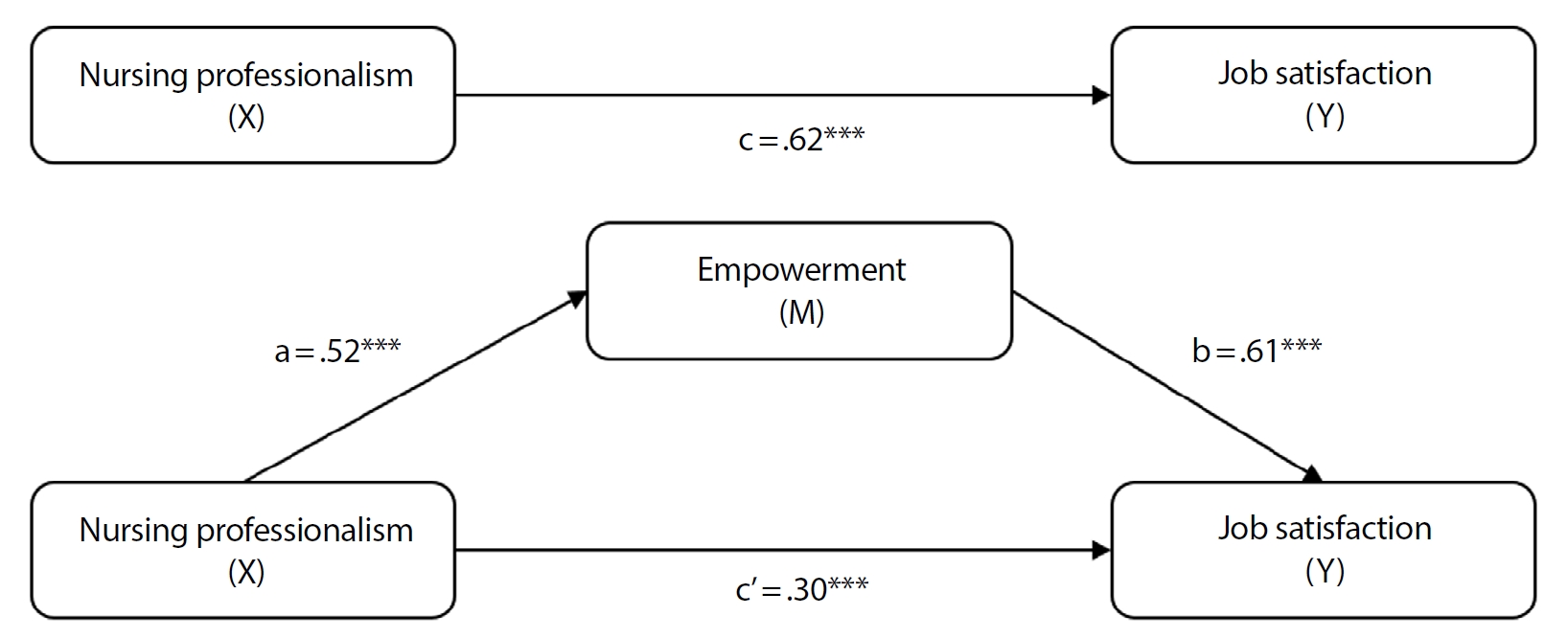
Purpose This study examined the mediating effect of empowerment on the relationship between nursing professionalism and job satisfaction, with the goal of informing strategies to enhance job satisfaction among insurance review nurses. Methods: A total of 165 insurance review nurses with more than 1 year of work experience in 12 general hospitals (≥500 beds) participated in this study. Data were analyzed using descriptive statistics, t-tests, analysis of variance, Pearson correlation analysis, and multiple regression analysis. The mediating effect was tested using the PROCESS Macro (model 4) in SPSS version 26.0 with 10,000bootstrap samples. Results: The mean scores for nursing professionalism, empowerment, and job satisfaction were 100.37 (standard deviation [SD], 17.03), 86.24 (SD, 17.70), and 45.44 (SD, 9.17), respectively. Significant positive correlations were observed between nursing professionalism and job satisfaction (r=.64, p<.001), empowerment and job satisfaction (r=.77, p<.001), and nursing professionalism and empowerment. Empowerment was found to partially mediate the relationship between nursing professionalism and job satisfaction (95% CI, .20–.44). Conclusion: Enhancing empowerment and strengthening nursing professionalism are essential for improving job satisfaction among insurance review nurses. Institutional interventions that promote professional identity and provide structural empowerment may increase job satisfaction and support retention within this specialized nursing workforce.
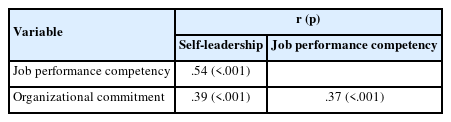
Purpose This study aimed to determine the effects of self-leadership on job performance competency and organizational commitment among insurance review nurses. Methods: A nationwide online survey was conducted using structured questionnaires. Participants included 189 insurance review nurses working in advanced general hospitals and general hospitals in South Korea. Data were collected through self-administered questionnaires between August 19 and September 17, 2021. Data analysis was performed using descriptive statistics, independent t-tests, one-way analysis of variance, Pearson’s correlation coefficients, and hierarchical multiple regression with IBM SPSS version 23.0. Results: The mean score for self-leadership was 3.64±0.43 out of 5, for job performance competency was 3.10±0.68 out of 5, and for organizational commitment was 4.38±1.09 out of 7. Statistically significant positive correlations were observed among self-leadership, job performance competency, and organizational commitment in insurance review nurses. Hierarchical multiple regression analysis showed that self-leadership explained an additional 13.9 percentage points of variance in job performance competency and an additional 5.3 percentage points in organizational commitment. Self-leadership emerged as a statistically significant predictor of both job performance competency and organizational commitment. Conclusion: This study empirically demonstrates that self-leadership has significant effects on job performance competency and organizational commitment among insurance review nurses. These findings provide empirical evidence relevant to human resource management strategies for insurance review nurses.
Purpose The purpose of this study was to develop and validate the Job Competency Scale (JCS) for insurance review nurses working in hospitals. Methods The initial items were generated through a literature review and interviews with 10 experts. The content validity of the items was evaluated through content validity and face validity tests. Data from 301 insurance review nurses working in hospitals were analyzed using item analysis, exploratory and confirmatory factor analysis, and convergent validity; reliability was tested using Cronbach’s ⍺. Results The final JCS consisted of 25 items and five factors (knowledge integration, professional ethics, communication and interpersonal relationship, information literacy and problem solving, self-development) that explained 72.4% of the variance. Confirmatory factor analysis indicated that the theoretical model comprising 25 items satisfied all goodness-of-fit parameters. Convergent validity was confirmed by the Task Performance Scale for insurance review nurses (r=.53, p<.001). The total Cronbach’s ⍺ score for scale was .94. Conclusion The JCS was found to be a reliable and valid instrument that can be used to measure the job competency of insurance review nurses working in hospitals.
Citations
Citations to this article as recorded by
Effects of Self-leadership on Job Performance Competency and Organizational Commitment of Insurance Review Nurses: A Nationwide Survey Ju Eun Oh, Seok Hee Jeong, Young Hee Mun, Hee Sun Kim Journal of Korean Academy of Nursing Administration.2025; 31(5): 537. CrossRef
Purpose The aim of this study was to explore the causes and effects of burnout experienced by insurance review nurses working in hospitals.
Methods: Data were collected from April to May, 2021, using focus group interviews. The study enrolled 19 insurance review nurses with at least one year of experience. Data were analyzed using the content analysis method.
Results: Causes of burnout were divided into three categories: eight subcategories (feeling of insufficient competence in an insurance review, closed mind in a limited working space, incompetency from other departments, harsh words and deeds that exclude me, insurance cuts controlling my work performance, cloudy mind chased by the billing date, ineffective hospital information systems, and question with no answer) and 23 causes. The impact of burnout was divided into three categories: six subcategories (experiencing mental and physical symptoms, projecting one’s feelings into family or neglecting them, withdrawing myself, wearing a mask, decreased work performance, and desiring to leave one’s work), and 14 concepts.
Conclusion: This study provides basic data for strategy development to prevent and solve burnout problems among insurance review nurses. It is important to develop programs and policies to solve the burnout problem of insurance review nurses in the future.
Citations
Citations to this article as recorded by
Mediating Effect of Empowerment in the Relationship between Nursing Professionalism and Job Satisfaction among Insurance Review Nurses Eun Jung Park, Young-Ran Kweon Journal of Korean Academy of Nursing Administration.2026; 32(1): 28. CrossRef
Demand for Simulation Education to Strengthen Patient Safety Competency of Graduated Nursing Students and New Nurses: Qualitative Content Analysis Jung Min Park, Sangeun Jun Journal of Korea Society for Simulation in Nursing.2024; 12(2): 17. CrossRef
Development and Validation of the Job Competency Scale for Insurance Review Nurses Working in Hospital Song Hwa Nam, Eun A Kim Journal of Korean Academy of Nursing Administration.2023; 29(5): 588. CrossRef


 First
First Prev
Prev