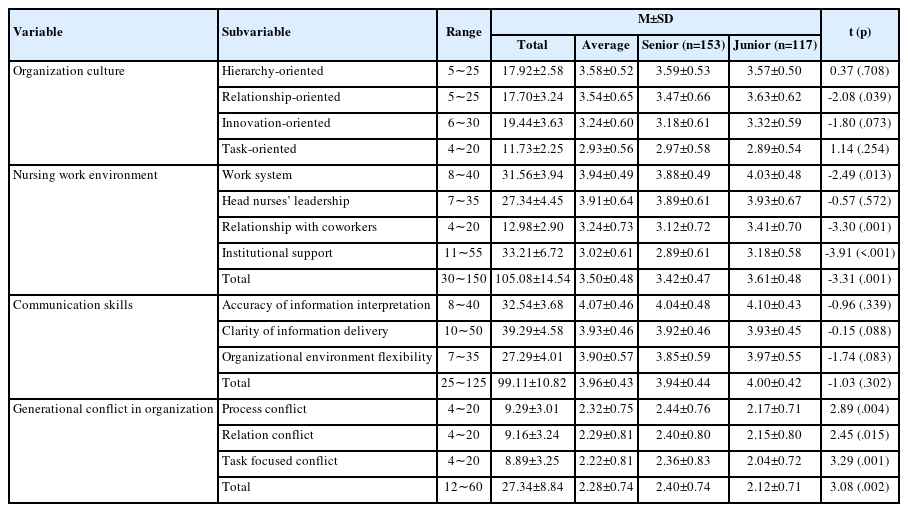
Purpose This study aimed to identify structural factors associated with intergenerational conflict among nurses and to explore how these conflicts manifest in clinical settings. Methods: An explanatory sequential mixed-methods design was used. Quantitative data were collected from 270 nurses using structured questionnaires that measured organizational culture, work environment, communication skills, and intergenerational conflict. Key influencing factors were identified using multiple regression analysis. Qualitative data were collected through in-depth interviews with 10 nurses and analyzed using Colaizzi’s phenomenological method. Results: Hierarchy-oriented culture, task-oriented culture, work systems, and organizational-environment flexibility significantly influenced intergenerational conflict (F=6.25, p<.001). The adjusted explanatory power of the regression model was 24.9% (adjusted R²=.249). Among these variables, work systems emerged as the strongest predictor of intergenerational conflict. The qualitative findings indicated that anonymous suggestion systems, differences in work approaches, and differences in emotional interpretation intensified conflict. Conclusion: Intergenerational conflict among nurses appears to stem from procedural ambiguity, emotional misunderstandings, and value incongruence. Organizations should redesign suggestion systems to ensure procedural fairness, strengthen evidence-based practice education, implement communication training focused on emotional awareness, and develop institutional strategies that support generational integration.
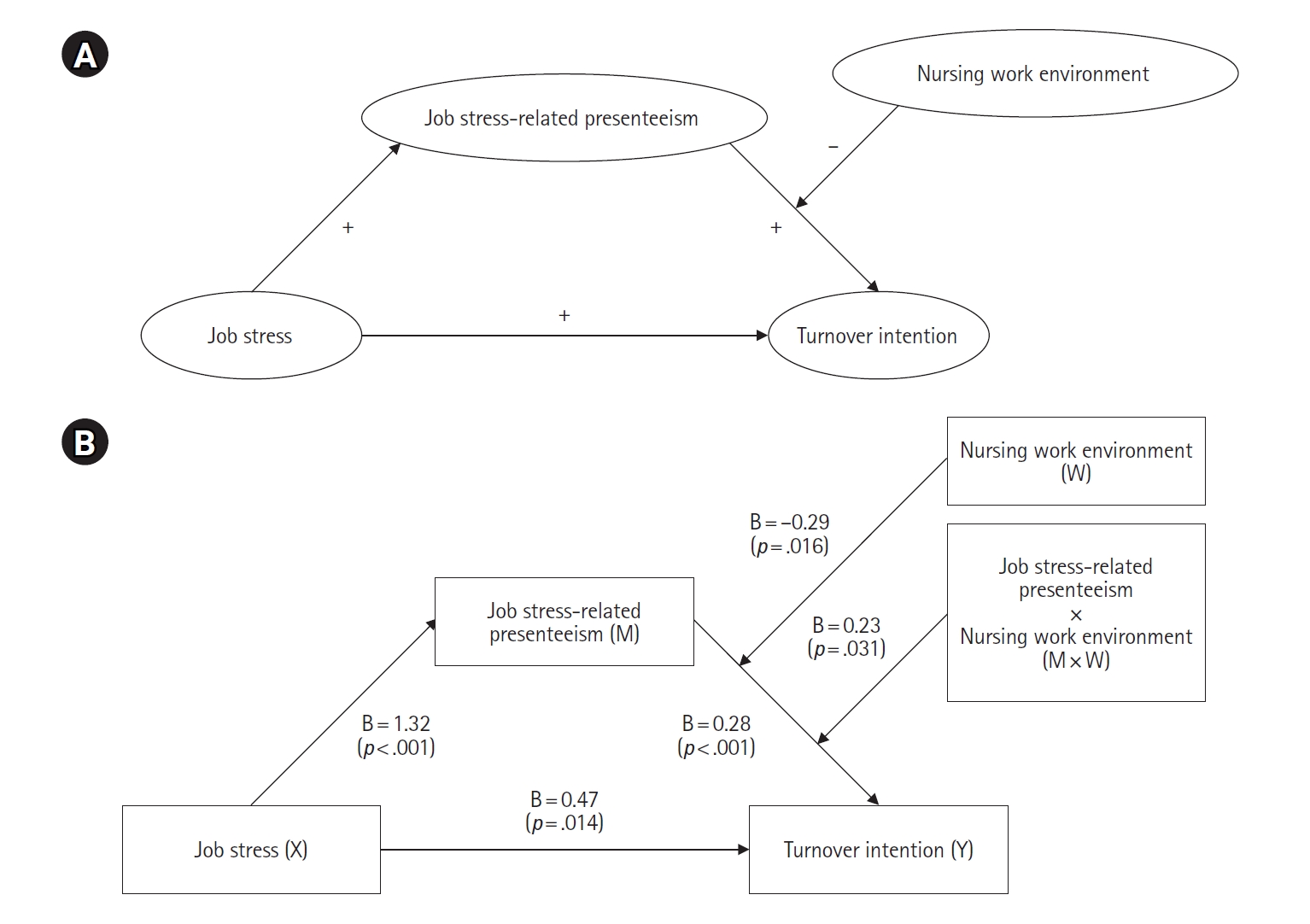
Purpose This study examined the mediating effect of job stress-related presenteeism and the moderated mediating effect of the nursing work environment on the relationship between job stress and nurses’ turnover intention. Methods: A predictive correlational research design was employed from September 8 to September 26, 2023, involving 176 nurses working in general and tertiary hospitals nationwide. Data were analyzed using IBM SPSS Statistics version 25.0, the PROCESS macro version 4.2, and the EasyFlow Statistics macro version 1.8. Results: The mean scores were 2.76±0.38 for job stress, 3.11±0.81 for job stress-related presenteeism, 2.47±0.50 for nursing work environment, and 3.57±0.75 for turnover intention. Job stress was positively associated with turnover intention through job stress-related presenteeism (B=1.32, p<.001), and the nursing work environment significantly moderated this partial mediating effect (B=0.31; 95% CI, 0.04~0.53). Conclusion: These findings may inform the development of strategies and policies aimed at reducing nurses’ turnover intention and improving human resource management in clinical settings. In addition, this study contributes to the growing body of research on job stress, job stress-related presenteeism, nursing work environment, and turnover intention among nurses.
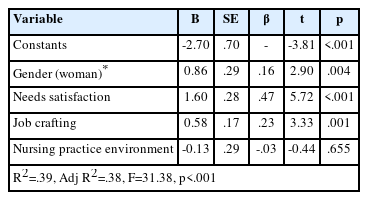
Purpose This study investigated the effects of need satisfaction, job crafting, and the nursing practice environment on retention intention among advanced beginner-stage nurses. Methods: Data were collected from 194 advanced beginner-stage nurses working at one university hospital in Chungcheongnam-do and two general hospitals in Gyeongsangbuk-do. The data were analyzed using descriptive statistics, the t-test, analysis of variance (ANOVA), Pearson’s correlation coefficients, and multiple regression analysis using IBM SPSS version 25.0. Results: The mean score for retention intention among advanced beginner stage nurses was 4.96 out of a possible 8 points. Factors associated with retention intention were need satisfaction (β=.47, p<.001), and job crafting (β=.23, p=.001), and gender (female; β=.16, p=.004). These variables explained 38% of the variance in retention intention in the regression model (F=31.38, p<.001). Conclusion: The findings suggest that improving need satisfaction and enhancing job crafting may increase retention intention among advanced beginner-stage nurses. The development of job-crafting enhancement programs, along with organizational initiatives that support job crafting and establish nursing policies aligned with these efforts, may contribute to improved nurse retention.
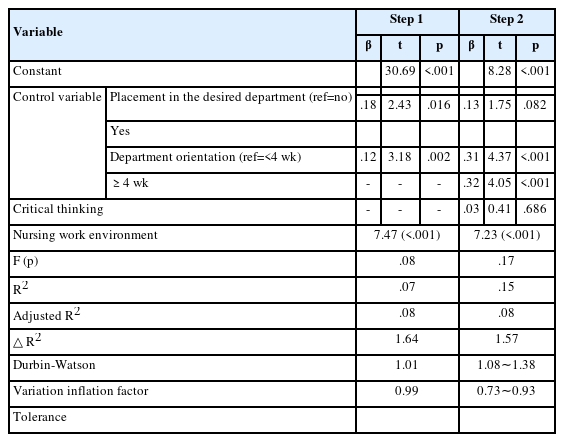
Purpose This study aimed to identify the influences of fatigue, critical thinking, and nursing work environment on patient safety nursing behaviors among new graduate nurses. Methods: The participants were 180 new graduate nurses who had been working for less than 12 months in hospitals. Data were collected using a structured, self-administered survey from December 15 to 30, 2023. The SPSS version 29.0 program was used for data analysis, which included descriptive analysis, the t-test, one-way analysis of variance (ANOVA), Pearson correlation coefficients, and hierarchical regression analysis. Results: Hierarchical regression analysis showed that critical thinking (β=.32, p<.001) and department orientation (β=.31, p<.001) were significant factors influencing patient safety nursing behavior. Conclusion: These results suggest that providing sufficient departmental orientation for new graduate nurses is necessary to support accurate and safe patient safety nursing practices. In addition, it is important to foster critical thinking and to develop and implement educational programs that enhance patient safety nursing behaviors, and to establish comprehensive support systems.
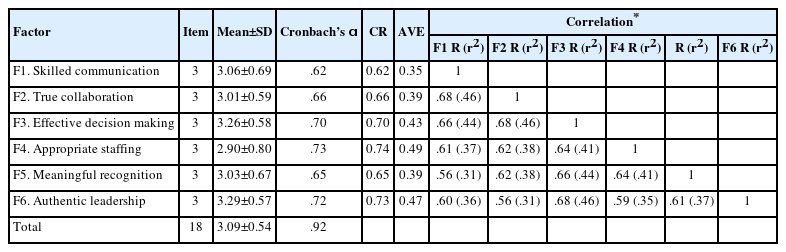
Purpose This study was conducted to evaluate the validity and reliability of the Korean version of the Healthy Work Environment Assessment Tool (K-HWEAT), originally developed by the American Association of Critical-Care Nurses. Methods: The study was conducted among nurses working at three university hospitals located in metropolitan areas between May 29 and October 10, 2019. A total of 543 nurses participated. Data were analyzed using AMOS version 26.0 to assess the construct validity of the K-HWEAT. Results: Confirmatory factor analysis initially failed to meet acceptable model fit indices. Model fit improved after reassigning item 1 from factor 1 to factor 2 and item 12 from factor 4 to factor 6, as well as allowing correlated error terms based on high modification indices. Following these adjustments, standardized root mean square residual remained unchanged (0.05 to 0.05) and root mean square error of approximation decreased from 0.09 to 0.07, whereas goodness of fit index increased from 0.88 to 0.91, adjusted goodness of fit index from 0.83 to 0.86, Normed Fit Index from 0.85 to 0.89, and comparative fit index from 0.88 to 0.92. The K-HWEAT demonstrated a moderate correlation with the Korean version of the Practice Environment Scale of the Nursing Work Index (r=.60, p<.001), supporting criterion validity. The overall Cronbach’s α was .92, with the six factors showing internal consistency coefficients ranging from 0.62 to 0.74. Conclusion: These findings support the reliability and validity of the K-HWEAT. However, further conceptual refinement of individual items may be necessary to enhance construct clarity.
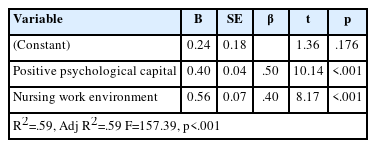
Purpose This study aimed to investigate the factors influencing job embeddedness among advanced beginner nurses, with particular emphasis on the roles of positive psychological capital and the nursing work environment. Methods: This cross-sectional study included 216 advanced beginner nurses from two university-affiliated hospitals. Data were obtained using standardized questionnaires and analyzed with descriptive statistics, the independent t-test, one-way analysis of variance, Pearson correlation coefficients, and multiple regression analysis. Results: The average score for job embeddedness was 3.34±0.54, for positive psychological capital was 4.00±0.67, and for the nursing work environment was 2.67±0.39. Multiple regression analysis showed that positive psychological capital and the nursing work environment significantly predicted job embeddedness, accounting for 59.3% of its variance. Conclusion: The findings suggest that enhancing positive psychological capital and improving the nursing work environment are essential for promoting job embeddedness among advanced beginner nurses. These results provide empirical support for the development of targeted interventions that facilitate their transition toward becoming competent nurses.
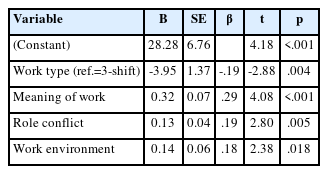
Purpose This study examined the effects of role conflict, work environment, and meaning of work on job embeddedness among physician assistants to provide foundational data for their retention and professional development. Methods: A descriptive survey was conducted with 180 physician assistants from six tertiary hospitals in Seoul and Chungcheong Province. Data were collected from July to November 2022. Role conflict, work environment, meaning of work, and job embeddedness were measured using validated scales. Data were analyzed using SAS Enterprise Guide 7.1 with descriptive statistics, the independent t-test, ANOVA, Pearson correlation coefficients, and multiple regression analysis. Results: Job embeddedness correlated positively with meaning of work (r=.28, p<.001) and work environment (r=.22, p=.002) and weakly with role conflict (r=.14, p=.045). Multiple regression identified meaning of work (B=0.32, p<.001), role conflict (B=0.13, p=.005), work environment (B=0.14, p=.018), and work type (B=-3.95, p=.004) as significant predictors (Adj. R²=19.8%). Meaning of work had the greatest impact. Conclusion: Enhancing job embeddedness among physician assistants requires improving the work environment, clarifying professional roles, and strengthening professional recognition and organizational support.
Citations
Citations to this article as recorded by
Experiences of work performance among physician assistant nurses during the period of healthcare disruption in South Korea: a qualitative content analysis Juyoung Ha, Minji Kim Journal of Korean Academy of Nursing.2026; 56(1): 98. CrossRef
Job Burnout Associated with Work Environment among Physician Assistant Nurses: A Secondary Analysis of the 2025 Survey on Working Conditions of Health and Medical Workers Kyongok Park, Hanyi Lee, Hyeon Sik Chu Journal of The Korean Society of Living Environmental System.2026; 33(2): 188. CrossRef
Operating Room Nurses’ Role Transitions to Surgical Assistant Nurses: Experience and Learning during a Resident Strike Eun Kyung Jung, Yeon Hee Kim, Jeounghee Kim Journal of Korean Association for Qualitative Research.2026; 11(1): 1. CrossRef
Purpose This study aimed to identify the impact of clinical nurses’ grit and nursing work environment on job enthusiasm and provide basic data for system improvement to maintain and secure nursing personnel. Methods: Data were collected online from July to August 2022 targeting 210 clinical nurses at three general hospitals located in Jeollabuk-do. Data analysis was performed using the IBM SPSS 26.0 program. Results: Job enthusiasm exhibited statistically significant differences according to age (F=5.20, p=.006) and presence of children (F=0.95, p<.001). Furthermore, job enthusiasm showed statistically significant positive correlations with grit (r=.64, p<.001) and the nursing work environment (r=.49, p<.001). The following factors were found to affect job enthusiasm: having children (β=.26, p<.001), grit (β=.46, p<.001), nursing work environment (β=.33, p<.001), and age over 40 (β=.16, p<.001). Conclusion: Based on the results of this study, it is recommended that an internal motivation strengthening program that promotes grit should be developed and applied to increase work enthusiasm among clinical nurses. Additionally, hospital organizations should prepare various policies to improve the nursing work environment.
Citations
Citations to this article as recorded by
Effects of the Nursing Work Environment, Patient-Centered Communication, Occupational Coping Self-Efficacy, and Professional Identity on Missed Nursing Care among General Hospital Nurses Yuju Kim, Ju-Yeon Uhm Journal of Fundamental Nursing Science.2026; 33(2): 277. CrossRef
PURPOSE This study was conducted to expand nurse's experience of harmful work environments. METHODS Data were collected through in-depth dividual interviews and analyzed using Colaizzi phenomenological analysis methodology. RESULTS Harmful work environments experienced by nurses were categorized as followed: ‘Neglect concerning infections’, ‘Being thrown into a violent working environment’, ‘The hard times of being alone’, ‘Struggling with the harmful work environments’. CONCLUSION The results of this study provide a deep understanding of the harmful work environments. It is necessary to create safe work environments and it is important to improve awareness in the system of organizations as well as individuals. Also, it is necessary to develop tools to measure work environment including risk factors.
Citations
Citations to this article as recorded by
The influence of tertiary hospital nurses’ ageism, empathy, and work intensity on the performance of geriatric nursing: A cross-sectional study Jang mi Park, Jung Suk Park Journal of Korean Gerontological Nursing.2025; 27(1): 74. CrossRef
Associations of anxiety and fatigue with hazardous occupational conditions of Korean nurses in early pregnancy: A cross‐sectional study Jung‐Hee Kim, Oksoo Kim, Mijung Cho, Hyunseon Jeong, Hyunju Dan International Journal of Nursing Practice.2024;[Epub] CrossRef
Development and Evaluation of Nursing Work Environment Scale of Clinical Nurses Yeong Ju Ko, Gwi-Ryung Son Hong Journal of Korean Academy of Nursing Administration.2022; 28(5): 576. CrossRef



 First
First Prev
Prev