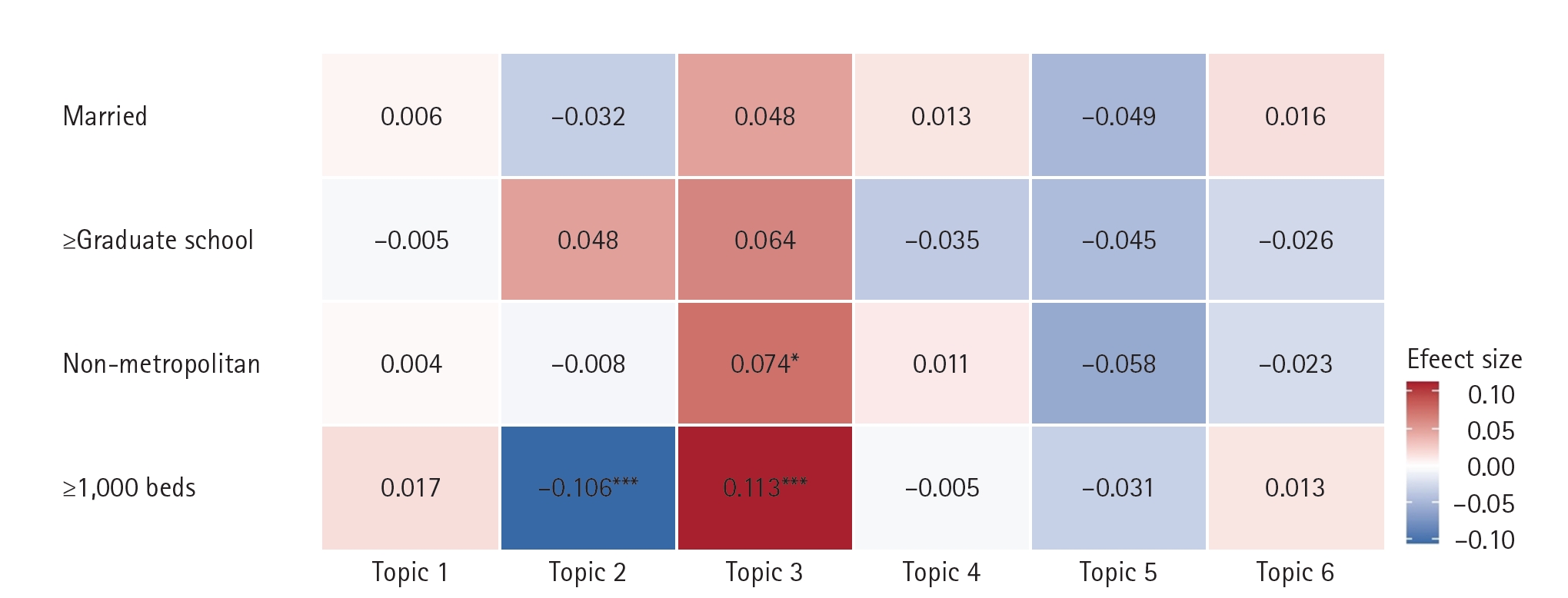
Purpose This study explored nurses’ experiences and perspectives regarding the shift system improvement pilot project, as well as their recommendations for shift work policies, and examined variations according to nurse and hospital characteristics. Methods: Structural topic modeling was applied to open-ended survey responses from 208 nurses. Topic prevalence was examined according to career length, marital status, education, hospital location, and bed capacity. Findings: Six topics emerged: experiences with implementing a pilot project for shift system improvement; shift system improvements for sustainability; physical burden and challenges of fixed night shifts; the impact of shift system improvement on personal life; nurse staffing levels for providing safe nursing care; and nursing workforce expansion and work distribution for quality care. Workforce adequacy showed the highest prevalence and was the dominant theme across all career lengths. The prevalence of system improvement was higher among nurses with ≤3 years and >10 years of experience, whereas nurses with 3–10 years of experience focused more on project participation. Smaller hospitals prioritized system improvements, whereas larger hospitals emphasized the physical burden. Conclusion: Nursing workforce adequacy emerged as nurses’ primary concern, surpassing concerns related to shift system design. Policy should prioritize legally mandated nurse staffing ratios as the foundation for sustainable shift systems, with interventions tailored to organizational capacity and career length.
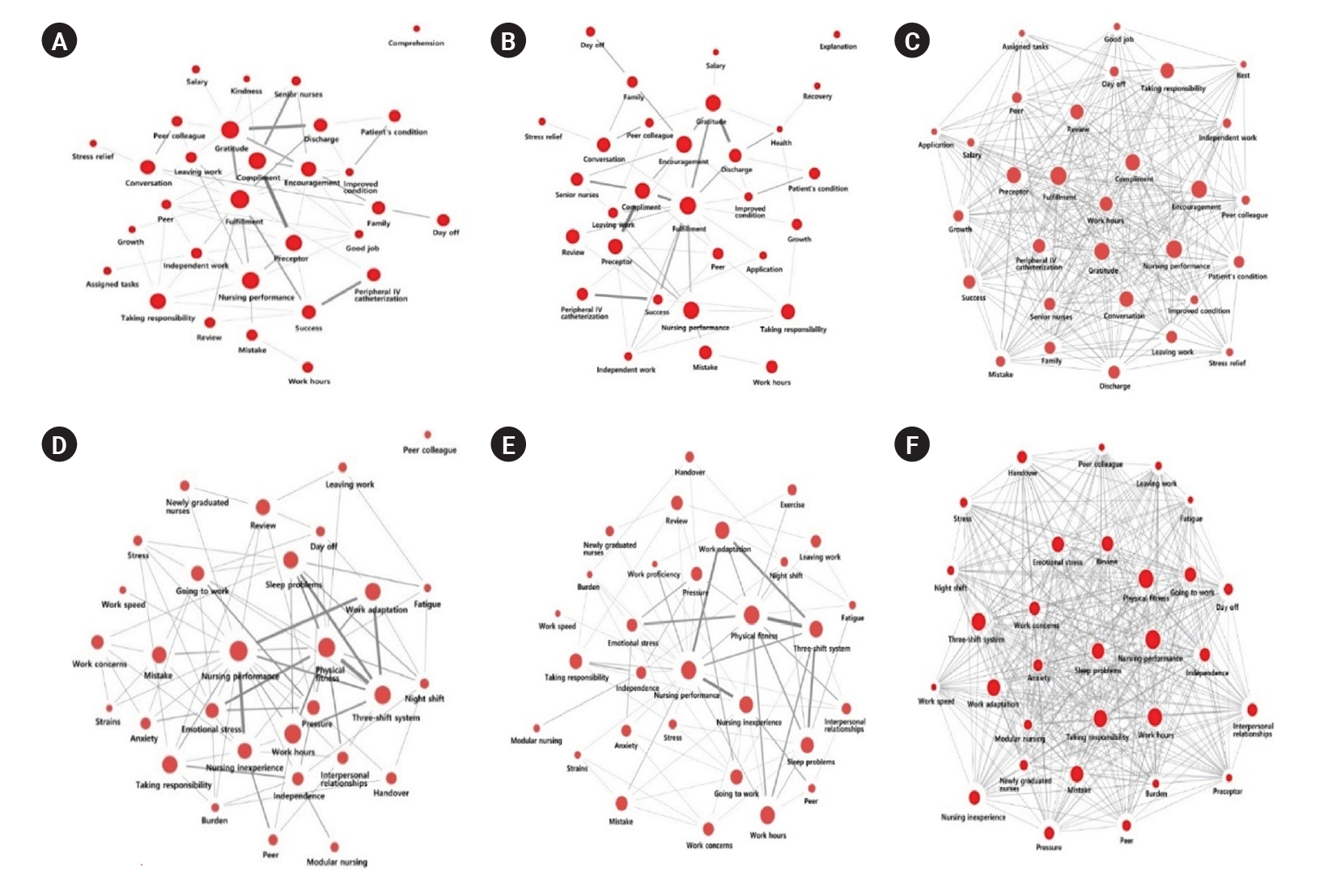
Purpose This study identified themes associated with the clinical adaptation of newly graduated nurses. Methods: We collected 522 interview journals from newly graduated nurses and nurse educators at a tertiary hospital between January 2021 and December 2023. After excluding incomplete data, 407 “promoting enjoyment” entries and 426 “presenting challenges” entries were analyzed using network analysis and topic modeling in NetMiner 4.5.1. Results: Topic modeling identified four themes in each category. For promoting enjoyment, the themes were: “Upon completing my designated responsibilities, I depart from the workplace,” “On my days off, I enjoy indulging in my favorite activities,” “Being recognized by my colleagues makes me feel like I’m contributing my part to the team,” and “The condition of my patient has improved.” For presenting challenges, the themes were: “The numerous responsibilities I must handle make it difficult to complete everything within the designated time frame,” “I struggle with both my tasks and relationships with colleagues,” “I’m anxious about caring for patients on my own,” and “Irregular shift patterns and occupational distress significantly impair my sleep quality.” Conclusion: Educational methodologies need to be developed to facilitate the clinical adaptation of newly graduated nurses. These findings can inform the Ministry of Health and Welfare’s nurse educator policy and future nursing workforce strategies.
Hyunjung Ko, Nara Han, Seulki Jeong, Jeong A Jeong, Hye Ryoung Yun, Eun Sil Kim, Young Jun Jang, Eun Ju Choi, Chun Hoe Lim, Min Hee Jung, Jung Hee Kim, Dong Hyu Cho, Seok Hee Jeong
J Korean Acad Nurs Adm 2024;30(5):529-542. Published online December 31, 2024
Purpose This study aimed to explore customer perspectives of nursing services in tertiary hospitals. Methods The data comprised mobile Voice Of Customer (VOC) data related to “nursing” or “nurses” generated from June 25, 2019, to December 31, 2022, in a tertiary hospital. A total of 44,727 VOC data points were collected, of which 4,040 were selected for the final analysis. Text network analysis and topic modeling were conducted using NetMiner 4.5.1. Results Topic modeling identified five topics for positive aspects and four topics for areas requiring improvement.
The positive aspects were: 1) sincere nursing care; 2) rapid response from professional medical staff; 3) teamwork for delivering customer-centric services; 4) provision and coordination of system-based healthcare services; and 5) customer-focused responsiveness. The areas requiring improvement were: 1) demand for skilled nursing care tailored to customer expectations; 2) demand for enhanced communication and reduced mechanical responses; 3) demand for appropriate handling of diverse situations; and 4) demand for overall improvements to the healthcare system, including reservation systems. Conclusion These results may be used to enhance customer and patient experiences in tertiary hospitals and are necessary for utilization from a hospital management perspective.
Purpose To describe clinical nurses’ experience and grievance in an online community using a co-occurrence network and topic modeling.
Methods: We analyzed posts from Nurscape, which is the largest online community for nurses in Korea. After extracting posts using web scrapping, text preprocessing was done to detect nouns. In a visualization phase, co-occurrence network analysis and latent dirichlet allocation-based topic modeling were applied.
Results: A total of 13,200 posts were analyzed. The co-occurrence network’s core keywords were newly graduate nurse, general ward, career, turnover, and grievance. The topic modeling showed four topics: (1) ‘Clinical practice-related difficulties’ described clinical hardships, such as the heavy workload of nurses; (2) ‘Concerns about resignation’ incorporated keywords asking for advice on resignation; (3) ‘Searching for information on employment/reemployment’ focused on the working conditions or working climate of a specific hospital; and (4) ‘Organizational action call’ captured the voices urging organized actions to improve nurses’ work environment.
Conclusion: Clinical nurses share experiences through the online community and seek advice or information and urge organizational action. Professional nursing organizations should identify and deal with problems that nurses are currently facing. The results of this study can contribute to establishing the policy direction of nursing organizations.
Citations
Citations to this article as recorded by
A Text Network Analysis of Nurse Managers’ Feedback Journals Naru Kang, Shinhye Ahn, Hye Won Jeong CIN: Computers, Informatics, Nursing.2026;[Epub] CrossRef
National Petition Analysis Related to Nursing: Text Network Analysis and Topic Modeling HyunJung Ko, Seok Hee Jeong, Eun Jee Lee, Hee Sun Kim Journal of Korean Academy of Nursing.2023; 53(6): 635. CrossRef
Perspectives of Frontline Nurses Working in South Korea during the COVID-19 Pandemic: A Combined Method of Text Network Analysis and Summative Content Analysis SangA Lee, Tae Wha Lee, Seung Eun Lee Journal of Korean Academy of Nursing.2023; 53(6): 584. CrossRef
An Exploratory Study on Current Nursing Issues in the COVID-19 era through Newspaper Articles: The Application of Text Network Analysis Young Joo Lee Journal of Korean Academy of Nursing Administration.2022; 28(3): 307. CrossRef
Analysis of Online Community Data on Industrial Engineering Juhee Han, Jinyi Yu, Younghoon Lee Journal of the Korean Institute of Industrial Engineers.2022; 48(3): 280. CrossRef


 First
First Prev
Prev