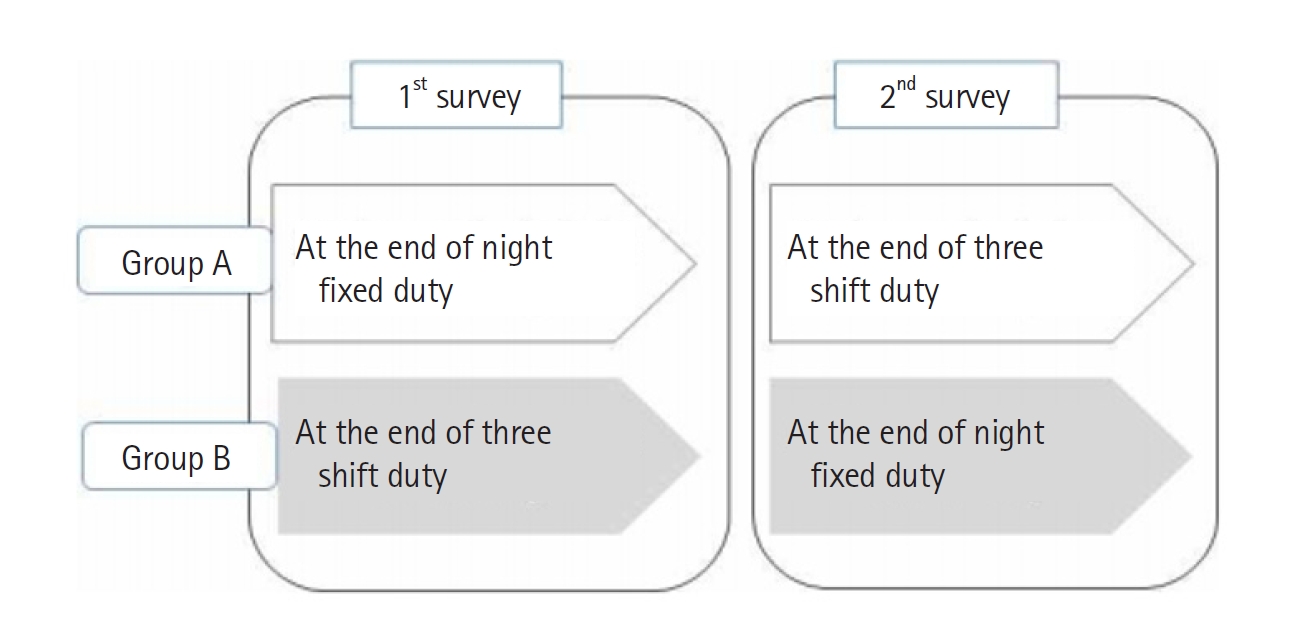
Purpose This study aimed to compare fatigue, adaptation to night shifts, and resilience among nurses who had experience with both fixed night duty and three-shift duty. Methods: This repeated-measures comparative study included 41 nurses at a university hospital in Incheon who had experienced both fixed night duty and three-shift duty. The measured variables were general characteristics, fatigue, adaptation to night shifts, and resilience. Data were analyzed using descriptive statistics, including frequencies, percentages, means, and standard deviations, as well as the paired t-test. Results: No statistically significant differences were found in fatigue or resilience between periods of fixed night duty and three-shift duty. However, adaptation to night shifts was significantly higher during fixed night duty. Conclusion: Because adaptation to night shifts was significantly higher during fixed night duty, fixed night duty may be considered an alternative work arrangement that broadens nurses’ scheduling options. Because fixed night duty is based on voluntary participation, its potential benefits should be clearly communicated to nurses.
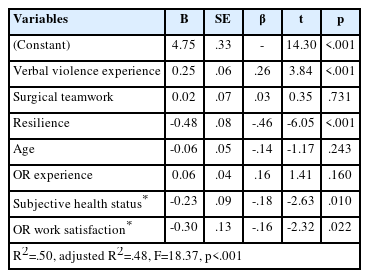
Purpose This study explored the influence of verbal violence experience, surgical teamwork, and resilience on burnout among operating room nurses. Methods: Data were collected from 135 operating room nurses who had worked for more than 6 months in the tertiary and general hospitals in two metropolitan cities. The IBM SPSS Statistics 27.0 program was used for descriptive statistics, independent t-tests, one-way analysis of variance, Pearson correlation coefficients, and stepwise multiple regression. Results: Burnout showed a significant positive correlation with verbal violence experience (r=.38, p<.001) and significant negative correlations with surgical teamwork (r=-.41, p<.001) and resilience (r=-.60, p<.001). Verbal violence experience was negatively correlated with surgical teamwork (r=-.38, p<.001), whereas surgical teamwork was positively correlated with resilience (r=.51, p<.001). Multiple regression analysis revealed that resilience (β=-.46, p<.001), verbal violence experience (β=.26, p<.001), subjective health status (β=-.18, p=.010), and satisfaction with operating room work (β=-.16, p=.022) significantly influenced burnout and explained 50% of the variance. Conclusion: These findings indicate that resilience, verbal violence experience, subjective health status, and work satisfaction are significant factors associated with burnout among operating room nurses. Therefore, targeted interventions focused on strengthening resilience, preventing verbal violence, and enhancing work satisfaction are needed to reduce burnout.
Purpose This study investigated the effects of newly graduated nurses’ perceived readiness for nursing practice, resilience, and preceptors’ teaching behaviors on turnover intention.
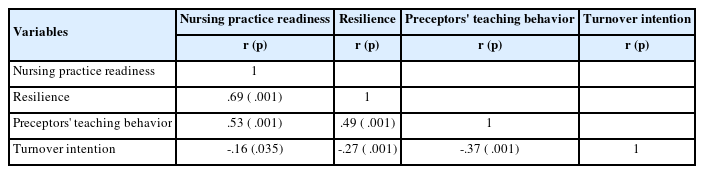
Methods A survey was conducted among 168 newly graduated nurses between August 7 and 31, 2023. The data were analyzed using descriptive statistics, t-tests, one-way ANOVA, Pearson's correlation, and hierarchical multiple regression analysis.
Results The factors that significantly affected turnover intention included preceptors' teaching behavior (β=-.29, p=.001) and resilience (β=-.21, p=.026). This model explained 32.0% of the variance.
Conclusion Newly graduated nurses’ resilience and their initial training environment are key factors influencing turnover intention. Therefore, nursing managers should develop strategies to enhance the resilience of newly graduated nurses and improve training systems. Additionally, efforts should be made to promote positive teaching behaviors among the educators responsible for training newly graduated nurses.
Citations
Citations to this article as recorded by
Experiences of work performance among physician assistant nurses during the period of healthcare disruption in South Korea: a qualitative content analysis Juyoung Ha, Minji Kim Journal of Korean Academy of Nursing.2026; 56(1): 98. CrossRef
Educational Innovation in Nursing Management after Reforms in the National Nurse Licensure Examination: A Narrative Review Yoomi Jung Journal of Korean Academy of Nursing Administration.2026; 32(3): 137. CrossRef
Factors Associated With Nursing Profession Self‐Efficacy Among Newly Graduated Nurses: A Cross‐Sectional Study Yujeong Kim, Eunhee Nam, Myojeong Kim, Dokyung Kim, Heejin Sim Nursing Open.2026;[Epub] CrossRef
Perceptions on Fixed Night Shift System and Turnover Intention of General Hospital Nurses Mi-Aie Lee, Hye-Jin Cho, Sung-Hee Ahn, Hyo-Ju Kim Journal of Korean Academy of Nursing Administration.2015; 21(5): 519. CrossRef
PURPOSE This study was done to identify the mediating effect of resilience on the relationship between nurse's character and happiness for nurses in general hospitals. METHODS Participants were 139 nurses working in general hospitals. A survey was used and data were collected in April 2019. Data were analyzed using the IBM SPSS/WIN 22.0 program. RESULTS The significant predictors for the happiness of nurses were nurse's character (β=.56) and resilience (β=.80). These variables explained 67% of the variance in happiness of nurses. Also, resilience had a total mediating effect on the relationship between nurse's character and happiness. CONCLUSION Findings indicate that nurse's character and resilience are important factors for the happiness of nurses in general hospitals.
Citations
Citations to this article as recorded by
Shift Work and Happiness in Nursing: Identifying Influencing Factors Through Seligman Authentic Happiness Theory Jihye Kim, Minyoung Kim, Jieun Kwak, Seungmin Yu, Sojung Park, Yaelim Lee Advances in Nursing Science.2026;[Epub] CrossRef
The Effects of Compassion Competence, Clinical Nursing Character, and Nursing Professionalism on Nursing Service Quality of Long-term Care Hospital Nurses Young Moon Cho, Hyun O We The Korean Journal of Rehabilitation Nursing.2024; 27(1): 11. CrossRef
The relationship between secondary traumatic stress and burnout in critical care nurses: The mediating effect of resilience Yun Jeong Jeong, Sujin Shin Intensive and Critical Care Nursing.2023; 74: 103327. CrossRef
Perspectives of the Value in Life among Nursing Professionals: A Q-methodology Study Misoon Jeon, Eun Sil Jang, Eun Ja Yeun Sage Open.2022;[Epub] CrossRef
Relationship between information sources, and resilience, with anxiety during the COVID-19 pandemic: an online investigation Ali Montazeri, Azadeh Tavoli, Farzaneh Maftoon, Mansoureh Farhangnia, Fatemeh Naghizadehmoghari, Melika Nourani, Negar Tashakkori, Hoorie Hoorie Hassanpour Health Monitor Journal of the Iranian Institute for Health Sciences Research.2022; 21(5): 513. CrossRef
Mediating Effects of Happiness between Gratitude Disposition and Psychological Well-being among Clinical Nurses Ji-Ah Song, Hyejin Yang Journal of Korean Academy of Fundamentals of Nursing.2022; 29(2): 227. CrossRef
Moderating Effect of Nurse’s Character on the Relationship between Attitudes toward Nursing Care of the Dying and Performance of Terminal Care in South Korea Kawoun Seo Healthcare.2021; 9(9): 1195. CrossRef
Vicarious Resilience in Hospital Nurses: A Concept Analysis Miri Jeong Healthcare.2025; 13(18): 2279. CrossRef
Mediation Analysis of Emotional Intelligence on the Relationship between Social Support and Resilience by Clinical Nurses in COVID-19 Hye-Yeon Shin, Myoung-Lyun Heo Journal of Korean Academy of Nursing Administration.2023; 29(3): 181. CrossRef



 First
First Prev
Prev