
| Jung Suk Park | 2 Articles |
Purpose
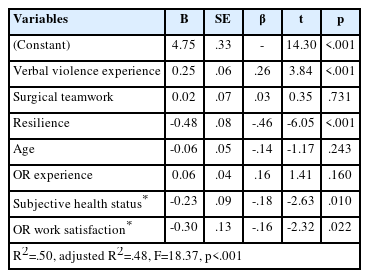
This study explored the influence of verbal violence experience, surgical teamwork, and resilience on burnout among operating room nurses. Methods: Data were collected from 135 operating room nurses who had worked for more than 6 months in the tertiary and general hospitals in two metropolitan cities. The IBM SPSS Statistics 27.0 program was used for descriptive statistics, independent t-tests, one-way analysis of variance, Pearson correlation coefficients, and stepwise multiple regression. Results: Burnout showed a significant positive correlation with verbal violence experience (r=.38, p<.001) and significant negative correlations with surgical teamwork (r=-.41, p<.001) and resilience (r=-.60, p<.001). Verbal violence experience was negatively correlated with surgical teamwork (r=-.38, p<.001), whereas surgical teamwork was positively correlated with resilience (r=.51, p<.001). Multiple regression analysis revealed that resilience (β=-.46, p<.001), verbal violence experience (β=.26, p<.001), subjective health status (β=-.18, p=.010), and satisfaction with operating room work (β=-.16, p=.022) significantly influenced burnout and explained 50% of the variance. Conclusion: These findings indicate that resilience, verbal violence experience, subjective health status, and work satisfaction are significant factors associated with burnout among operating room nurses. Therefore, targeted interventions focused on strengthening resilience, preventing verbal violence, and enhancing work satisfaction are needed to reduce burnout.
Purpose
This study aimed to examine the mediating role of nursing professionalism in the relationship between critical thinking disposition and medication safety competency among peri-anesthesia nurses. Methods Data were collected from 128 peri-anesthesia nurses with at least six months of experience in recovery-related departments across medical institutions nationwide. The analysis was conducted using IBM SPSS Statistics for Windows, version 24.0, including descriptive statistics, t-tests, one-way ANOVA, Scheffé tests, Pearson’s correlation coefficients, stepwise multiple regression, and the SPSS Process Macro. Results Medication safety competency showed a significant positive correlation with critical thinking disposition (r=.79, p<.001) and nursing professionalism (r=.80, p<.001). Similarly, critical thinking disposition was positively correlated with nursing professionalism (r=.78, p<.001). Nursing professionalism was identified as a partial mediator in the relationship between critical thinking disposition and medication safety competency, with a 95% confidence interval of .11 to .63. Conclusion Critical thinking disposition significantly enhances medication safety competency, with nursing professionalism serving as a partial mediator. These findings underscore the importance of developing targeted educational programs to foster critical thinking skills and nursing professionalism, ultimately improving medication safety competency among peri-anesthesia nurses. Citations Citations to this article as recorded by

|
|