1College of Nursing Science, Kyung Hee University, Korea.
2Researcher, Center for Public Healthcare, National Medical Center, Korea.
Correspondence: Hwang, Jee-In. College of Nursing Science, Kyung Hee University, Hoegi-Dong 1, Dongdaemoon-Gu, Seoul 130-701, Korea. Tel: 82-2-961-9145, jihwang@khu.ac.kr
• Received: July 27, 2010 • Revised: September 11, 2010 • Accepted: September 13, 2010
This study was conducted to examine the factors associated with work related injuries of nurses in small and medium sized hospitals.
Method
A cross-sectional survey was conducted with nurses in eight hospitals from October 2007 to January 2008. A questionnaire was designed to collect information on nurses' work related injuries, and individual and job related characteristics. The response rate was 65.1%. Data from 294 nurses were analyzed. Multiple logistic regression analysis was performed to determine factors associated with work related injuries.
Result
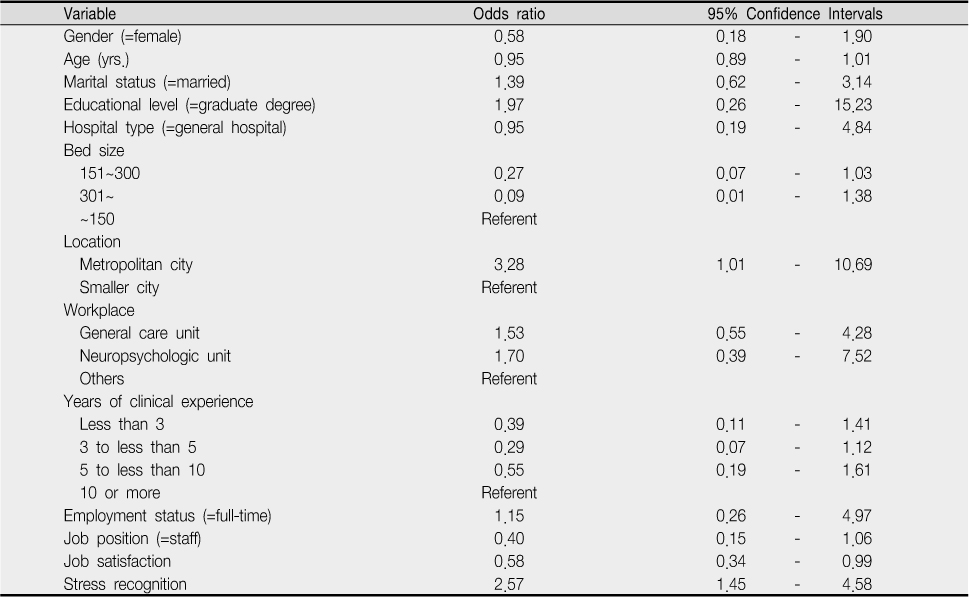
Of the 294 nurses, 19.1% (n=56) responded as having at least one injury during their job performance. The logistic regression analysis revealed that the significant factors influencing work related injuries were job satisfaction, stress recognition, and hospital's location. Nurses with a higher job satisfaction were less likely to experience work related injuries (OR=0.58). Nurses with a higher stress recognition (OR=2.57) and those working at hospitals in metropolitan cities (OR=3.28) were more likely to experience work related injuries.
Conclusions
The result of this study indicated that a substantial proportion of nurses in small and medium sized hospitals had experienced injuries related to nursing job. Interventions to prevent work related injuries among nurses should take into account the job satisfaction, stress recognition, and hospital characteristics.
2. Alamgir H, Cvitkovtch Y, Yu S, Yassi A. Work-related injury among direct care occupations in British Columbia, Canada. Occup Environ Med. 2007;64(11):769-775.
3. de Castro AB, Fujishiro K, Rue T, Tagalog EA, Samaco-Paquiz LP, Gee GC. Associations between work schedule characteristics and occupational injury and illness. Int Nurs Rev. 2010;57(2):188-194.
4. Chang SJ, Koh SB, Kang D, Kim SA, Chung JJ, Lee CG, Kang MG, Hyun SJ, Cho JJ, Cha BS, Park JK. Fatigue as a predictor of medical utilization, occupational accident and sickness absence. Korean J Occup Environ Med. 2005;17(4):318-332.
6. Deilkas ET, Hofoss D. Psychometric properties of the Norwegian version of the Safety Attitudes Questionnaire (SAQ), Generic version (Short Form 2006). BMC Health Serv Res. 2008;8:191.
7. Dembe AE, Delbos R, Erickson JB. Estimates of injury risks for healthcare personnel working night shifts and long hours. Qual Saf Health Care. 2009;18(5):336-340.
8. Dembe AE, Erickson JB, Delbos R. Predictors of work-related injuries and illnesses: National survey findings. J Occup Environ Hyg. 2004;1(8):542-550.
9. Dembe AE, Erickson JB, Delbos RG, Banks SM. The impact of overtime and long work hours on occupational injuries and illnesses: new evidence from the United States. Occup Environ Med. 2005;62(9):588-597.
11. Jung DY, Won JU, Park SG, Chang SJ, Kim HC. Job stress as a risk factor for occupational injuries among employees of small and medium-sized companies. Korean J Occup Environ Med. 2010;22(1):37-47.
12. Korea Ministry of Labor. 2008 Statistics of industrial accidents. 2009;Seoul, Korea Ministry of Labor.
13. Lim HS, Ahn YS. Occupational diseases among health care workers approved by Korea labor welfare corporation. Korean J Occup Environ Med. 2003;15(2):196-204.
14. Muecke S. Effects of rotating night shifts: literature review. J Adv Nurs. 2005;50(4):433-439.
17. Polit DF. Statistics and data analysis for nursing research. 2010;2nd ed. New Jersey, Pearson.
18. Samaha E, Lal S, Samaha N, Wyndham J. Psychological, lifestyle and coping contributors to chronic fatigue in shift-worker nurses. J Adv Nurs. 2007;59(3):221-232.
20. Simpson SA, Wadsworth EJ, Moss SC, Smith AP. Minor injuries, cognitive failures and accidents at work: incidence and associated features. Occup Med (Lond). 2005;55(2):99-108.
21. Sveinsdottir H. Self-assessed quality of sleep, occupational health, working environment, illness experience and job satisfaction of female nurses working different combination of shifts. Scand J Caring Sci. 2006;20(2):229-237.
22. Zontek TL, Isernhagen JC, Ogle BR. Psychosocial factors contributing to occupational injuries among direct care workers. AAOHN J. 2009;57(8):338-347.
23. Yoo SJ, Choi YH. Predictive factors influencing turnover intention of nurses in small and medium-sized hospitals in Daegu city. J Korean Acad Nurs Adm. 2009;15(1):16-25.
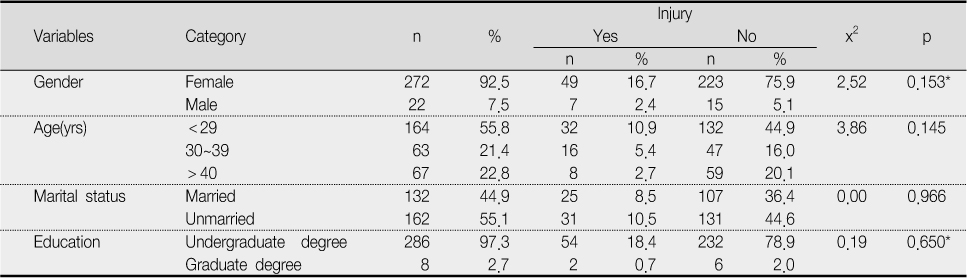
Table 1
General characteristics of the participants by injury occurrence
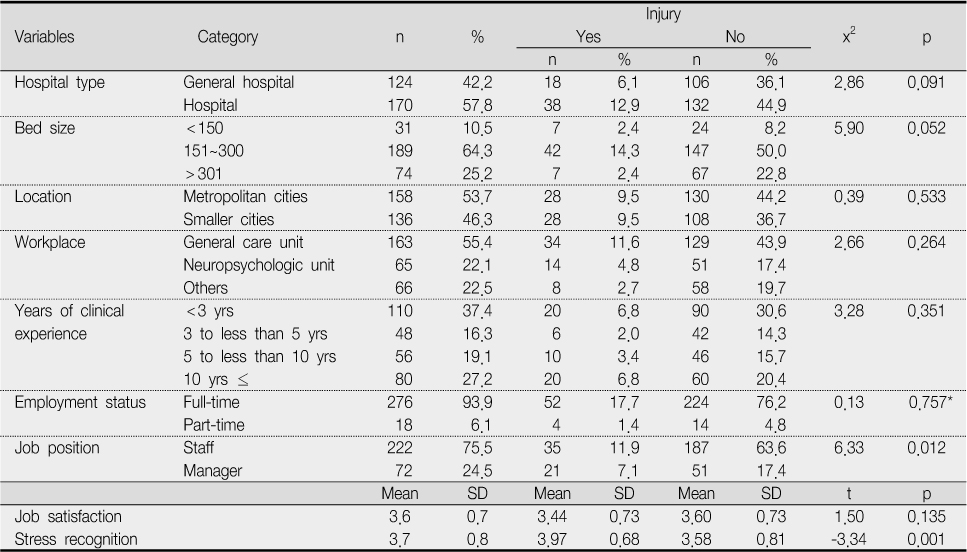
Table 2
Job-related characteristics by injury occurrence
*Fisher's exact test
Table 3
Pearson correlation coefficients among continuous variables
***<.001, **<.01, *<.05
Table 4
Logistic regression results for work-related injury occurrence
Figure & Data
References
Citations
Citations to this article as recorded by
Nurses’ perception of ethical climate, medical error experience and intent-to-leave Jee-In Hwang, Hyeoun-Ae Park Nursing Ethics.2014; 21(1): 28. CrossRef