
• KANAD
  • Contact us
  • E-Submission
ABOUT
BROWSE ARTICLES
EDITORIAL POLICY
FOR CONTRIBUTORS

Articles

Original Article

Adaptation Process of Nurses Who Return to Work after Parental Leave

Journal of Korean Academy of Nursing Administration 2016;22(1):33-45.
Published online: January 31, 2016

1Department of Nursing, Dongshin University, Korea.

2College of Nursing, Chonnam National University, Korea.

Corresponding author: Cho Chung, Hyang-In. College of Nursing, Chonnam National University, 160 Baekseo-ro, Dong-gu, Gwangju 61468, Korea. Tel: +82-62-530-4956, Fax: +82-62-220-4544, hchoch@hanmail.net
• Received: November 2, 2015   • Revised: November 30, 2015   • Accepted: December 21, 2015

Copyright © 2016 Korean Academy of Nursing Administration

This is an open access article distributed under the terms of the Creative Commons Attribution Non-Commercial License (http://creativecommons.org/licenses/by-nc/3.0/), which permits unrestricted non-commercial use, distribution, and reproduction in any medium, provided the original work is properly cited.

  • 803 Views
  • 16 Download
  • 11 Crossref
prev next
  • Purpose
    This study was conducted to generate a grounded substantive theory of the adaptation process of nurses who return to work after taking parental leave.
  • Methods
    Individual in-depth interviews with 13 participants were conducted between June and September 2014. Participants were interviewed 1~3 times; interviews were continued until the data became saturated. Data were analyzed using Strauss and Corbin's grounded theory method.
  • Results
    The core category of experience of the process of adaptation as a nurse who returned to work after parental leave was 'trying to regain one's previous position'. Participants used five interactional strategies: 'preparing in advance', 'initiating relationships with colleagues', 'keeping a positive attitude', 'understanding parenting helpers', 'Taking burden off one's mind'.
  • Conclusion
    The results of this study provide a theoretical basis for the adaptation process of nurses returning to work after taking parental leave. The importance of improving nurses' attitudes to their co-workers who take parental leave is highlighted along with the necessity of providing a family-friendly work environment. These results can be used to develop supportive policies and programs for nurses who return to their work after parental leave.

This article is a revision of the first author's doctoral dissertation from Chonnam National University.

  • 1. Kang SJ, Kim SY. The relationship among nurses' parenting stress and turnover intention. J Korean Acad Nurs Adm. 2011;17(4):508-515.
  • 2. Park YK, Yi JY, Lim SR, Jang HR, Kang HJ, Kim JS. Parenting stress, parenting guilt feelings, separation anxiety and alternative care in hospital-nurses. J Korea Contents Assoc. 2014;14(7):302-311.
  • 3. Hospital Nurses Association. 2014 Annual Report. Seoul: Author; 2014.
  • 4. Lee GJ. Nurse career break survey and reemployment support business performance evaluation studies [Internet]. Seoul, Korean Nurses Association. 2014;cited 2015 August 20. Available from: http://webzine.koreanurse.or.kr/Webzine2014/read_article.php?webzine_id=40&sub_cat_id=447&is_sub_no=694&article_id=939
  • 5. McMurtrie LJ, Cameron M, Oluanaigh P, Osborne YT. Keeping our nursing and midwifery workforce: Factors that support non-practising clinicians to return to practice. Nurse Educ Today. 2014;34(5):761-765.
  • 6. Statistics Korea. Utilization of female employees parental leave in 2013 [Internet]. Daejeon, Author. 2014;cited 2014, November 27. Available from: http://index.go.kr/potal/main/EachDtlPageDetail.do?idx_cd=3030
  • 7. Hospital Nurses Association. 2013 Annual Report. Seoul: Author; 2014.
  • 8. Park JH, Lee SG, Yun JH. Labor market analysis utilizing the employment insurance DB. Seoul: APRO; 2013. p. 1-163.
  • 9. Park HS, Kim KN, Kang EH, Lee JM, Park SM. Lived adaptation experience of new ICU nurses who are working in a newly established university hospital. J Korean Acad Fundam Nurs. 2011;18(2):226-236.
  • 10. Huang FF, Yang HH. The effects of nationality differences and work stressors on work adjustment for foreign nurse aides. BMC Health Serv Res. 2011;11:(1):192
  • 11. Baker M, Milligan K. How does job-protected maternity leave affect mother's employment? J Labor Econ. 2008;26(4):656-691.
  • 12. Pronzato CD. Return to work after childbirth: Does parental leave matter in Europe? Rev Econ Househ. 2009;7(4):341-360.
  • 13. Feldman R, Sussman AL, Zigler E. Parental leave and work adaptation at the transition to parenthood: Individual, marital, and social correlates. J Appl Dev Psychol. 2004;25(4):459-479.
  • 14. Kim JH. Parental leave and female labor supply in Korea. KDI J Econ Policy. 2012;3(1):169-197.
  • 15. Kim JW. An empirical study on parental leave and job continuity among female workers. Soc Welf Policy. 2008;33:239-260.
  • 16. Strauss A, Corbin J. Basic of qualitative research: Techniques and procedures for developing grounded theory. 2nd ed. London, UK: Sage Publication, Inc; 1998.
  • 17. Guba EG, Lincoln YS. Competing paradigms in qualitative research. In: Densin NK, Lincoln YS, editors. Handbook of qualitative research. Thousand Oaks, CA: Sage; 1994. p. 105-117.
  • 18. Byeon YS, Kim MY. Re-employment experience of nurses who have left the profession. J Korean Acad Nurs. 2008;38(5):768-778.
  • 19. Lee SW, Kim MJ, Yun ES, Park JD. Re-employment adaptation experience of nurses. Qual Res. 2009;10(1):39-50.
  • 20. Kim SC, Cho MK, Seong JA, Ryu DS. An analysis of necessary competencies for the woman scientists and technicians to return and rapid adapt to the research site. Korean J Hum Resour Dev. 2014;16(1):121-141.
  • 21. Jang SY, Ahn SY. The development and effectiveness of the program to assist highly-educated reentry women to labor market. Andragog Today. 2007;10(4):25-45.
  • 22. Choi YS, Yoon HH, Lee YM. A study on the workplace adapation of middle-aged (re-)employed female workers. Research report. Seoul: KRIVET; 2012. December;Report No.: 2012-52.
  • 23. Jang SY. The qualitative research on the reentry process of highly-educated housewives to their job market. Women Stud. 2008;74(1):79-104.
  • 24. Choi S, Kim JH. Experiences of clinical nurses aged over 40 as shift workers. J Korean Acad Nurs Adm. 2014;20(5):514-524.
  • 25. Chae HY, Lee KY. A qualitative study on men's experiences of work-life balance: focusing on men in dual-income families with children under the age of six. Fam Environ Res. 2013;51(5):497-511.
  • 26. Kim EK. The effect of marital relationship on the second childbirth intention. J Fam Relat. 2014;18(4):199-217.
  • 27. Choi JS. A grounded theory research on work-family role conflict: based on professional women with school aged children. Ment Health Soc Work. 2011;39(12):214-247.
  • 28. Nowak MJ, Naude M, Thomas G. Returning to work after maternity leave: Childcare and workplace flexibility. Korean J Ind Relat. 2013;55(1):118-135.
  • 29. Son JH. Career experiences of highly educated professional women: Focusing on women with 5-10 career years. Korean J Couns. 2013;14(1):501-522.
  • 30. Alstveit M, Severinsson E, Karlsen B. Readjusting one's life in the tension inherent in work and motherhood. J Adv Nurs. 2011;67(10):2151-2160.
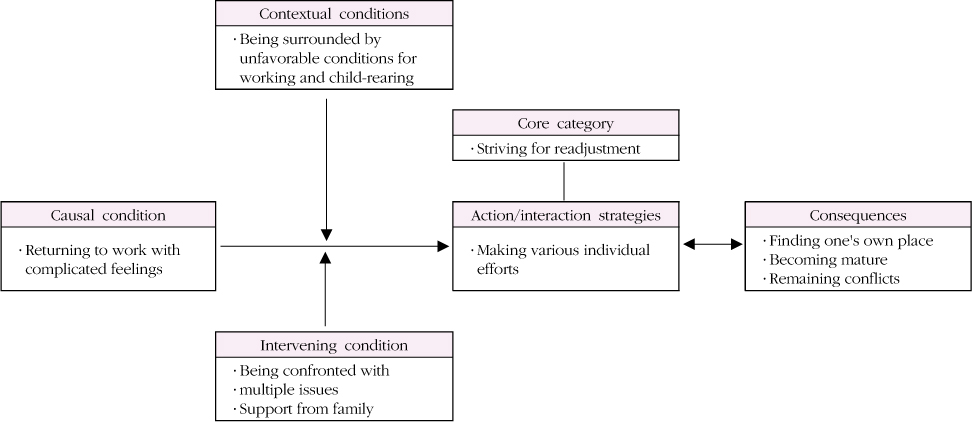
Figure 1

Paradigm model on adaptation process of nurses who returned to work after parental leave.

jkana-22-33-g001.jpg
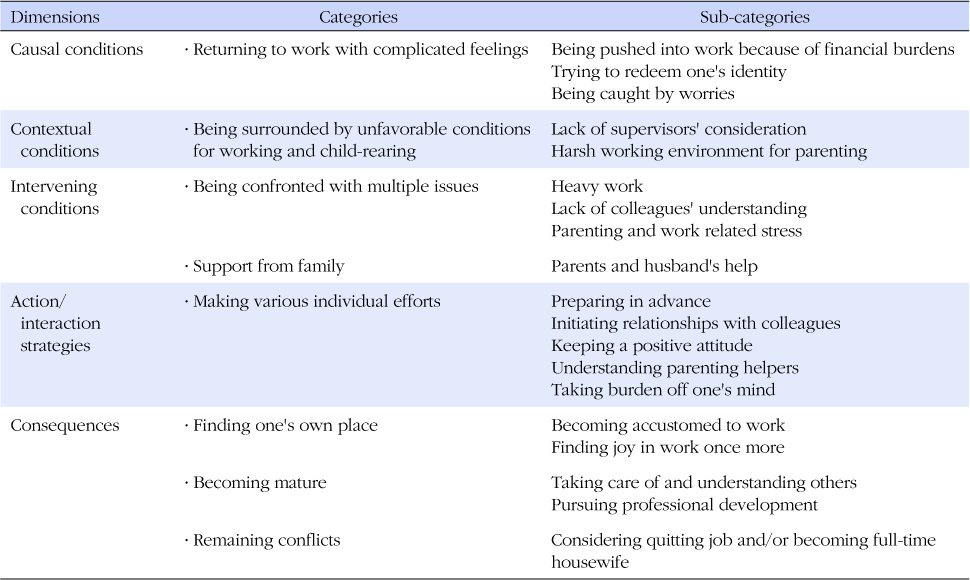
Table 1

Dimensions, Categories and Sub-categories of the Adaptation Process of Nurses who Returned to Work after Parental Leave

jkana-22-33-i001.jpg

Figure & Data

References

    Citations

    Citations to this article as recorded by  
    • Buying Time: Maternity Leave Policies and Critical Care Nurses’ Return to Work
      Adrianna Lorraine Watson, Daluchukwu Megwalu Tapp, Chelsey Young, Saydie Holyoak, Grace Houston, Brooklynn Nelson, Ashlynn Wood, Gabriela Marquez
      American Journal of Critical Care.2026; 35(2): 128.     CrossRef
    • Yoğun Bakım Hemşirelerinin Eksternal Ventriküler Drenaj Bakımına İlişkin Bilgi Düzeyleri: Yarı Deneysel Bir Çalışma
      Sema Koçaşlı, Cemile Nida Kayış, Şenay Gökdemir
      Yoğun Bakım Hemşireliği Dergisi.2025; 29(1): 33.     CrossRef
    • Parenting Without Penalty: Paid Parental Leave as a Boundary‐Management Strategy for Nursing Workforce Sustainability
      Adrianna Watson
      Journal of Advanced Nursing.2025;[Epub]     CrossRef
    • Experiences of Female Nurses’ Parental Leave in Taiwan: A Qualitative Study
      Ya-Hui Tseng, Kuo-Feng Wu, Hung-Ru Lin
      Healthcare.2023; 11(5): 664.     CrossRef
    • A Study on the Awareness of Dental Hygienists on Maternity Protection and Work-Family Balance Assistance Policy
      Seon-Hui Kwak, Bo-Mi Shin, Soo-Myoung Bae
      Journal of Dental Hygiene Science.2023; 23(4): 396.     CrossRef
    • Do parenting stress, work-family conflict, and resilience affect retention intention in Korean nurses returning to work after parental leave?: a cross-sectional study
      Young-Eun Jung, Mi-Hae Sung
      Korean Journal of Women Health Nursing.2022; 28(1): 18.     CrossRef
    • Development and Validation of an Instrument for Measuring Parenting Stress among Clinical Nurses
      Kyungmi Lee, Hyosung Cha
      Asian Nursing Research.2021; 15(4): 223.     CrossRef
    • Effect of Parenting Stress and Co-worker Support on Work-Life Balance in Nurses Reinstated after Parental Leave
      Yi-Rang Jeong, Taewha Lee
      Journal of Korean Academy of Nursing Administration.2020; 26(4): 331.     CrossRef
    • Effects of Leader-Member Exchange of Nurses who Return to Work after Parental Leave on Conflict between Work and Family: Focus on the Mediating Effects of Job Stress
      Ji Hyun Yoon, Jung-Ha Park
      Journal of Korean Academy of Nursing Administration.2020; 26(3): 294.     CrossRef
    • Influence of Awareness and Perceived Ease in Using Parental Leave on Job Satisfaction of Nurses in a Public Hospital
      Kyung-Suk Jang, Yeo-Jin Yi
      Journal of Korean Academy of Nursing Administration.2018; 24(3): 211.     CrossRef
    • The stress experience of nurses who are reemployed after career interruption
      Eun-Jin Soun, Jae-Hyeon Eom, Eun-Sook Nam, Young-Ran Chae, Myung-Sook Kil, Eun-Ha Park
      Journal of the Korea Academia-Industrial cooperation Society.2016; 17(5): 125.     CrossRef

    Download Citation

    Download a citation file in RIS format that can be imported by all major citation management software, including EndNote, ProCite, RefWorks, and Reference Manager.

    Format:

    Include:

    Adaptation Process of Nurses Who Return to Work after Parental Leave
    J Korean Acad Nurs Adm. 2016;22(1):33-45.   Published online January 31, 2016
    Download Citation
    Download a citation file in RIS format that can be imported by all major citation management software, including EndNote, ProCite, RefWorks, and Reference Manager.

    Format:
    • RIS — For EndNote, ProCite, RefWorks, and most other reference management software
    • BibTeX — For JabRef, BibDesk, and other BibTeX-specific software
    Include:
    • Citation for the content below
    Adaptation Process of Nurses Who Return to Work after Parental Leave
    J Korean Acad Nurs Adm. 2016;22(1):33-45.   Published online January 31, 2016
    Close

    Figure

    • 0
    Adaptation Process of Nurses Who Return to Work after Parental Leave
    Image
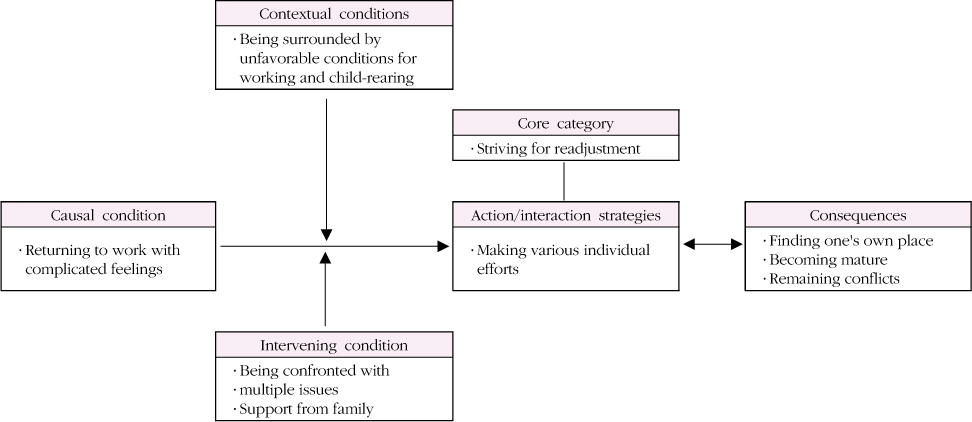
    Figure 1 Paradigm model on adaptation process of nurses who returned to work after parental leave.
    Adaptation Process of Nurses Who Return to Work after Parental Leave

    Dimensions, Categories and Sub-categories of the Adaptation Process of Nurses who Returned to Work after Parental Leave

    Table 1 Dimensions, Categories and Sub-categories of the Adaptation Process of Nurses who Returned to Work after Parental Leave

    TOP