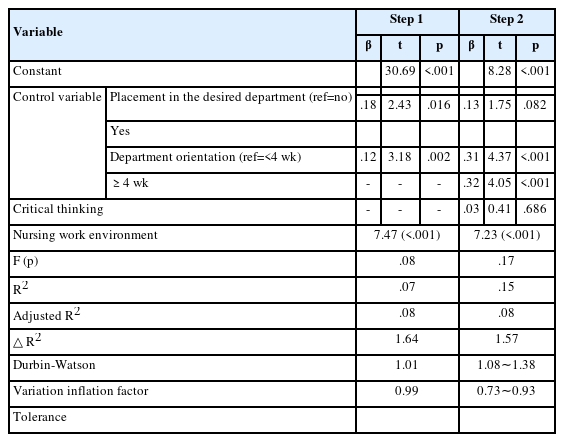
Purpose This study aimed to identify the influences of fatigue, critical thinking, and nursing work environment on patient safety nursing behaviors among new graduate nurses. Methods: The participants were 180 new graduate nurses who had been working for less than 12 months in hospitals. Data were collected using a structured, self-administered survey from December 15 to 30, 2023. The SPSS version 29.0 program was used for data analysis, which included descriptive analysis, the t-test, one-way analysis of variance (ANOVA), Pearson correlation coefficients, and hierarchical regression analysis. Results: Hierarchical regression analysis showed that critical thinking (β=.32, p<.001) and department orientation (β=.31, p<.001) were significant factors influencing patient safety nursing behavior. Conclusion: These results suggest that providing sufficient departmental orientation for new graduate nurses is necessary to support accurate and safe patient safety nursing practices. In addition, it is important to foster critical thinking and to develop and implement educational programs that enhance patient safety nursing behaviors, and to establish comprehensive support systems.
Purpose This study aimed to investigate the influence of role conflict, head nurses’ super leadership and nursing organizational culture on organizational commitment among male nurses.
Methods: This cross-sectional study included 221 male nurses who had worked for more than six months in university hospitals, general hospitals, and clinics. Data were collected using structured, self-administered questionnaires on role conflict, head nurse super leadership, nursing organizational culture, and organizational commitment. The data obtained were analyzed using descriptive analysis, independent t-test, analysis of variance, Scheffé test, Pearson’s correlation coefficients, and regression analysis.
Results: Organizational commitment had a significant positive correlation with head nurse super leadership, innovation-oriented culture, and relation-oriented culture; however, it had a significant negative correlation with role conflict and task-oriented culture. Among the general characteristics, the significant factors influencing organizational commitment among male nurses were number of beds and departments. Furthermore, among the main variables, innovation-oriented culture, task-oriented culture, role conflict, and head nurse super leadership influenced organizational commitment.
Conclusion: To increase male nurses’ organizational commitment, it is necessary to create an innovative organizational culture, reduce role conflicts, and improve head nurse super leadership.
Citations
Citations to this article as recorded by
Why Self‐Leadership Alone Is Not Enough: How Professional Self‐Concept and Organizational Commitment Shape Male Nurses’ Intention to Stay Donghyeok Lee, Mihwa Shim, Jungmin Lee, Matthew Vandermeulen Journal of Nursing Management.2026;[Epub] CrossRef
Organizational Culture and Resulting Leadership Behaviors: Empirical Evidence from Social Workers in Kuwait Hamad Adel Alaslawi Human Service Organizations: Management, Leadership & Governance.2024; 48(5): 582. CrossRef
“I’d Rather Do It Single-Handed”—Nursing Students’ Struggles with Group Assignments: A Qualitative Study Aimei Mao, Pak-Leng Cheong, Iat-Kio Van, Hon-Lon Tam Education Sciences.2023; 13(10): 1053. CrossRef
Purpose Nurses’ burnout is at risk due to increased of respiratory infections and their high demand and expectations. This study aimed to identify the factors that influence burnout among nurses caring for patients with respiratory infections.
Methods: A total of 196 nurses caring for patients with respiratory infections from nine hospitals in Korea participated in this study. Data were collected through a structured, self-administered survey that included general characteristics, risk perception of respiratory infections, infection control fatigue, positive psychological capital, and burnout.
Results: Burnout was significantly positively correlated with infection control fatigue and significantly negatively correlated with positive psychological capital; burnout was not significantly related to risk perception of respiratory infections. Infection control fatigue, positive psychological capital and total career significantly influenced burnout. These variables accounted for 38% of the burnout among nurses caring for patients with respiratory infections.
Conclusion: Evidence-based guidelines are needed to support the ability of nurses with little experience in responding to infectious diseases and reducing infection control fatigue and providing effective educational programs at institutions that can improve the positive psychological capital of individual nurses.
Citations
Citations to this article as recorded by
Understanding Burnout in School Nurses: The Role of Job Demands, Resources, and Positive Psychological Capital Jun Young Shin, Seung Eun Lee, Brenna L. Morse The Journal of School Nursing.2025;[Epub] CrossRef
Factors Influencing Burnout of Nurses in Comprehensive Nursing Care Service Wards: Focusing on Positive Psychological Capital, Role Conflict, and Authentic Leadership Jung Wha Park, Kyoung Ja Kim, Ji Young Im, Ji Young Kim Journal of Korean Academy of Nursing Administration.2025; 31(4): 345. CrossRef
Effects of Infection Control Fatigue, Job Stress, and Resilience on Burnout in Nurses during the COVID-19 Era Chan Mi Moon, Jeong Hee Kang Journal of Korean Academy of Fundamentals of Nursing.2024; 31(4): 410. CrossRef
COVID-19 Obesity: Differences in Infection Risk Perception, Obesity Stress, Depression, and Intention to Participate in Leisure Sports Based on Weight Change Chulhwan Choi, Kyung-Rok Oh, Mun-Gyu Jun Healthcare.2023; 11(4): 526. CrossRef
The impact of Long COVID, work stress related to infectious diseases, fatigue, and coping on burnout among care providers in nursing home: A cross-sectional correlation study Hyunju Lee, Youngja Seo, Jihye Kim, Hye Young Song, Jinhee Park, Youngran Yang Journal of Korean Gerontological Nursing.2023; 25(3): 271. CrossRef
Effects of Job Stress, Social Support, and Infection Control Fatigue on Professional Quality of Life among Nurses in Designated COVID-19 Hospitals Minyoung Shin, Woojoung Joung Journal of Korean Academy of Nursing Administration.2023; 29(5): 603. CrossRef
The Influence of Infection Control Fatigue and Compassion Competence on Disaster Nursing Core Competencies of Nurses at COVID-19 Designated Hospitals Jae-Hyun Ha, Hyun-Ju Lee, Ki-Ryeon Kim Journal of Korean Academy of Fundamentals of Nursing.2022; 29(4): 461. CrossRef
Purpose This study was conducted to identify the influence of communication self-efficacy and perception of the patient safety culture on the experience of nursing errors among operating room nurses.
Methods: A cross-sectional design was used, with a convenience sample of 184 operation room nurses from 16 hospitals in Korea. Data were collected through a structured self-administered survey. The questionnaires included Communication, Self Efficacy, Safety Attitude Questionnaire, and experiences of nursing errors in operation room. Data were analyzed using descriptive analysis, Shapiro-Wilk test, Mann-Whitney U test, Kruskal-Wallis test, Pearson correlation coefficients and multiple linear regression.
Results: The experience of nursing errors had significant negative correlations with communication self-efficacy (r=-.39, p<.001) and perception of the patient safety culture (r=-.36, p<.001). Factors significantly influencing the experiences of nursing errors included communication self-efficacy (β=-.25, p=.002), and perception of patient safety culture (β=-.21, p=.009). The overall explanatory power was 19% (F=14.85, p<.001).
Conclusion: It is necessary to develop continuous education and programs improving communication self efficacy and perception of patient safety culture to reduce risk of nursing errors in the operating room.
Citations
Citations to this article as recorded by
Development of a communication self-efficacy scale for nurses: a psychometric validation study Kuem Sun Han, Jihye Shin, Soo Yeon Lee Journal of Korean Academy of Nursing.2025; 55(2): 269. CrossRef
Lived Experiences of Nurses in Delivering Peri-Operative Care Emilyn Fajardo, Romeo Tuazon, Ariel Bongco Psychology and Education: A Multidisciplinary Journal.2025; 38(8): 861. CrossRef
The relationship between clinical decision-making levels and self-efficacy levels of operating room nurses Sedat Kaya, Gizem Kubat Bakir Perioperative Care and Operating Room Management.2024; 37: 100416. CrossRef
Efficacy of an error reporting-based education program on nursing students’ skill confidence, immersion, and satisfaction Youngsook Lim, Sunae Kim, Ohsoon Yoon, SunJung Park International Journal of ADVANCED AND APPLIED SCIENCES.2023; 10(10): 200. CrossRef
The Relationship between Nurse-Perceived Patient Safety Culture and Patient Safety Hyunju Ji, Seung Eun Lee Journal of Korean Academy of Nursing Administration.2022; 28(3): 190. CrossRef


 First
First Prev
Prev