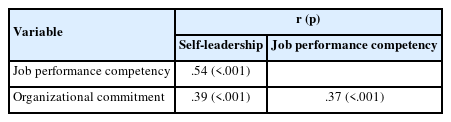
Purpose This study aimed to determine the effects of self-leadership on job performance competency and organizational commitment among insurance review nurses. Methods: A nationwide online survey was conducted using structured questionnaires. Participants included 189 insurance review nurses working in advanced general hospitals and general hospitals in South Korea. Data were collected through self-administered questionnaires between August 19 and September 17, 2021. Data analysis was performed using descriptive statistics, independent t-tests, one-way analysis of variance, Pearson’s correlation coefficients, and hierarchical multiple regression with IBM SPSS version 23.0. Results: The mean score for self-leadership was 3.64±0.43 out of 5, for job performance competency was 3.10±0.68 out of 5, and for organizational commitment was 4.38±1.09 out of 7. Statistically significant positive correlations were observed among self-leadership, job performance competency, and organizational commitment in insurance review nurses. Hierarchical multiple regression analysis showed that self-leadership explained an additional 13.9 percentage points of variance in job performance competency and an additional 5.3 percentage points in organizational commitment. Self-leadership emerged as a statistically significant predictor of both job performance competency and organizational commitment. Conclusion: This study empirically demonstrates that self-leadership has significant effects on job performance competency and organizational commitment among insurance review nurses. These findings provide empirical evidence relevant to human resource management strategies for insurance review nurses.
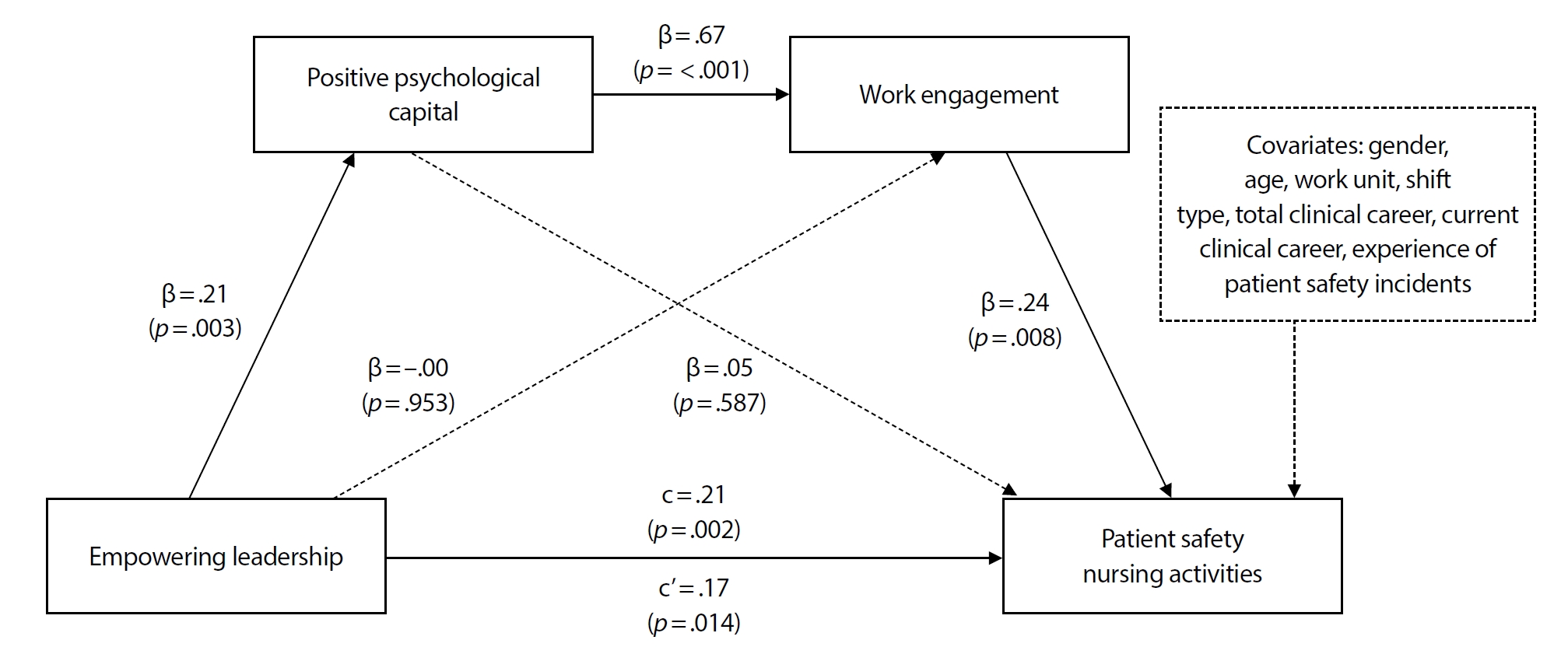
Purpose This study examined the double mediating effects of positive psychological capital and work engagement on the relationship between nurse unit managers’ empowering leadership and nurses’ patient safety nursing activities. Methods: Data were collected from 217 ward nurses employed at a tertiary hospital. Statistical analyses were conducted using SPSS version 29.0. Differences between groups were tested using independent t-tests, one-way analysis of variance, and the Duncan method. When normality assumptions were violated, the Mann–Whitney U and Kruskal–Wallis tests with Bonferroni correction were applied. Pearson correlation coefficients were computed, and mediation analysis was performed using Hayes’ PROCESS macro model 6. Results: Empowering leadership among nurse unit managers had a significantly positive effect on ‘nurses’ patient safety nursing activities. Furthermore, positive psychological capital and work engagement demonstrated significant double mediating effects on the relationship between empowering leadership and patient safety nursing activities. Conclusion: Enhancing patient safety nursing activities requires the establishment of a safety culture and institutional framework, the development of leadership training programs, and provision of systematic education.
Purpose This study aimed to examine the relationships among self-leadership, role conflict, practice environment, and patient safety competency, and to identify factors influencing patient safety competency in clinical practice nurses. Methods: A total of 152 clinical practice nurses from four university hospitals participated in this cross-sectional study. Data were collected using a structured questionnaire and analyzed to identify key predictors of patient safety competency. Results: Patient safety competency was positively associated with self-leadership, the practice environment, and the presence of regular educational programs tailored for clinical practice nurses. Self-leadership and the practice environment were identified as significant predictors, explaining 30% of the variance in patient safety competency. Conclusion: The findings underscore the importance of fostering self-leadership and enhancing the practice environment to improve patient safety competency among clinical practice nurses. Tailored education and training programs aimed at strengthening self-leadership skills should be developed. Additionally, organizational efforts to optimize the clinical practice environment are essential to support safe and effective nursing practice.
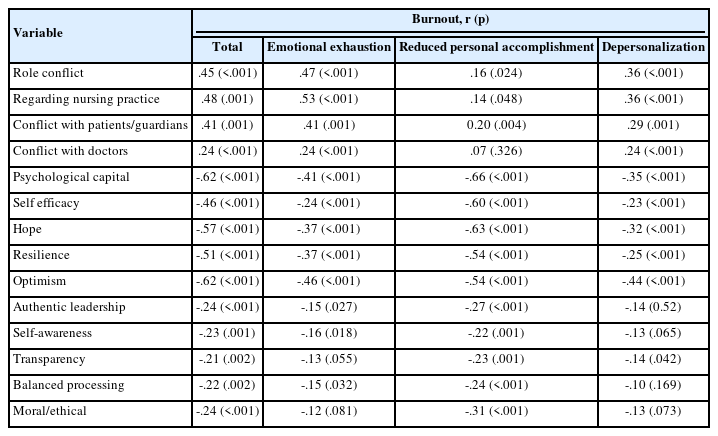
Purpose This study aimed to identify the influence of positive psychological capital, role conflict, and authentic leadership on burnout among nurses working in comprehensive nursing care service wards of general hospitals. Methods: A descriptive cross-sectional survey was conducted with 208 nurses from four general hospitals. Data were collected using structured questionnaires between September 26, 2024, and October 18, 2024, and were analyzed using descriptive statistics, independent t-tests, one-way analysis of variance, Pearson’s correlation coefficient, and hierarchical multiple regression analysis. Results: Burnout showed a correlation with role conflict (r=.45, p<.001), positive psychological capital (r=-.62, p<.001) and authentic leadership (r=-.24, p<.001). In the regression analysis, the factors significantly associated with burnout included conflict with patients/guardians (β=.24, p<.001) and conflict regarding nursing practices (β=.22, p<.001), which are subdomains of role conflict. Among the components of positive psychological capital, optimism (β=-.37, p<.001) was identified as a significant protective factor against burnout. However, authentic leadership was not found to be a statistically significant predictor. Conclusion: To effectively manage nurse burnout, it is essential to develop strategic programs that focus on enhancing optimism. Furthermore, establishing clear delegation guidelines between nurses and nursing assistants is recommended.
Citations
Citations to this article as recorded by
The Influence of Role Conflict and Organizational Justice on Nursing Service Quality: A Cross-Sectional Survey on Nurses’ Perceptions Jeon Seung Ahn, Jeong Eun Moon The Korean Journal of Health Service Management.2026; 20(1): 75. CrossRef
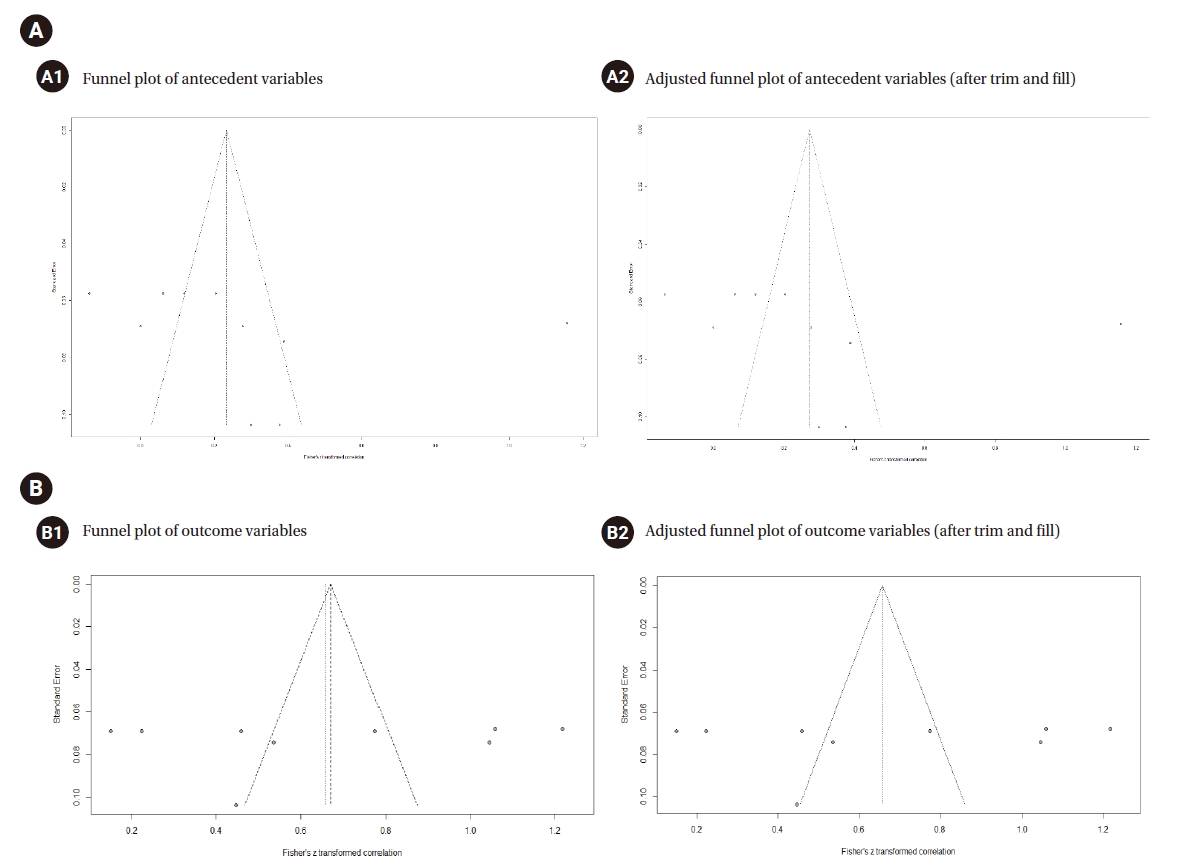
Purpose This study aimed to conduct a systematic review to explore leadership-related variables among nurses in the novice and advanced beginner stages, identify research trends, and analyze effect sizes to provide evidence for developing a nursing leadership program. Methods: A systematic review and meta-analysis were conducted according to PRISMA(Preferred Reporting Items for Systematic Reviews and Meta-Analyses) and NECA (National Evidence based Healthcare Collaborating Agency) guidelines. Literature was searched from February 26 to April 26, 2024 using databases including KISS, KMbase, RISS, KoreaMed, Science ON, CINAHL, CENTRAL, Embase, PubMed, Web of Science, and Korean nursing journals. Meta-analysis was performed using R version 3.6.2. Results: From 589 articles, five studies were selected. Self-leadership was most frequently studied topic (80.0%). Leadership antecedents with k≥2 included preceptor’s clinical teaching behavior (correlation effect size [ESr], 0.34). For leadership outcomes, effect size analyses for cases with k≥2 indicated resilience (ESr, 0.72), nursing performance (ESr, 0.69), and organizational socialization (ESr, 0.31), with resilience demonstrating the largest effect. Conclusion: Preceptor’s clinical teaching behavior, resilience, nursing performance, and organizational socialization were identified as critical factors in leadership of the nurses at novice and advanced beginner stage. Enhancing leadership requires preceptor support, which can improve resilience and help early-career nurses overcome challenges. Therefore, strategies for leadership development must include specific measures to ensure preceptor support.
Purpose This study aimed to identify the effects of shared leadership, communication skills, and team effectiveness, as perceived by nurses and nursing assistants in comprehensive nursing service units.
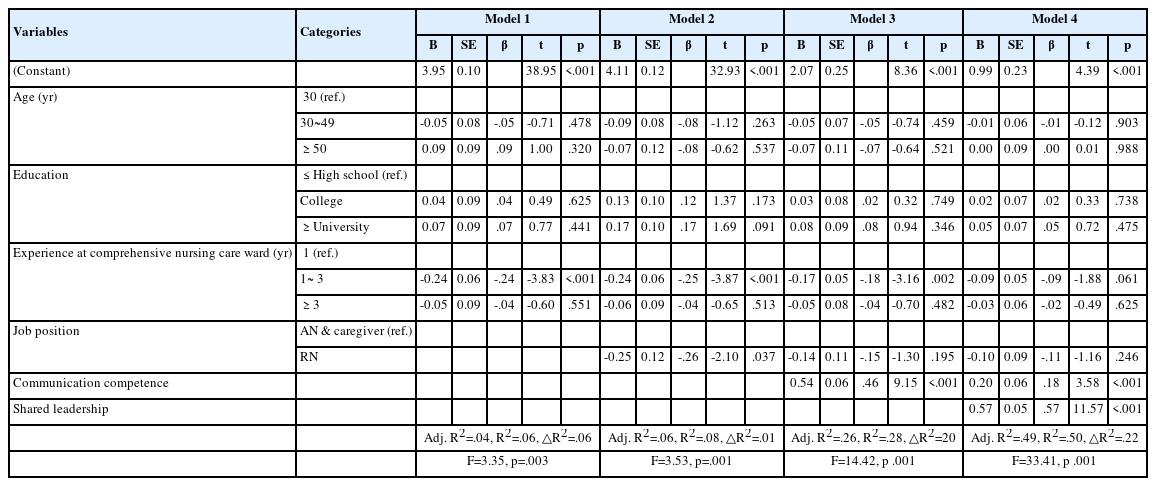
Methods A cross-sectional research design was adopted, and the sample included 306 nurses, nurse assistants, and caregivers working in nine hospitals with fewer than 500 beds in two South Korean cities. The data were analyzed using descriptive statistics, t-tests, ANOVA, Pearson’s correlation coefficient, and four-step hierarchical regression analysis.
Results The factors influencing team effectiveness in the hierarchal multiple regression analysis were shared leadership (β=.57, p<.001) and communication skills (β=.18, p<.001). These factors explained 49% of the total variance.
Conclusion To enhance team effectiveness in compressive nursing service units, educational programs focusing on shared leadership and communication skills among nurses, nursing assistants, and caregivers must be developed.
Citations
Citations to this article as recorded by
Effects of Shared Leadership, Role Conflict, and Organizational Commitment on Patient-Safety Competency Among Clinical Hye-Jeong Hwang Journal of Digital Contents Society.2025; 26(7): 1821. CrossRef
Impact of the Empowering Leadership of Nurse Unit Managers on Patient Safety Nursing Activities: Double Mediating Effects of Positive Psychological Capital and Work Engagement Jin-Young Park, Eungyung Kim Journal of Korean Academy of Nursing Administration.2025; 31(5): 516. CrossRef
Effects of Resilience, Nursing Managers’ Empowering Leadership on Turnover Intention among New Nurses: Mediating role of Transition Shock Hyun Jin Jung, Hyun Kyung Kim, Seok Hee Jeong Journal of Korean Academy of Nursing Administration.2024; 30(3): 212. CrossRef
The role of followership on organizational citizenship behavior in the service industry: A double mediation model Noermijati Noermijati, Ema Zahra Firdaus, Desi Tri Kurniawati, Masyhuri Problems and Perspectives in Management.2024; 22(2): 124. CrossRef
Factors Affecting Non-response in a Cohort Study of Female Participants: The Korea Nurses' Health Study (Preprint) Young Taek Kim, Chiyoung Prof. Cha, Gumhee Baek, Bohye Kim, Bo Mi Song, Joong-Yeon Lim, Hyun-Young Park, Juhyun Shin JMIR Public Health and Surveillance.2024;[Epub] CrossRef
Followership in health care clinicians: a scoping review Sulaiman Alanazi, Richard Wiechula, David Foley JBI Evidence Synthesis.2023; 21(9): 1764. CrossRef
Effect of Authentic Leadership to Organizational Citizenship Behavior of Nurses Mediated by Team Trust Eungju Kim, Eungyung Kim Journal of Korean Academy of Nursing Administration.2022; 28(4): 451. CrossRef


 First
First Prev
Prev