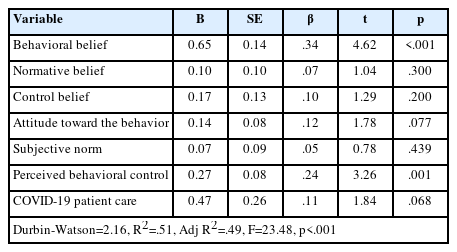
Purpose The coronavirus disease 2019 (COVID-19) pandemic has substantially influenced nursing environments and has underscored the importance of active patient care. Nursing intention plays a critical role in the provision of care for patients with COVID-19; however, limited evidence exists regarding the factors that influence nurses’ intention to provide patient care specific to COVID-19. This study aimed to examine factors associated with nursing intention for COVID-19 patient care, guided by the Theory of Planned Behavior. Methods: This study employed a cross-sectional descriptive design. Data were collected from August 30 to October 1, 2020, using structured questionnaires completed by 169 clinical nurses working in hospitals with more than 600 beds in Seoul, Korea. The collected data were analyzed using multiple regression analysis. Results: Behavioral beliefs (β=.34, p<.001) and perceived behavioral control (β=.24, p<.001) were significantly associated with nursing intention for COVID-19 patient care. Conclusion: There is a need to develop specific strategies and educational programs to enhance nursing intention for COVID-19 patient care in the context of emerging infectious diseases by strengthening behavioral beliefs and perceived behavioral control. Providing up-to-date care protocols or simulation-based education may help increase nurses’ behavioral beliefs and perceived behavioral control.

 First
First Prev
Prev