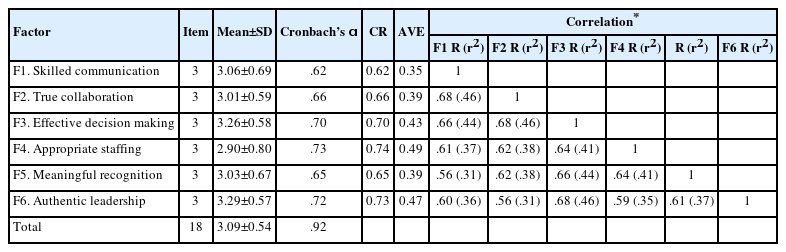
Purpose This study was conducted to evaluate the validity and reliability of the Korean version of the Healthy Work Environment Assessment Tool (K-HWEAT), originally developed by the American Association of Critical-Care Nurses. Methods: The study was conducted among nurses working at three university hospitals located in metropolitan areas between May 29 and October 10, 2019. A total of 543 nurses participated. Data were analyzed using AMOS version 26.0 to assess the construct validity of the K-HWEAT. Results: Confirmatory factor analysis initially failed to meet acceptable model fit indices. Model fit improved after reassigning item 1 from factor 1 to factor 2 and item 12 from factor 4 to factor 6, as well as allowing correlated error terms based on high modification indices. Following these adjustments, standardized root mean square residual remained unchanged (0.05 to 0.05) and root mean square error of approximation decreased from 0.09 to 0.07, whereas goodness of fit index increased from 0.88 to 0.91, adjusted goodness of fit index from 0.83 to 0.86, Normed Fit Index from 0.85 to 0.89, and comparative fit index from 0.88 to 0.92. The K-HWEAT demonstrated a moderate correlation with the Korean version of the Practice Environment Scale of the Nursing Work Index (r=.60, p<.001), supporting criterion validity. The overall Cronbach’s α was .92, with the six factors showing internal consistency coefficients ranging from 0.62 to 0.74. Conclusion: These findings support the reliability and validity of the K-HWEAT. However, further conceptual refinement of individual items may be necessary to enhance construct clarity.
PURPOSE Purposes of this study were to develop a Nurse Emotional Labor Strategy Scale in Korean (K-NELSS) and to evaluate its psychometric properties. METHODS The 14 items Emotional Labor Strategy Scale (ELSS) was translated into Korean and modified to apply to nurses. Two hundred and fifty nurses working in various units completed the questionnaire. Factor validity using confirmatory factor analysis, construct validity using correlation with burn-out, and criterion validity using correlation with Korean-Emotional Labor Scale (K-ELS) were identified. Reliability was tested by Cronbach's α. RESULTS K-NELSS has 3 domains: surface acting, deep acting, and expression of naturally felt emotions. Confirmatory factor analysis showed moderate goodness of fit (RMSEA=.80, SRMR=.07, CFI=93, TFI=.92). Correlation between surface acting and burn-out was r=.37 (p < .001), and between K-NELSS and K-ELS were r=.57 (p < .001) in surface action and r=.62 (p < .001) in deep acting. Cronbach's αs for surface acting, deep acting, and expression of naturally felt emotions were .89, .88, .84, respectively. CONCLUSION Psychometric properties of K-NELSS indicate that it is a useful and reliable tool to assess emotional labor of Korean nurses. In addition, with a small number of items, it is relatively easy to use.
Citations
Citations to this article as recorded by
Psychometric Evaluation of The Thai Version of Emotional Labor Scale (T-ELS) in Thai Nurses Vachira Posai, Wisarut Srisintorn, Paramee Thongsuksai, Chanokporn Jitpanya Journal of Health Research.2025;[Epub] CrossRef
Psychological pathway to emotional exhaustion among nurses and midwives who provide perinatal bereavement care in China: a path analysis Jialu Qian, Gaoyan Wu, Cecilia Jevitt, Shiwen Sun, Man Wang, Xiangyu Sun, Xiaoyan Yu BMC Psychiatry.2024;[Epub] CrossRef
The Level and Outcomes of Emotional Labor in Nurses: A Scoping Review Hanbo Feng, Meng Zhang, Xueting Li, Yang Shen, Xiaohan Li, Nilesh Kumar Journal of Nursing Management.2024;[Epub] CrossRef
Effects of Emotional Labor and Compassion Competence on Dental Hygiene Performance in Dental Hygienists Sun-Mi Kim, Young-Im Kim Journal of Dental Hygiene Science.2021; 21(2): 79. CrossRef
Emotional Labor Strategies, Stress, and Burnout Among Hospital Nurses: A Path Analysis Ji‐Soo Kim Journal of Nursing Scholarship.2020; 52(1): 105. CrossRef
Emotional labor and job types of male firefighters in Daegu Metropolitan City Sung Kyu Park, Han Cheol Heo, Joon Sakong, Man Joong Jeon Annals of Occupational and Environmental Medicine.2019;[Epub] CrossRef


 First
First Prev
Prev