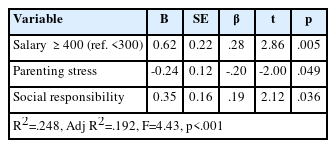
Purpose This study aimed to examine the factors influencing the retention intention of female nurses raising young and school-age children during the COVID-19 pandemic. Methods: In total, 131 female nurses working in hospitals with 30 or more beds who remained employed throughout the pandemic participated in this cross-sectional descriptive study. Data were collected using a structured self-report questionnaire in July 2023 and analyzed using descriptive statistics, correlation analysis, and multiple regression analysis with IBM SPSS 29.0. Results: The mean score for retention intention was 3.98 out of 5. Parenting stress averaged 3.02, family support 4.08, family-friendly policies 1.83 (out of 4), family-friendly organizational culture 2.98, and social responsibility 3.56. Regression analysis identified a monthly salary over 4 million KRW (β=.28, p=.005), parenting stress (β=–.20, p=.049), and social responsibility (β=.19, p=.036) as significant factors influencing retention intention, with an explanatory power of 19.2% (F=4.43, p<.001). Conclusion: Retention intention among nurses with young children during the COVID-19 pandemic was associated with financial stability, reduced parenting stress, and a strong sense of social responsibility. To enhance nurse retention during future public health crises, policies should incorporate practical childcare support and strengthen professional social responsibility.
PURPOSE The purposes of this study were to understand correlation of parenting stress and turnover intention of nurses, and to provide basic data for effective nursing management. METHODS Subjects included 287 nurses who had children and worked in hospitals. Data were collected through organized questionnaires from September 1st to 30th 2010. Collected data was analyzed with descriptive statistics, t-test, ANOVA, correlation analysis using PASW statistics 18 program. RESULTS The average score for parenting stress of the participants was 3.12 out of 5. Nurture stress was statistically different depending on age, job position, shift work, night duty and stages of family development. The average score for turnover intention of the participants was 3.34 out of 5. Turnover intention was statistically different depending on age, number of children and stages of family development. As a result of correlation analysis of parenting stress and turnover intention, turnover intention showed positive correlation with daily stress, stress caused from taking parent role and average parenting stress. CONCLUSION This study indicates that parenting stress is related with turnover intention, nursing managers should make efforts to decrease parenting stress in order to reduce turnover intention of nurses.
Citations
Citations to this article as recorded by
How parenting-related characteristics influence parenting stress among nurses with young children in the Seoul metropolitan area, South Korea: a cross-sectional study Minhwa Hwang, Nagyeong Lee, Gunjeong Lee BMC Nursing.2025;[Epub] CrossRef
Quality of Occupational Experience and Personal Characteristics in Association With Nurse Turnover Intentions Among Nurses Working in Hospital Toru Saigusa, Mitsuyoshi Takatori, Hisako Akaike, Miyuki Iino Journal of Japan Academy of Nursing Science.2024; 44: 90. CrossRef
Development and Validation of an Instrument for Measuring Parenting Stress among Clinical Nurses Kyungmi Lee, Hyosung Cha Asian Nursing Research.2021; 15(4): 223. CrossRef
Parenting stress, self‐efficacy and COVID‐19 health risks as predictors of general stress among nurses Aileen S. Garcia, Christin L. Carotta, Robin Brown, Patricia Da Rosa, Brandi Pravecek, Paula Carson International Journal of Nursing Practice.2021;[Epub] CrossRef
Experience of Conflict in Three Shift Nurses Rearing more than Two Kids: Phenomenological Study Jeung-Im Kim, Jeong Won Yeom, Sun-Kyung Park, Hyun-Hee Jeong, Uhm-Joo Min, Sun Hwa Park, Jung-Mi Lee, Young-Sun Yeom Korean Journal of Women Health Nursing.2018; 24(3): 252. CrossRef
Parenting stress in married dental hygienists Yoon-Sook Hwang, Soo-Hwa Kim Journal of Korean society of Dental Hygiene.2016; 16(3): 435. CrossRef
Adaptation Process of Nurses Who Return to Work after Parental Leave Hyo Ju Jung, Hyang-In Cho Chung Journal of Korean Academy of Nursing Administration.2016; 22(1): 33. CrossRef
Attitudes toward child rearing in female clinical nurses working in three shifts Eun‐Ho Ha Nursing & Health Sciences.2016; 18(4): 416. CrossRef
A Study on Variables Associated with Female Nurses’ Mothering Stresses Hyung Kyung Park, Hyuk Jun Moon Family and Environment Research.2015; 53(6): 595. CrossRef
Effects of job satisfaction and spouse support on parenting stress in female fire fighters with preschool-aged children Ga-Young Che, Mi-Lye Baek The Korean Journal of Emergency Medical Services.2015; 19(1): 87. CrossRef



 First
First Prev
Prev