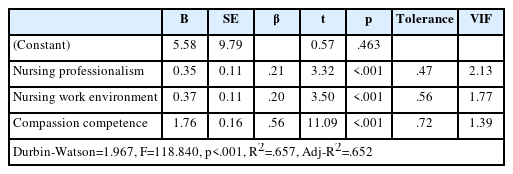
Purpose This study aimed to identify the influence of nursing professionalism, the nursing work environment, and compassion competence on person-centered care among nurses working in comprehensive nursing care units. Methods: An online survey using structured self-report questionnaires was administered to 190 nurses in comprehensive nursing care units at three tertiary general hospitals. The collected data were analyzed using descriptive statistics, the independent t-test, the Mann-Whitney U-test, one-way analysis of variance, Pearson’s correlation coefficient, and multiple linear regression using SPSS version 29.0 program. Results: The average score for person-centered care was 3.70±0.49, nursing professionalism was 3.56±0.51, the nursing work environment was 2.53±0.46, and compassion competence was 4.01±0.47. Person-centered care demonstrated significant positive correlations with nursing professionalism (r=.636, p<.001), the nursing work environment (r=.542, p<.001), and compassion competence (r=.743, p<.001). Factors influencing person-centered care included compassion competence (β=.56, p<.001), nursing professionalism (β=.21, p<.001), and the nursing work environment (β=.20, p<.001), with an explanatory power of 65.2% (F=118.84, p<.001). Conclusion: To improve person-centered care among nurses in comprehensive nursing care units, it is necessary to strengthen nurses’ compassion competence and professionalism, as well as enhance the nursing work environment. The findings of this study may be used as foundational evidence for developing programs to promote person-centered care in comprehensive nursing care units.
Purpose This study examined hospital nurses’ perception of work-life balance, nursing work environment, nursing organizational culture, and job satisfaction before turnover, and compared differences in variables between current clinical nurses and non-clinical nurses. Methods This descriptive study involved 172 nurses with over six months experience, who changed jobs within the last 5 years in G Province. Data were collected from September 5th-22nd, 2022, and analyzed through independent t-test, one-way ANOVA, and Pearson correlation coefficient using SPSS/WIN 25.0 program. Results Total work-life balance (t=3.85, p<.001), work-family balance (t=4.79, p<.001), work-leisure balance (t=2.96, p=.004), work-growth balance (t=3.01, p=.003), and overall work-life balance (t=2.95, p=.004) in work-life balance, the role of professionalism (r=2.05, p=.042) and interpersonal relationships (t=2.59, p=.011) in job satisfaction, the relationship-oriented nursing organizational culture (t=2.68, p=.008), and the nurse-doctor relationship within the nursing work environment (t=2.51, p=.013) were all significantly higher among current clinical nurses than non-clinical nurses. Conclusion Hospital-level interventions should be established and implemented to improve work-life balance, the relationship-oriented nursing organizational culture, and job satisfaction through interprofessional relationships to retain hospital nurses.
Citations
Citations to this article as recorded by
The Effects of Nurses’ Dispatch Work Characteristics on Job Embeddedness, Organizational Commitment, and Turnover Intention Eejee Jung, Gunjeong Lee Journal of Korean Academy of Nursing Administration.2025; 31(5): 560. CrossRef
PURPOSE This study was done to investigate the relationships between nursing work environment, leader-member exchange(LMX), peer support, and organizational commitment in one city with a severe nurse shortage. METHODS Participants were 198 nurses who had worked for more than 6 months with the same head nurse. They worked in five general hospitals located in one city. In April 2016 participants completed a survey questionnaire about their nursing work environment, LMX, peer support, and organizational commitment. Data were analyzed using descriptive statistics, t-test, ANOVA, Pearson correlation coefficient, and multiple regression. RESULTS There was a significant difference in nursing work environment by experience of turnover (t=−2.58, p=.010). LMX showed significant difference by department (F=3.81, p=.011). Factors influencing nurses' organizational commitment were nurse participation in hospital affairs (β=.23, p=.028) and nurse manager ability, leadership and support (β=.18, p=.022). Explanatory power was 18.2% in the regression model. CONCLUSION The results suggest that it is necessary to improve the nursing work environment in order to increase organizational commitment. Improvement of the nursing system should be considered along with supplementation of nurses particularly during a severe nurse shortage.
Citations
Citations to this article as recorded by
The Journey to First‐Line Nursing Management: A Qualitative Study in a Spanish University Hospital Beatriz Esquisábel‐Soteras, Glenn Robert, Aitor Acilu‐Fernández, Alberto González‐García, Sofía Neddermann‐Carrillo, Mónica Vázquez‐Calatayud, Miren Idoia Pardavila‐Belio Journal of Advanced Nursing.2026; 82(1): 662. CrossRef
Effect of Leader-Member Exchange on Patient Safety Culture in Perioperative Nurses: The Mediating Role of Organizational Silence Nayeop Lee, Yoonju Lee Journal of Korean Academy of Nursing Administration.2024; 30(5): 462. CrossRef
The Effect of Professional Autonomy and Nursing Work Environment on Nurses’ Patient Safety Activities: A Perspective on Magnet Hospitals Songyi Yuk, Soyoung Yu, Shawn Yong-Shian Goh Journal of Nursing Management.2023; 2023: 1. CrossRef
The Effect of Nurses’ Perceived Leader-Member Exchange on Psychological Ownership, Job Engagement, and Turnover Intention Eun Ah Cho, Myun Sook Jung, Eun Ju Heo Journal of Korean Academy of Nursing Administration.2023; 29(3): 298. CrossRef
The Influence of Relational Bonds, Followership, and Occupational Stress on Nurses' Organizational Commitment Gipeum Choi, Hyojung Park Journal of Korean Academy of Fundamentals of Nursing.2023; 30(1): 56. CrossRef
Association of Nursing Work Environment, Relationship with the Head Nurse, and Resilience with Post-Traumatic Growth in Emergency Department Nurses Sun-Young Jung, Jin-Hwa Park International Journal of Environmental Research and Public Health.2021; 18(6): 2857. CrossRef
Factors Influencing Retention Intention of Nurses at Long-Term Care Hospitals in Korea So Young Shin, Joo Hee Kim Journal of Gerontological Nursing.2021; 47(10): 44. CrossRef
Why Do They Stay? Intention to Stay among Registered Nurses in Nursing Homes Ji Yeon Lee, Juh Hyun Shin International Journal of Environmental Research and Public Health.2020; 17(22): 8485. CrossRef
Analyzing the Job Demands-Control-Support Model in Work-Life Balance: A Study among Nurses in the European Context Virginia Navajas-Romero, Antonio Ariza-Montes, Felipe Hernández-Perlines International Journal of Environmental Research and Public Health.2020; 17(8): 2847. CrossRef
Effects of Positive Psychological Capital, Social Support and Head Nurses' Authentic Leadership on Organizational Commitment of Nurses at the Advanced Beginner Stage Hye Sook Kwon, Yeongmi Ha Journal of Korean Academy of Nursing Administration.2020; 26(3): 284. CrossRef
Mediating Effect of Nursing Professionalism on the Relationship between Nurses' Character and Organizational Commitment of the Nurse Sun Young Jung, Hyun Deuk Lee Journal of Korean Academy of Nursing Administration.2019; 25(3): 239. CrossRef
PURPOSE The study was undertaken to investigate influence of nurses' work environment, organizational commitment, and nursing professionalism on turnover intention of nurses working in long term care hospitals. METHODS The study was cross-sectional study. Participants were 199 nurses working in one of 7 long term care hospitals. Data were collected from May 1 to June 30, 2016 and analysed using two stage hierarchial regression analysis with SPSS 22.0. RESULTS There was a statistically significant difference in turnover intention according to age (F=6.23, p < .001), present work career (t=−2.11, p=.036), frequency of night duty (t=−3.53, p=.001), and present position (t=−4.07, p < .001). The significant predictors of turnover intention were attachment (β=−0.29, p=.005), nursing professionalism (β=−.21, p=.030), identification (β=−.21, p=.014), continuance (β=−.19, p=.008), collegial nurse-physician relations (β=−.16, p=.039), and originality of nursing (β=.16, p=.014). These factors explained 50.4% of the variance. CONCLUSION The results suggest that several points need to be considered in order to reduce turnover intention in long term care hospital nurses. These points include building work environments to improve collegial nurse-physician relations, promoting recognition of nurses' organizational commitment, nursing professionalism and the political efforts of organizations supporting nursing originality.
Citations
Citations to this article as recorded by
Effects of Psychiatric Nurses’ Professional Self-Concept on Mental Health Nursing Competency: The Moderating Effects of Communication Competence and Job Satisfaction Min-young Yun, Jeongyee Bae Journal of Korean Academy of psychiatric and Mental Health Nursing.2026; 35(2): 207. CrossRef
Influential factors of moral distress and job satisfaction on turnover intention of long-term care hospital nurses: A cross-sectional descriptive study Ningjie Liu, Sun Mi Ha Journal of Korean Gerontological Nursing.2025; 27(2): 216. CrossRef
Effects of Grit and Nursing Work Environment on Work Engagement in Clinical Nurses Young Ju Kim, Hye Young Cho Journal of Korean Academy of Nursing Administration.2025; 31(3): 312. CrossRef
Factors influencing person-centered care among nurses in long-term care hospitals in South Korea: a cross-sectional study Suhye Kwon, Hyochol Brian Ahn, Miseon Bang Journal of Korean Biological Nursing Science.2025; 27(3): 412. CrossRef
The Experience of turnover to long-term care hospital nurse: A phenomenological qualitative research Inhee Choo, Milim Cho, Eunha Kim Journal of Korean Gerontological Nursing.2024; 26(4): 392. CrossRef
Effect of Nursing Practice Environment on Intent to Leave in Hospital Nurses: Focused on the Mediating Effect of Reciprocity So Young Lee, Mi-Aie Lee Journal of Korean Academy of Nursing Administration.2024; 30(3): 201. CrossRef
Factors affecting nurses retention during the COVID‐19 pandemic: a systematic review Mansoureh Ashghali Farahani, Shahin Nargesi, Nadia Saniee, Zeinab Dolatshahi, Farshad Heidari Beni, Shabnam Shariatpanahi Human Resources for Health.2024;[Epub] CrossRef
Impacts of Ethical Dilemma, Job Stress, and Burnout on Turnover Intention of Long-term Care Hospital Nurses Geun-Myun Kim, Ok-Kyun Lee, So-Hyeong Sim Journal of Korean Academy of psychiatric and Mental Health Nursing.2024; 33(2): 210. CrossRef
Effects of perceived spiritual management, work engagement, and organizational commitment on job satisfaction among clinical nurses: the mediating role of perceived spiritual management Eun-Hye Lee, Hea-Jin Yu BMC Nursing.2023;[Epub] CrossRef
Relationships of Self-leadership, Working Environment, and Professionalism among School Health Teachers Joohee Kim, Young Ko Research in Community and Public Health Nursing.2023; 34: 294. CrossRef
Effects of External Employment Opportunities, Nursing Professionalism, and Nursing Work Environments on Korean Hospital Nurses’ Intent to Stay or Leave Mi-Aie Lee, So-Hee Lim International Journal of Environmental Research and Public Health.2023; 20(5): 4026. CrossRef
Comparative Study on Work-Life Balance, Nursing Work Environment, Nursing Organizational Culture, and Job Satisfaction before Turnover among Nurses Leaving Hospital: Current Clinical Nurses versus Non-clinical Nurses Yejin Seo, Mi Yu Journal of Korean Academy of Nursing Administration.2023; 29(4): 385. CrossRef
The effect of nursing work environment on slow nursing among long-term care hospital nurses: A descriptive study Hyeon-mi Woo Journal of Korean Gerontological Nursing.2023; 25(2): 206. CrossRef
The Effect of Professional Autonomy and Nursing Work Environment on Nurses’ Patient Safety Activities: A Perspective on Magnet Hospitals Songyi Yuk, Soyoung Yu, Shawn Yong-Shian Goh Journal of Nursing Management.2023; 2023: 1. CrossRef
Effects of job embeddedness and nursing working environment on turnover intention among trauma centre nurses: A cross‐sectional study Hye Ju Lee, Soo‐Kyoung Lee Journal of Nursing Management.2022; 30(7): 2915. CrossRef
The effects of tertiary hospital nurses' ageism and nursing practice environment on geriatric nursing performance Hyemin Kang, Sujin Shin Journal of Korean Gerontological Nursing.2022; 24(4): 355. CrossRef
Factors Influencing Retention Intention of Nurses at Long-Term Care Hospitals in Korea So Young Shin, Joo Hee Kim Journal of Gerontological Nursing.2021; 47(10): 44. CrossRef
Effect of Job Embeddedness on Turnover Intention of Nurses in Long Term Care Hospitals: The Mediating Effect of Nursing Work Environment Sun Mi Ha, Yeong Ju Ko Journal of Korean Academy of Nursing Administration.2020; 26(5): 439. CrossRef
Effects of recognition of flexible work systems, organizational commitment, and quality of life on turnover intentions of healthcare nurses Myoungjin Kwon Technology and Health Care.2019; 27(5): 499. CrossRef
Relationship among Nursing Professionalism, Nursing Work Environment, and Patient Safety Nursing Activities in General Hospital Nurses Mi-Aie Lee, Sunjoo Kang, Hye Sun Hyun Journal of Korean Academy of Nursing Administration.2019; 25(4): 317. CrossRef
Mediating Effect of Nursing Professionalism on the Relationship between Nurses' Character and Organizational Commitment of the Nurse Sun Young Jung, Hyun Deuk Lee Journal of Korean Academy of Nursing Administration.2019; 25(3): 239. CrossRef



 First
First Prev
Prev