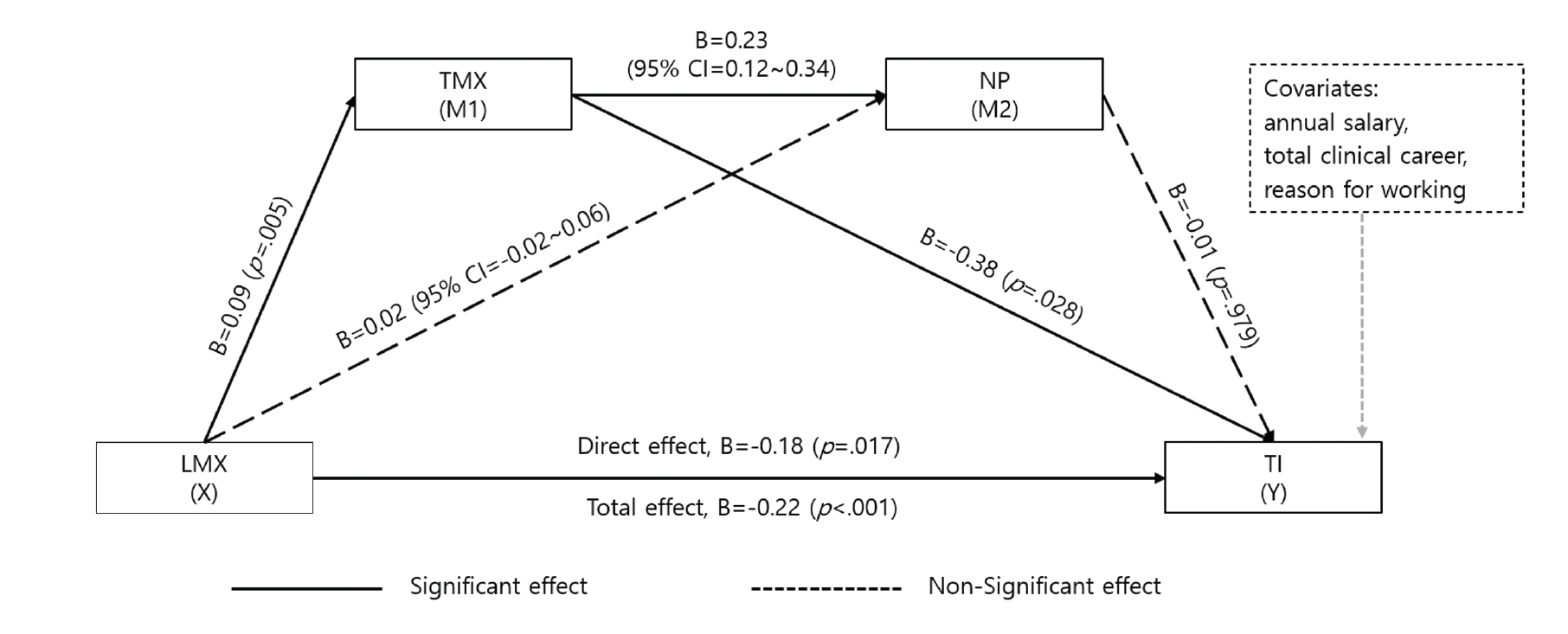
Purpose This study aimed to examine the mediating pathways of team-member exchange and nursing performance in the relationship between leader-member exchange and turnover intention among competent-stage nurses. Methods: Participants were 214 clinical nurses with 3–6 years of experience working in tertiary hospitals in South Korea. Data were collected using self-reported questionnaires on general characteristics, leader-member exchange, team-member exchange, nursing performance, and turnover intention between September 30 and November 4, 2024. Data were analyzed using IBM SPSS version 29.0 and PROCESS macro version 4.2. Results: Leader-member exchange had a significant positive effect on team-member exchange and a significant negative effect on turnover intention. Team-member exchange significantly mediated the relationship between leader-member exchange and turnover intention. In contrast, nursing performance did not mediate this relationship, and the sequential mediating effect of team-member exchange and nursing performance was not statistically significant. Conclusion: Further research focused on competent-stage nurses is needed to identify targeted interventions for reducing turnover intention. These findings suggest that hospital organizations should develop and implement programs that strengthen leader-member exchange between nurses and nursing leaders and team-member exchange among colleagues, which may help reduce turnover intention among competent-stage nurses.
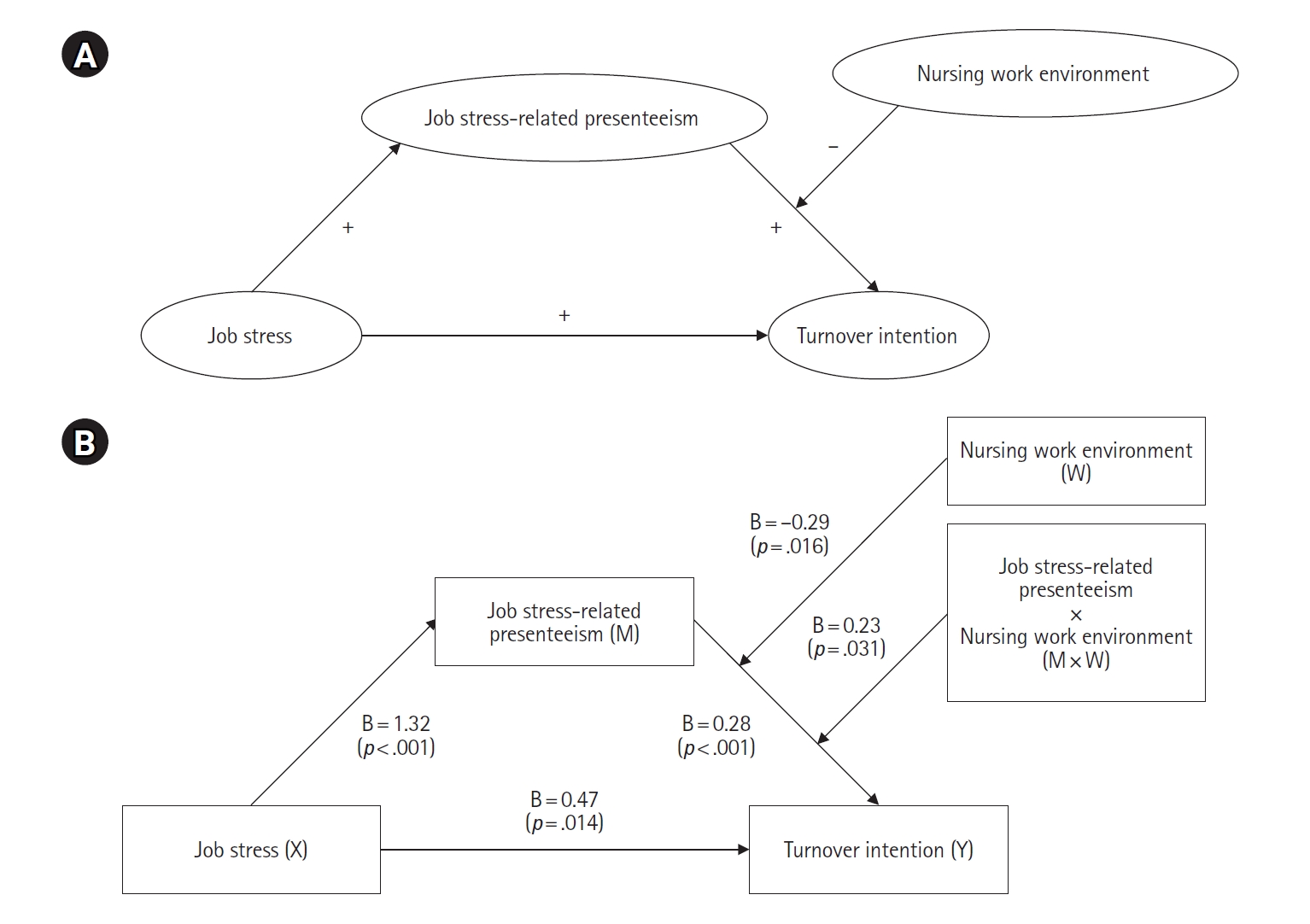
Purpose This study examined the mediating effect of job stress-related presenteeism and the moderated mediating effect of the nursing work environment on the relationship between job stress and nurses’ turnover intention. Methods: A predictive correlational research design was employed from September 8 to September 26, 2023, involving 176 nurses working in general and tertiary hospitals nationwide. Data were analyzed using IBM SPSS Statistics version 25.0, the PROCESS macro version 4.2, and the EasyFlow Statistics macro version 1.8. Results: The mean scores were 2.76±0.38 for job stress, 3.11±0.81 for job stress-related presenteeism, 2.47±0.50 for nursing work environment, and 3.57±0.75 for turnover intention. Job stress was positively associated with turnover intention through job stress-related presenteeism (B=1.32, p<.001), and the nursing work environment significantly moderated this partial mediating effect (B=0.31; 95% CI, 0.04~0.53). Conclusion: These findings may inform the development of strategies and policies aimed at reducing nurses’ turnover intention and improving human resource management in clinical settings. In addition, this study contributes to the growing body of research on job stress, job stress-related presenteeism, nursing work environment, and turnover intention among nurses.
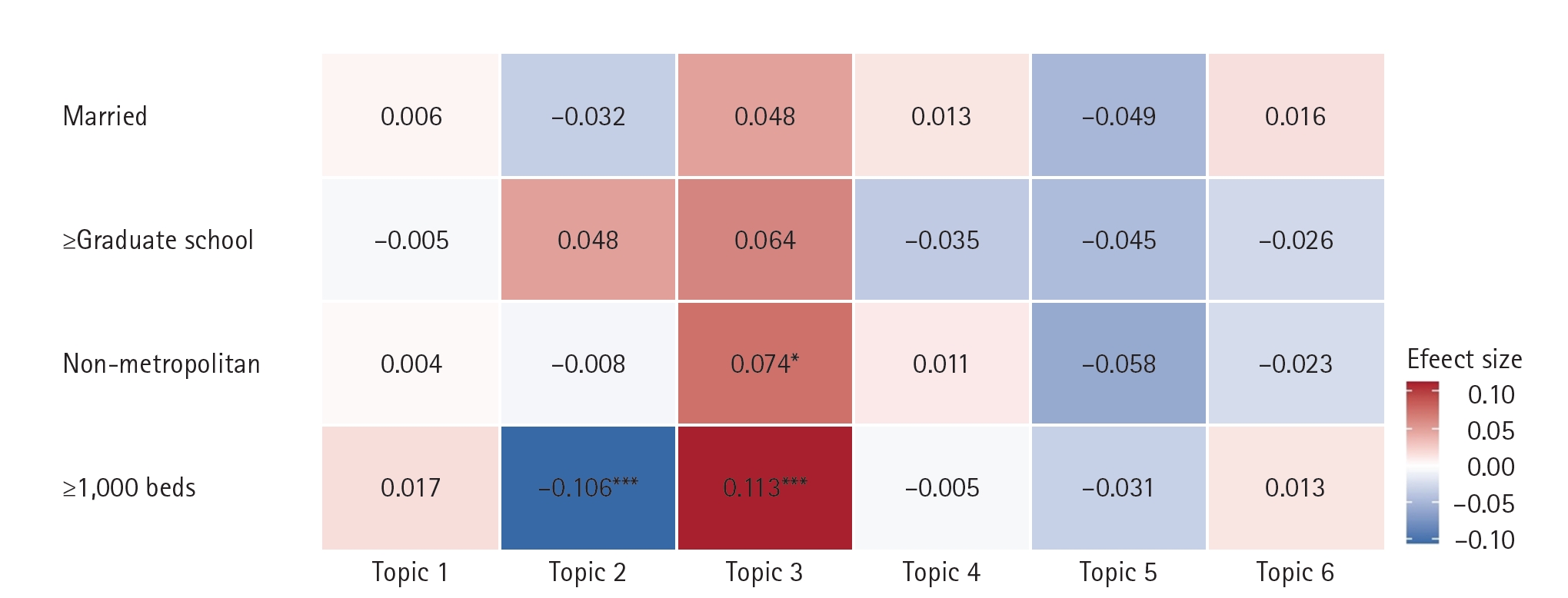
Purpose This study explored nurses’ experiences and perspectives regarding the shift system improvement pilot project, as well as their recommendations for shift work policies, and examined variations according to nurse and hospital characteristics. Methods: Structural topic modeling was applied to open-ended survey responses from 208 nurses. Topic prevalence was examined according to career length, marital status, education, hospital location, and bed capacity. Findings: Six topics emerged: experiences with implementing a pilot project for shift system improvement; shift system improvements for sustainability; physical burden and challenges of fixed night shifts; the impact of shift system improvement on personal life; nurse staffing levels for providing safe nursing care; and nursing workforce expansion and work distribution for quality care. Workforce adequacy showed the highest prevalence and was the dominant theme across all career lengths. The prevalence of system improvement was higher among nurses with ≤3 years and >10 years of experience, whereas nurses with 3–10 years of experience focused more on project participation. Smaller hospitals prioritized system improvements, whereas larger hospitals emphasized the physical burden. Conclusion: Nursing workforce adequacy emerged as nurses’ primary concern, surpassing concerns related to shift system design. Policy should prioritize legally mandated nurse staffing ratios as the foundation for sustainable shift systems, with interventions tailored to organizational capacity and career length.
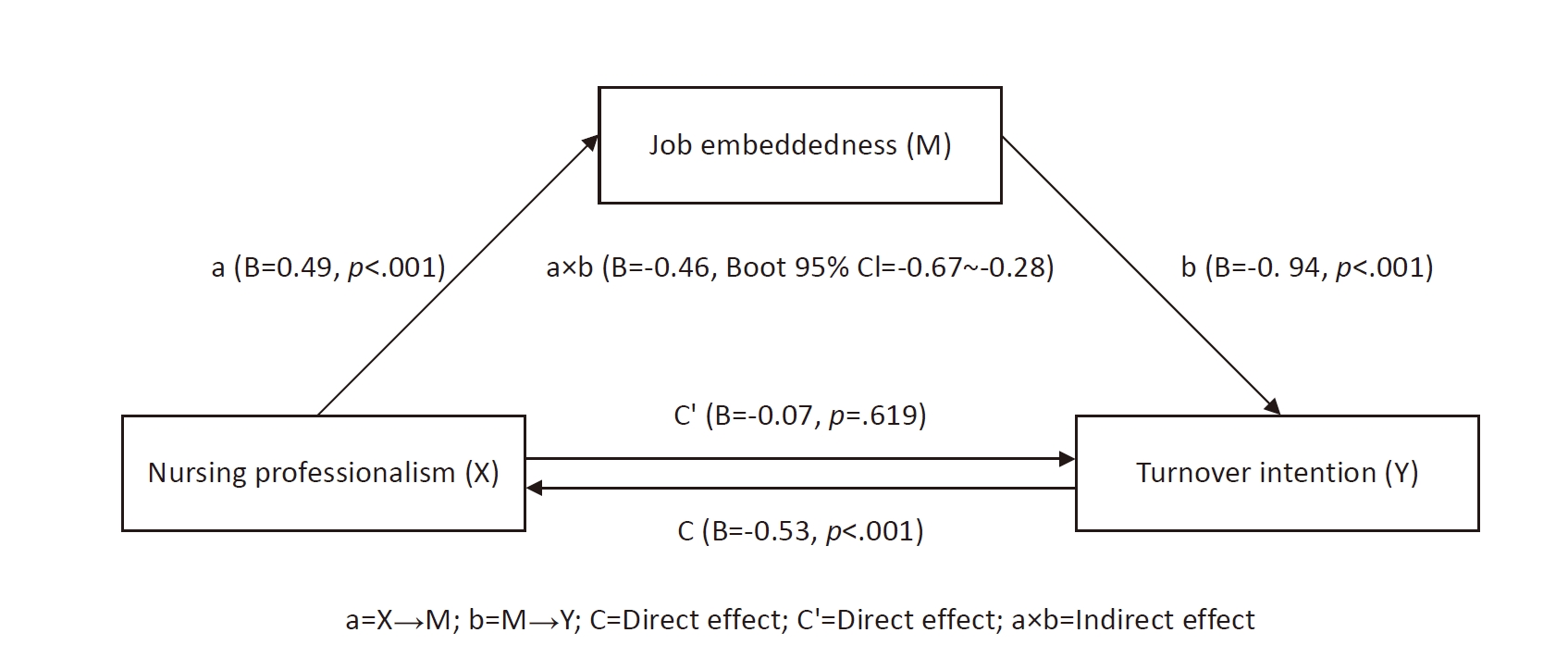
Purpose This study investigates the mediating effect of job embeddedness in the relationship between nursing professionalism and turnover intention among clinical nurses. Methods: A nationwide online survey was conducted using a structured questionnaire. Participants included 204 clinical nurses from tertiary hospitals in South Korea. Data on general characteristics, nursing professionalism, job embeddedness, and turnover intention were collected through self-reported questionnaires from March 19 to March 22, 2024. The analysis involved descriptive statistics, independent t-tests, one-way analysis of variance, Scheffé test, Pearson's correlation coefficients, multiple linear regression analysis, and bootstrapping, using SPSS/WIN version 29.0 and the SPSS PROCESS macro 4.2 version programs. Results: The mean score of nursing professionalism was 3.48±0.45 out of 5, job embeddedness was 3.13±0.52 out of 5, and turnover intention was 2.80±1.00 out of 5. Nursing professionalism did not directly impact turnover intention (B=-0.07, p=.649). Job embeddedness acted as a mediating factor in the relationship between nursing professionalism and turnover intention (B=-0.46, p<.05). Conclusion: These findings suggest that increasing job embeddedness can reduce nurses' turnover intention. Therefore, to decrease nurses' turnover intention, it is essential to enhance nursing professionalism while simultaneously promoting job embeddedness.
Purpose This study aimed to investigate the relationships among nursing skill mix, missed nursing care, and adverse events according to the nursing skill mix and the factors influencing. Methods This study is a descriptive survey that used survey data were collected from 158 nurses working in comprehensive nursing care wards in small and medium-sized hospitals. The data were analyzed using the t-test, analysis of variance, and multiple regression analysis. Results The average age of the study participants was 37.9 years, and they had over 10 years of experience. The average mean ratio of nursing skill mix 1 was 69.98. For nursing skill mix 2, the average mean ratio was 68.44%. The mean score for missed nursing care was 1.33, and the mean score for adverse events was 1.90 points. The factors affecting adverse events experience were missed nursing care, total work experience of >3 years, number of beds between ≥200 and <300. Conclusion Our findings suggest that patient safety and management education should consider the nurses’ age and total work experience. Furthermore, nursing workforce management, particularly focusing on nursing assistants in small- and medium-sized hospitals, is essential for fostering a safer healthcare environment.
Citations
Citations to this article as recorded by
Effects of presenteeism on turnover intention in clinical nurses through the serial mediating roles of missed nursing care and job satisfaction: a cross-sectional predictive correlational study Hyeonseon Cheon, Seok Hee Jeong, Hyun Kyung Kim, Hyoung Eun Chang Journal of Korean Academy of Nursing.2025; 55(4): 584. CrossRef



 First
First Prev
Prev