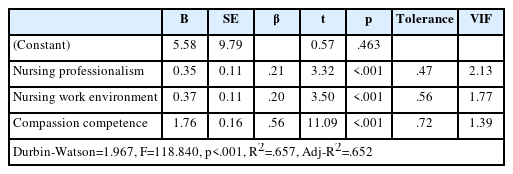
Purpose This study aimed to identify the influence of nursing professionalism, the nursing work environment, and compassion competence on person-centered care among nurses working in comprehensive nursing care units. Methods: An online survey using structured self-report questionnaires was administered to 190 nurses in comprehensive nursing care units at three tertiary general hospitals. The collected data were analyzed using descriptive statistics, the independent t-test, the Mann-Whitney U-test, one-way analysis of variance, Pearson’s correlation coefficient, and multiple linear regression using SPSS version 29.0 program. Results: The average score for person-centered care was 3.70±0.49, nursing professionalism was 3.56±0.51, the nursing work environment was 2.53±0.46, and compassion competence was 4.01±0.47. Person-centered care demonstrated significant positive correlations with nursing professionalism (r=.636, p<.001), the nursing work environment (r=.542, p<.001), and compassion competence (r=.743, p<.001). Factors influencing person-centered care included compassion competence (β=.56, p<.001), nursing professionalism (β=.21, p<.001), and the nursing work environment (β=.20, p<.001), with an explanatory power of 65.2% (F=118.84, p<.001). Conclusion: To improve person-centered care among nurses in comprehensive nursing care units, it is necessary to strengthen nurses’ compassion competence and professionalism, as well as enhance the nursing work environment. The findings of this study may be used as foundational evidence for developing programs to promote person-centered care in comprehensive nursing care units.
Purpose The purpose of this study was to investigate the influence of emotional intelligence, and professional self-concept on compassion competence in psychiatric nurses.
Methods: Participants were 180 psychiatric nurses working on psychiatric wards in university hospitals and psychiatry specialized hospitals. Data analysis was performed using stepwise multiple regression with SPSS/Win 24.0.
Results: Compassion competence significantly differed by age (F=3.31, p=.021), marital status (F=4.12,p=.017), educational background (F=5.46, p=.005), clinical career (F=6.26, p=.002), type of duty (t=-3.01, p=.003), salary (F=3.48, p=.033), current position (F=4.66, p=.011), qualification (t=-2.23, p=.023), compassion education experience (t=3.32, p=.001) and workplace (t=-2.46, p=.015). The compassion competence of psychiatric nurses was positively correlated with professional self-concept (r=.57, p<.001) and emotional intelligence (r=.63, p<.001). The significant predictors of compassion competence were self-emotion appraisal (β=.30, p<.001), professional practice (β=.21, p=.007), use of emotion (β=.19, p=.020), clinical career (β=.18, p=.003), workplace (β=.15, p=.010), communication (β=.12, p=.034) and compassion education experience (β=.11, p=.044). The explanatory power of these factors was 48% of the variance.
Conclusion: In order to enhance the compassion competence of psychiatric nurses, it is important to improve emotional intelligence and strengthen professional self-concept. Political efforts of organizations supporting compassionate nursing practice are also necessary.
Citations
Citations to this article as recorded by
Effects of Psychiatric Nurses’ Professional Self-Concept on Mental Health Nursing Competency: The Moderating Effects of Communication Competence and Job Satisfaction Min-young Yun, Jeongyee Bae Journal of Korean Academy of psychiatric and Mental Health Nursing.2026; 35(2): 207. CrossRef
Factors influencing person-centered care among nurses in long-term care hospitals in South Korea: a cross-sectional study Suhye Kwon, Hyochol Brian Ahn, Miseon Bang Journal of Korean Biological Nursing Science.2025; 27(3): 412. CrossRef
The Mediating Effect of Professional Values on the Relationship Between Self-Leadership and Compassion Competence of Community Mental Health Nurses Hye Young Kim, Won Hee Jun Western Journal of Nursing Research.2024; 46(7): 501. CrossRef



 First
First Prev
Prev