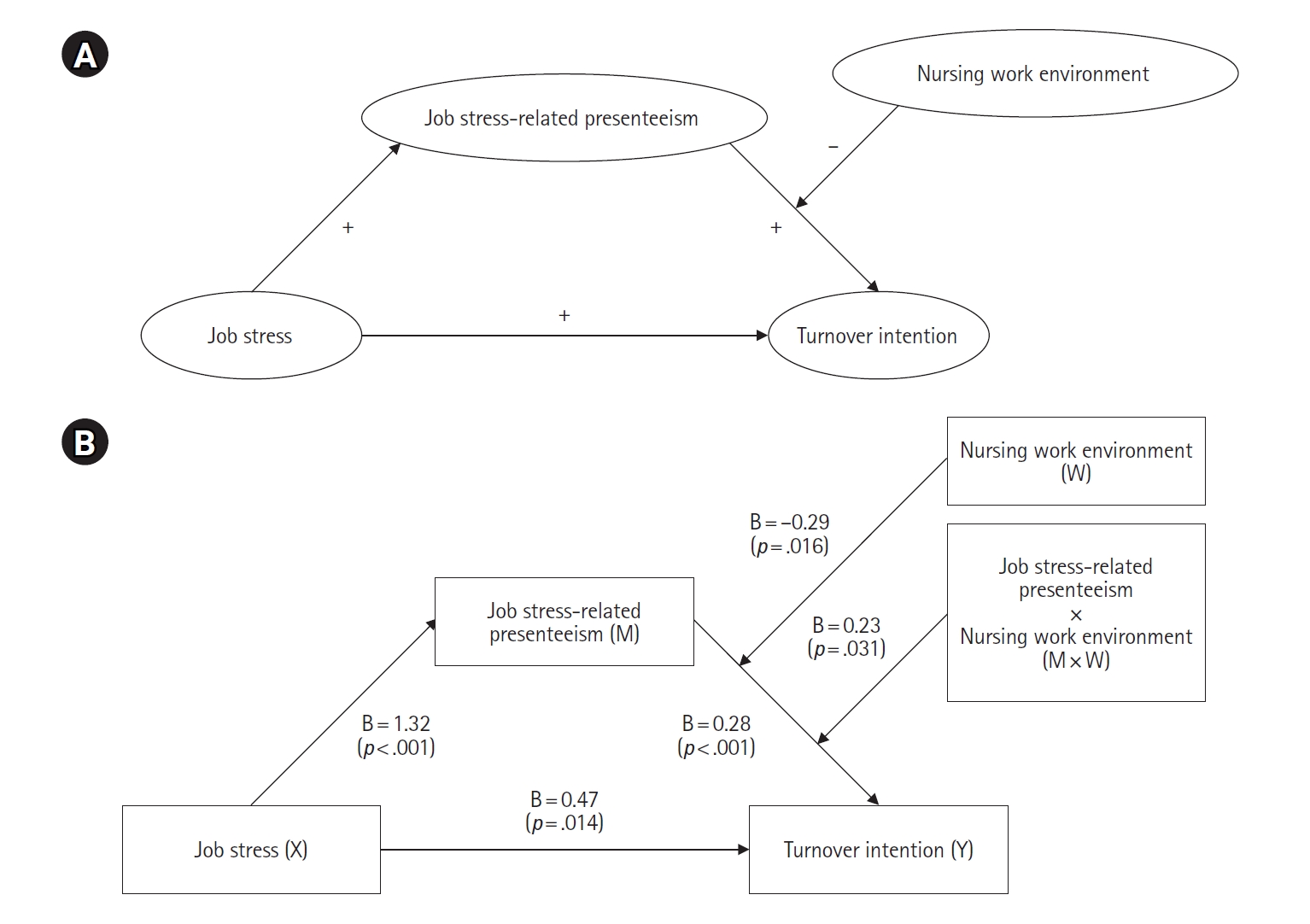
Purpose This study examined the mediating effect of job stress-related presenteeism and the moderated mediating effect of the nursing work environment on the relationship between job stress and nurses’ turnover intention. Methods: A predictive correlational research design was employed from September 8 to September 26, 2023, involving 176 nurses working in general and tertiary hospitals nationwide. Data were analyzed using IBM SPSS Statistics version 25.0, the PROCESS macro version 4.2, and the EasyFlow Statistics macro version 1.8. Results: The mean scores were 2.76±0.38 for job stress, 3.11±0.81 for job stress-related presenteeism, 2.47±0.50 for nursing work environment, and 3.57±0.75 for turnover intention. Job stress was positively associated with turnover intention through job stress-related presenteeism (B=1.32, p<.001), and the nursing work environment significantly moderated this partial mediating effect (B=0.31; 95% CI, 0.04~0.53). Conclusion: These findings may inform the development of strategies and policies aimed at reducing nurses’ turnover intention and improving human resource management in clinical settings. In addition, this study contributes to the growing body of research on job stress, job stress-related presenteeism, nursing work environment, and turnover intention among nurses.
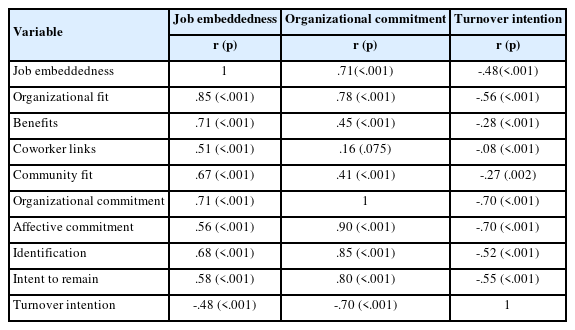
Purpose This study examined the effects of dispatch work experience on job embeddedness, organizational commitment, and turnover intention among nurses. Methods: A cross-sectional survey was conducted among 130 nurses working at a tertiary hospital in Seoul. Data were analyzed using IBM SPSS version 28.0 with descriptive statistics, the independent t-test, one-way analysis of variance, Pearson correlation coefficients, and multiple linear regression. Results: Overall, 62.3% of participants reported improved competency following dispatch work experience, whereas 80.7% perceived pre-training as insufficient. Nurses with prior interaction with dispatch unit staff demonstrated significantly higher job embeddedness (F=10.37, p=.002) and organizational commitment (F=5.87, p=.017), along with significantly lower turnover intention (F=4.98, p=.027). Multiple regression analysis showed that job embeddedness was positively associated with prior interaction with dispatch unit staff (β=.170, p=.031) and perceiving dispatch operations as appropriate (β=.297, p<.001). Organizational commitment was significantly influenced by the perception of dispatch operations as appropriate (β=.209, p=.013). No dispatch-related factors were significantly associated with turnover intention. Conclusion: Positive perceptions of dispatch work and prior interaction with dispatch unit staff contribute to job embeddedness and organizational commitment. Improvements such as enhanced pre-interaction opportunities, practice-based training, and consideration of dispatch preferences are needed to optimize dispatch work experiences.
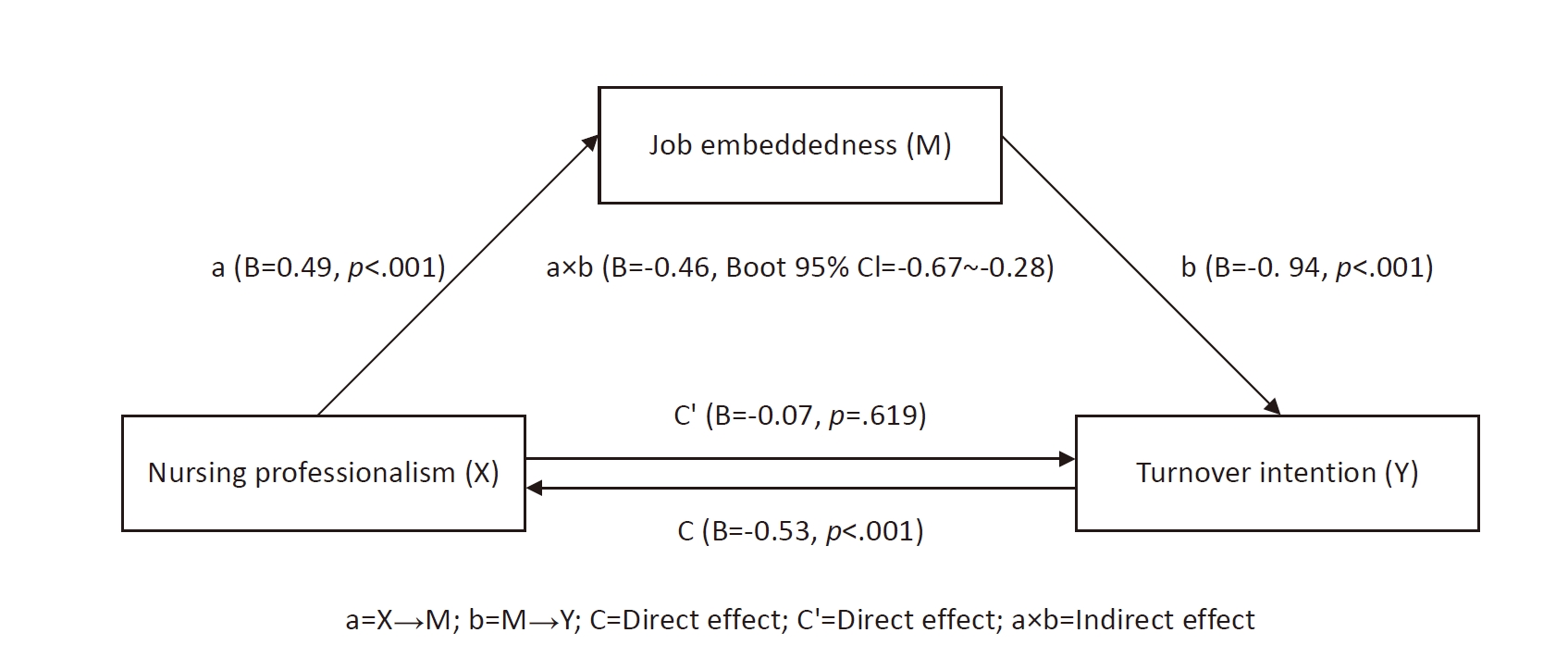
Purpose This study investigates the mediating effect of job embeddedness in the relationship between nursing professionalism and turnover intention among clinical nurses. Methods: A nationwide online survey was conducted using a structured questionnaire. Participants included 204 clinical nurses from tertiary hospitals in South Korea. Data on general characteristics, nursing professionalism, job embeddedness, and turnover intention were collected through self-reported questionnaires from March 19 to March 22, 2024. The analysis involved descriptive statistics, independent t-tests, one-way analysis of variance, Scheffé test, Pearson's correlation coefficients, multiple linear regression analysis, and bootstrapping, using SPSS/WIN version 29.0 and the SPSS PROCESS macro 4.2 version programs. Results: The mean score of nursing professionalism was 3.48±0.45 out of 5, job embeddedness was 3.13±0.52 out of 5, and turnover intention was 2.80±1.00 out of 5. Nursing professionalism did not directly impact turnover intention (B=-0.07, p=.649). Job embeddedness acted as a mediating factor in the relationship between nursing professionalism and turnover intention (B=-0.46, p<.05). Conclusion: These findings suggest that increasing job embeddedness can reduce nurses' turnover intention. Therefore, to decrease nurses' turnover intention, it is essential to enhance nursing professionalism while simultaneously promoting job embeddedness.
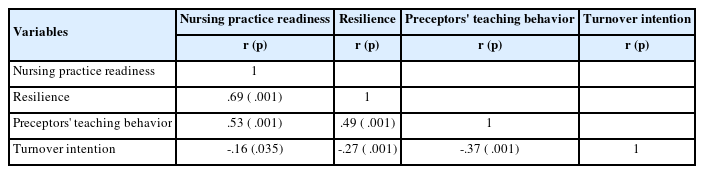
Purpose This study investigated the effects of newly graduated nurses’ perceived readiness for nursing practice, resilience, and preceptors’ teaching behaviors on turnover intention.
Methods A survey was conducted among 168 newly graduated nurses between August 7 and 31, 2023. The data were analyzed using descriptive statistics, t-tests, one-way ANOVA, Pearson's correlation, and hierarchical multiple regression analysis.
Results The factors that significantly affected turnover intention included preceptors' teaching behavior (β=-.29, p=.001) and resilience (β=-.21, p=.026). This model explained 32.0% of the variance.
Conclusion Newly graduated nurses’ resilience and their initial training environment are key factors influencing turnover intention. Therefore, nursing managers should develop strategies to enhance the resilience of newly graduated nurses and improve training systems. Additionally, efforts should be made to promote positive teaching behaviors among the educators responsible for training newly graduated nurses.
Citations
Citations to this article as recorded by
Experiences of work performance among physician assistant nurses during the period of healthcare disruption in South Korea: a qualitative content analysis Juyoung Ha, Minji Kim Journal of Korean Academy of Nursing.2026; 56(1): 98. CrossRef
Educational Innovation in Nursing Management after Reforms in the National Nurse Licensure Examination: A Narrative Review Yoomi Jung Journal of Korean Academy of Nursing Administration.2026; 32(3): 137. CrossRef
Factors Associated With Nursing Profession Self‐Efficacy Among Newly Graduated Nurses: A Cross‐Sectional Study Yujeong Kim, Eunhee Nam, Myojeong Kim, Dokyung Kim, Heejin Sim Nursing Open.2026;[Epub] CrossRef
Perceptions on Fixed Night Shift System and Turnover Intention of General Hospital Nurses Mi-Aie Lee, Hye-Jin Cho, Sung-Hee Ahn, Hyo-Ju Kim Journal of Korean Academy of Nursing Administration.2015; 21(5): 519. CrossRef
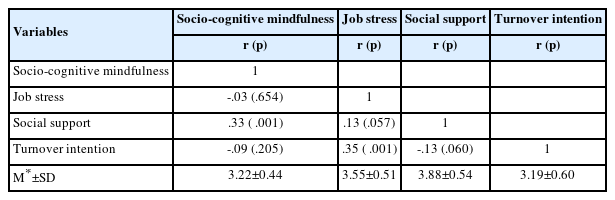
Purpose This study aimed to investigate the relationship between socio-cognitive mindfulness, job stress, social support, and turnover intention among general hospital nurses and identify the factors influencing nurses’ turnover intention.
Methods A descriptive survey was conducted among 218 nurses from five general hospitals located in G metropolitan city. The participants completed a questionnaire measuring the study variables, and the data were analyzed using t-tests, ANOVA, Pearson’s correlation coefficient, and hierarchical multiple regression analysis in SPSS/WIN 28.0.
Results Significant differences were found in turnover intention by gender (t=-2.12, p=.036), family type (t=-3.09, p=.002), work department (F=7.01, p<.001), and work type (t=2.55, p=.011). Socio-cognitive mindfulness was positively related to social support (r=.331, p<.001), and turnover intention was positively related to job stress (r=.347, p<.001). The factors influencing nurses’ turnover intention included job stress (β=.317, p<.001), work department (artificial kidney room: β=-.287, p=.004; emergency room: β=-.219, p=.015), social support (β=-.183, p=.005), and work type (shift work: β=.170, p=.036), respectively. These factors explained 23.4% of the variance.
Conclusion The findings indicate the need to develop programs to effectively cope with job stress and implement mentoring systems or psychological support programs to reduce turnover intention among nurses at the organizational level.
Citations
Citations to this article as recorded by
Effects of Job Satisfaction, Job Stress, and Social Support on the Turnover Intention of Employed Pharmacists Working in Community Pharmacies Kwang Mo Yang, Yun Jeong Lee Korean Journal of Clinical Pharmacy.2026; 36(1): 43. CrossRef


 First
First Prev
Prev