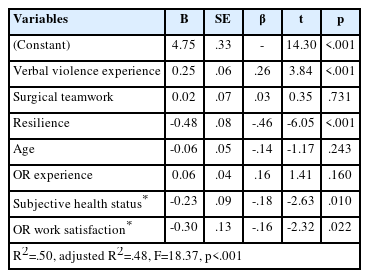
Purpose This study explored the influence of verbal violence experience, surgical teamwork, and resilience on burnout among operating room nurses. Methods: Data were collected from 135 operating room nurses who had worked for more than 6 months in the tertiary and general hospitals in two metropolitan cities. The IBM SPSS Statistics 27.0 program was used for descriptive statistics, independent t-tests, one-way analysis of variance, Pearson correlation coefficients, and stepwise multiple regression. Results: Burnout showed a significant positive correlation with verbal violence experience (r=.38, p<.001) and significant negative correlations with surgical teamwork (r=-.41, p<.001) and resilience (r=-.60, p<.001). Verbal violence experience was negatively correlated with surgical teamwork (r=-.38, p<.001), whereas surgical teamwork was positively correlated with resilience (r=.51, p<.001). Multiple regression analysis revealed that resilience (β=-.46, p<.001), verbal violence experience (β=.26, p<.001), subjective health status (β=-.18, p=.010), and satisfaction with operating room work (β=-.16, p=.022) significantly influenced burnout and explained 50% of the variance. Conclusion: These findings indicate that resilience, verbal violence experience, subjective health status, and work satisfaction are significant factors associated with burnout among operating room nurses. Therefore, targeted interventions focused on strengthening resilience, preventing verbal violence, and enhancing work satisfaction are needed to reduce burnout.
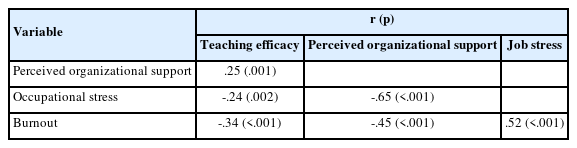
Purpose This study aimed to investigate the effects of teaching efficacy, perceived organizational support, and occupational stress on burnout among preceptor nurses. Methods: Participants included 156 nurses who had at least one month of preceptor experience within the past year. Data were collected using a structured self-report questionnaire and analyzed with SPSS version 27.0. Descriptive statistics, independent sample t-tests, one-way analysis of variance with Scheffé post-hoc tests, Pearson’s correlation analysis, and multiple regression analysis were performed. Results: Occupational stress (β=.36, p<.001) and teaching efficacy (β=-.17, p=.017) were significant predictors of burnout among preceptor nurses, jointly explaining 36.0% of the variance. Conclusion: Occupational stress and teaching efficacy were identified as key determinants of burnout in preceptor nurses. Effective burnout prevention strategies should focus on reducing occupational stress through workload management and strengthening teaching efficacy via continuous training and organizational support.
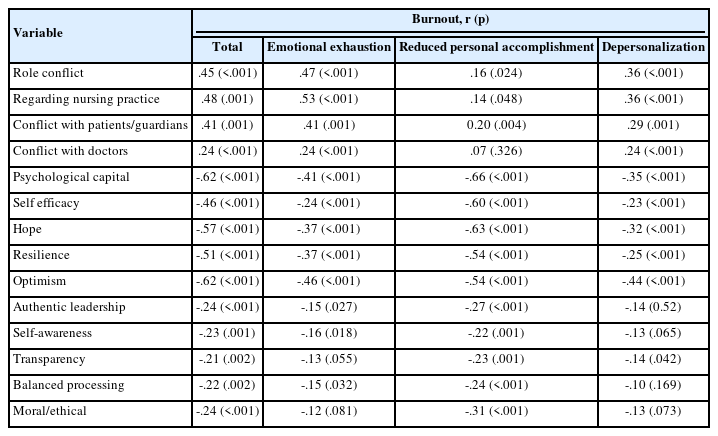
Purpose This study aimed to identify the influence of positive psychological capital, role conflict, and authentic leadership on burnout among nurses working in comprehensive nursing care service wards of general hospitals. Methods: A descriptive cross-sectional survey was conducted with 208 nurses from four general hospitals. Data were collected using structured questionnaires between September 26, 2024, and October 18, 2024, and were analyzed using descriptive statistics, independent t-tests, one-way analysis of variance, Pearson’s correlation coefficient, and hierarchical multiple regression analysis. Results: Burnout showed a correlation with role conflict (r=.45, p<.001), positive psychological capital (r=-.62, p<.001) and authentic leadership (r=-.24, p<.001). In the regression analysis, the factors significantly associated with burnout included conflict with patients/guardians (β=.24, p<.001) and conflict regarding nursing practices (β=.22, p<.001), which are subdomains of role conflict. Among the components of positive psychological capital, optimism (β=-.37, p<.001) was identified as a significant protective factor against burnout. However, authentic leadership was not found to be a statistically significant predictor. Conclusion: To effectively manage nurse burnout, it is essential to develop strategic programs that focus on enhancing optimism. Furthermore, establishing clear delegation guidelines between nurses and nursing assistants is recommended.
Citations
Citations to this article as recorded by
The Influence of Role Conflict and Organizational Justice on Nursing Service Quality: A Cross-Sectional Survey on Nurses’ Perceptions Jeon Seung Ahn, Jeong Eun Moon The Korean Journal of Health Service Management.2026; 20(1): 75. CrossRef
Purpose This study aimed to explore the effects of presenteeism, burnout, and nursing performance on intention to retention among nurses of an intensive care unit in one tertiary hospital.
Method The data were collected from from July 1 to July 31, 2023, from 172 nurses at intensive care units. Data were analyzed using the SPSS/WIN 26.0 program.
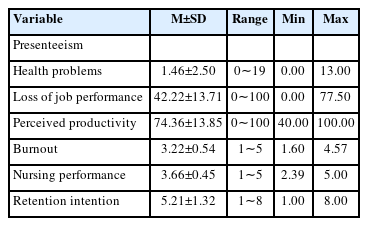
Results A four-step hierarchical regression model, including control variables, presenteeism, burnout, and nursing performance, accounted for 44.9% of the factors influencing intention to retention. Burnout (β=-.54, p<.001), nursing performance (β=.21, p=.002), health problem (β=-.07, p=.040), and experience of turnover (β=-.16, p=.008) were identified as the significant predictor of intention to retention. Model III, which adds burnout, has a significant 23.5%p increase in explanatory power over Model II, indicating that burnout has the strongest impact on intention to retention.
Conclusion For enhancing the intention to retention of the intensive care nurses, it is necessary to provide a systematic strategy and support to increase the performance of nurses and to try to reduce the burnout and health problems of nurses.
Citations
Citations to this article as recorded by
Job Burnout Associated with Work Environment among Physician Assistant Nurses: A Secondary Analysis of the 2025 Survey on Working Conditions of Health and Medical Workers Kyongok Park, Hanyi Lee, Hyeon Sik Chu Journal of The Korean Society of Living Environmental System.2026; 33(2): 188. CrossRef



 First
First Prev
Prev