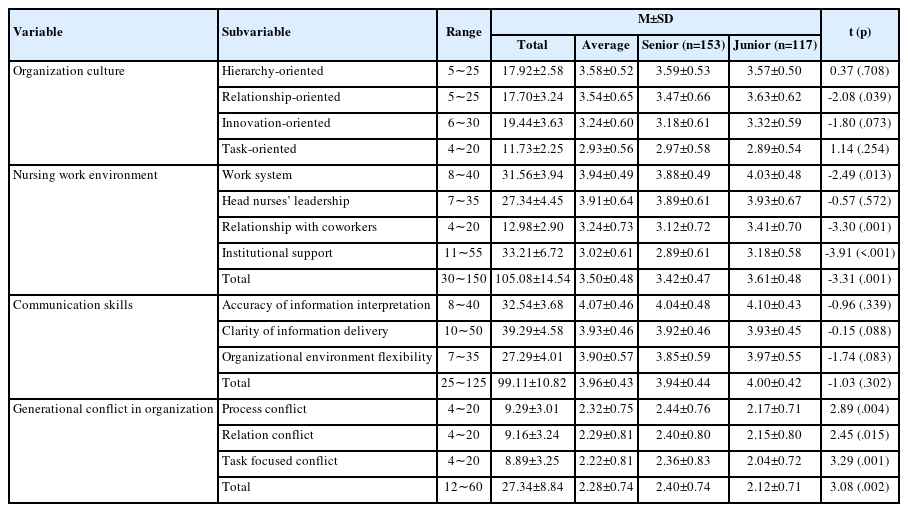
Purpose This study aimed to identify structural factors associated with intergenerational conflict among nurses and to explore how these conflicts manifest in clinical settings. Methods: An explanatory sequential mixed-methods design was used. Quantitative data were collected from 270 nurses using structured questionnaires that measured organizational culture, work environment, communication skills, and intergenerational conflict. Key influencing factors were identified using multiple regression analysis. Qualitative data were collected through in-depth interviews with 10 nurses and analyzed using Colaizzi’s phenomenological method. Results: Hierarchy-oriented culture, task-oriented culture, work systems, and organizational-environment flexibility significantly influenced intergenerational conflict (F=6.25, p<.001). The adjusted explanatory power of the regression model was 24.9% (adjusted R²=.249). Among these variables, work systems emerged as the strongest predictor of intergenerational conflict. The qualitative findings indicated that anonymous suggestion systems, differences in work approaches, and differences in emotional interpretation intensified conflict. Conclusion: Intergenerational conflict among nurses appears to stem from procedural ambiguity, emotional misunderstandings, and value incongruence. Organizations should redesign suggestion systems to ensure procedural fairness, strengthen evidence-based practice education, implement communication training focused on emotional awareness, and develop institutional strategies that support generational integration.
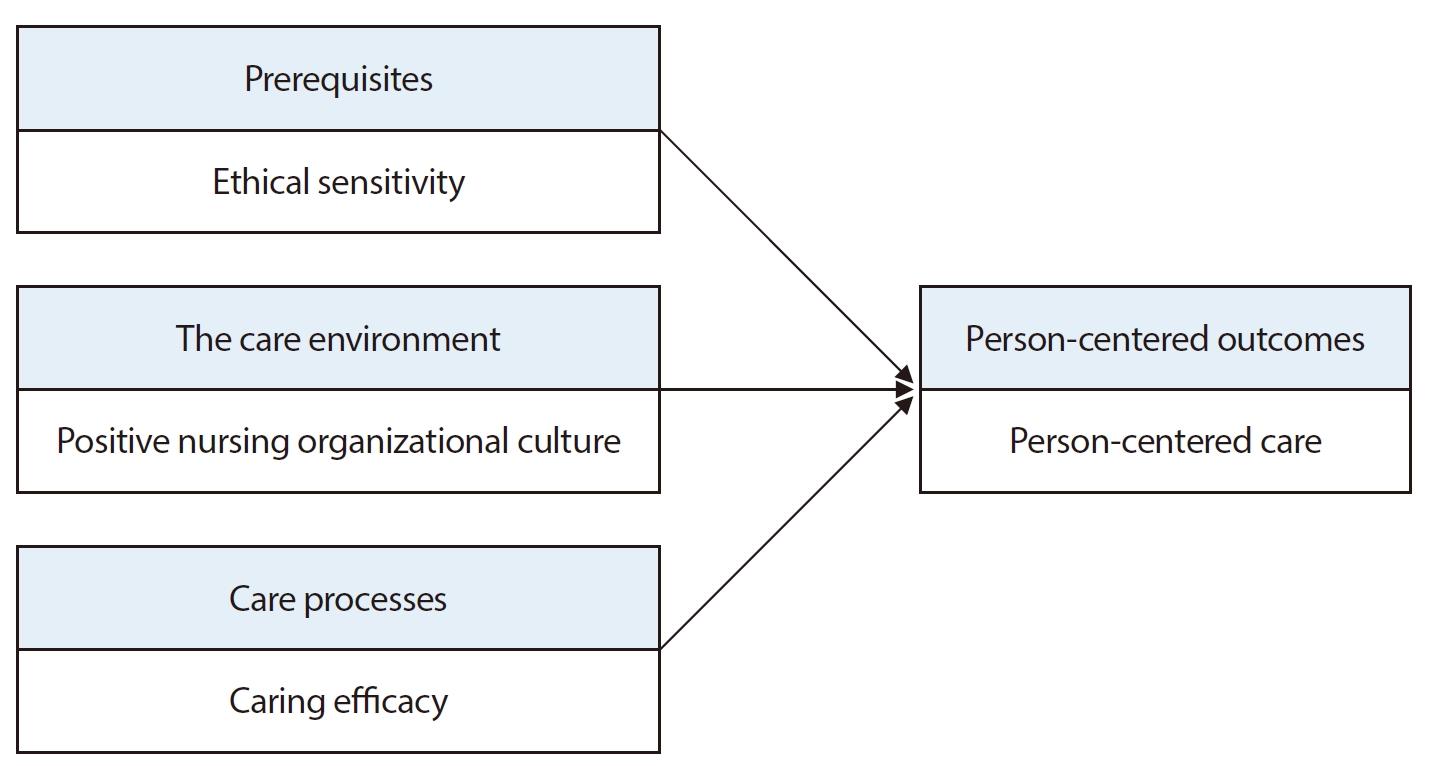
Purpose This study aimed to identify the influence of ethical sensitivity, positive nursing organizational culture, and caring efficacy on person-centered care among clinical nurses in general hospitals. Methods: The participants were 181 clinical nurses working in general hospitals located in Jinju and Changwon cities, Gyeongnam Province, South Korea. Data were collected from December 17, 2024, to January 25, 2025. Data analysis was performed using SPSS Statistics 27.0 and included descriptive statistics, the independent t-test, one-way analysis of variance, Pearson correlation analysis, and multiple regression analysis. Results: The participants’ mean scores were 4.16±0.42 for ethical sensitivity, 3.76±0.64 for positive nursing organizational culture, 4.23±0.67 for caring efficacy, and 3.90±0.50 for person-centered care. Person-centered care showed a significant positive correlation with ethical sensitivity (r=.49, p<.001), positive nursing organizational culture (r=.54, p<.001), and caring efficacy (r=.58, p<.001). Caring efficacy had the most significant effect on person-centered care (β=.41, p<.001), followed by positive nursing organizational culture (β=.30, p<.001) and ethical sensitivity (β=.19, p=.005). These variables accounted for 47.8% of the variance in person-centered care. Conclusion: To improve person-centered care, educational programs aimed at improving ethical sensitivity and caring efficacy, along with the establishment of a nursing organizational culture based on trust and respect, should be implemented.
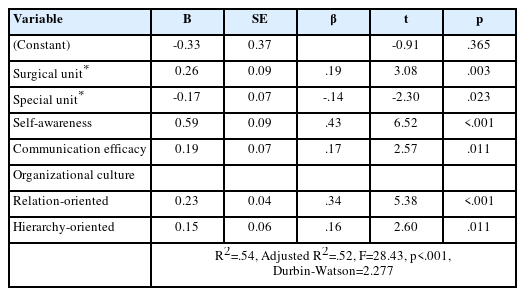
Purpose This study aimed to identify factors influencing communication competence among hospital nurses. Methods: The participants were 136 nurses working at five general or tertiary hospitals with over 100 beds in Busan, Ulsan, and Geoje Island. Data were collected using structured self-report online questionnaires from July 18 to August 31, 2023. The data were analyzed using descriptive statistics, the t-test, one-way analysis of variance, the Scheffé test, Pearson's correlation coefficients, and stepwise regression analysis using IBM SPSS version 25.0. Results: Self-awareness (β=.43, p<.001), a relationship-oriented organizational culture (β=.34, p<.001), working in a surgical ward (β=.19, p=.003), communication efficacy (β=.17, p=.011), hierarchy-oriented organizational culture (β=.16, p=.011), and working in a special unit (β=-.14, p=.023) were factors that significantly influenced nurses' communication competence. The model explained 52% of the variance in communication competence (F=28.43, p<.001) Conclusion: To improve communication competence in hospital nurses, healthcare institutions should provide learning opportunities to improve nurses’ self-awareness and communication efficacy. It is also essential to establish rules and order within a hierarchy-oriented organizational culture, while simultaneously promoting a relationship-oriented organizational culture based on trust and respect among colleagues.
Citations
Citations to this article as recorded by
Factors Influencing Psychiatric Nursing Competency among Emergency Nurses: The Mediating Effect of Psychological Safety in a Cross-Sectional Study Yu Jin Lee, Chung Hee Woo Journal of Korean Academy of psychiatric and Mental Health Nursing.2026; 35(1): 53. CrossRef


 First
First Prev
Prev